Living Trust in Illinois: Do You Actually Need One?
A living trust in Illinois is the estate planning tool everyone sells and almost nobody explains. Online form companies push trusts on people who do not need them. Generic national guides skip the Illinois rules that actually decide whether a living trust makes sense for you. This guide gives you the straight answer: a three question test, the honest alternatives, the $4,000,000 Illinois estate tax trap, and the single mistake that quietly cancels more trusts than anything else. It is written by a DuPage County estate planning attorney who has been drafting and administering these documents since 1990.
The Three Question Test
Skip the sales pitch. Whether you need a living trust in Illinois comes down to three questions.
1. Do you own Illinois real estate?
A home titled in your own name guarantees a probate case. The small estate affidavit, the shortcut Illinois offers for modest estates, cannot transfer real estate under 755 ILCS 5/25-1. So if you own property and want your family out of court, you need either a trust or a transfer on death instrument, which we cover below.
2. Is your estate anywhere near $4,000,000?
Illinois taxes estates above $4,000,000, and the exemption is far less generous than the federal one. If your home, retirement accounts, and life insurance together approach that number, trust planning stops being about convenience and starts being about tax. Married couples in particular can waste an entire exemption without the right structure.
3. Do you want privacy and speed?
Probate in DuPage County runs through the courthouse in Wheaton and becomes public record. Uncontested cases typically take nine months to more than a year. Trust administration is private, immediate, and never appears on a court docket. For some families that alone is worth the setup cost.
If you answered no to all three, do not let anyone sell you a trust before you read the next section.
When a Living Trust Is Overkill
Here is what the form sellers will not tell you: Illinois already gives smaller estates ways around probate that cost little or nothing.
The small estate affidavit. If the probate assets are worth less than $150,000 and there is no real estate, your family can collect bank accounts and other property with a sworn affidavit under 755 ILCS 5/25-1. No case, no judge, no trust required. That threshold rose from $100,000 to $150,000 effective August 15, 2025, and most websites still quote the old number.
Beneficiary designations. Retirement accounts, life insurance, and payable on death bank accounts already pass outside probate to whoever you named. For many households this covers most of the estate before a trust enters the conversation.
Joint ownership. A home owned in joint tenancy or tenancy by the entirety passes automatically to the surviving spouse. The catch: that only postpones the problem. On the second death, the property is back in probate territory unless a trust or TODI is in place.
The TODI: The Real Estate Alternative Nobody Mentions
Illinois has a tool that quietly does the trust's most famous job for a fraction of the cost. The transfer on death instrument under 755 ILCS 27 is a recorded deed that names who receives your real estate when you die. No probate, no trust, and you keep full ownership and control during life.
Here is the part even many attorneys miss: since January 1, 2022, under Public Act 102-68, a TODI works for all Illinois real property, not just a residence. Commercial buildings, vacant land, and multi unit buildings all qualify. The instrument must be signed, witnessed, notarized, and recorded with the DuPage County Recorder before death, and it can be revoked at any time.
If your only probate trigger is a single property and your estate is nowhere near the $4,000,000 line, a TODI plus clean beneficiary designations may be all you need. A trust still wins when you own multiple properties, want someone to manage assets if you become incapacitated, have blended family or minor children considerations, or have estate tax exposure.
The $4,000,000 Illinois Estate Tax Trap
As of 2026, Illinois imposes its own estate tax on estates over $4,000,000 under 35 ILCS 405, completely separate from the federal estate tax. Two features make it a trap for ordinary families.
The exemption is frozen. The federal exemption is roughly $14,000,000 and adjusts for inflation. The Illinois exclusion is $4,000,000 and is not indexed. Every year of home appreciation and retirement growth pushes more DuPage households toward it.
There is no portability. A surviving spouse cannot inherit the deceased spouse's unused Illinois exemption the way federal law allows. A married couple who simply leaves everything to each other outright can waste the first $4,000,000 exemption entirely, exposing the survivor's estate to tax that proper planning would have avoided. Credit shelter trust structuring preserves both exemptions. For couples with real estate, retirement savings, and life insurance, this is often the strongest financial argument for a trust, stronger than probate avoidance.
Revocable vs. Irrevocable in Illinois
When people say living trust they almost always mean a revocable trust under the Illinois Trust Code, 760 ILCS 3. You stay in control, you can amend or revoke it any time, and you file no separate tax return while you are alive. In exchange, it gives you no creditor protection and no tax shelter during life. Its jobs are probate avoidance, privacy, and incapacity management.
An irrevocable trust is the opposite trade. You give up control, and in return the assets can be protected from creditors, positioned for Medicaid planning under the five year lookback, or moved out of your taxable estate. Irrevocable trusts are specialized tools for specific problems, not the default.
Funding: The Step That Kills More Trusts Than Anything Else
An unfunded living trust avoids nothing. This is the failure we see most in DuPage probate: a beautiful trust binder on the shelf, and the house still titled in the decedent's individual name. Result: full probate anyway, on top of what the family paid for the trust.
Funding means actually retitling assets. Illinois real estate moves into the trust by a new deed recorded with the DuPage County Recorder. Bank and brokerage accounts get retitled to the trustee or name the trust as beneficiary. Retirement accounts generally stay in your individual name, with beneficiary designations coordinated to the plan. If your attorney hands you a trust without a funding plan, you bought half a product.
A Trust Alone Is Not an Estate Plan
A complete Illinois plan is a system: the living trust, a pour over will that catches anything left outside the trust and, critically, names guardians for minor children, which a trust legally cannot do, plus property and healthcare powers of attorney for lifetime decisions. Our wills and estate planning pages cover how the pieces fit.
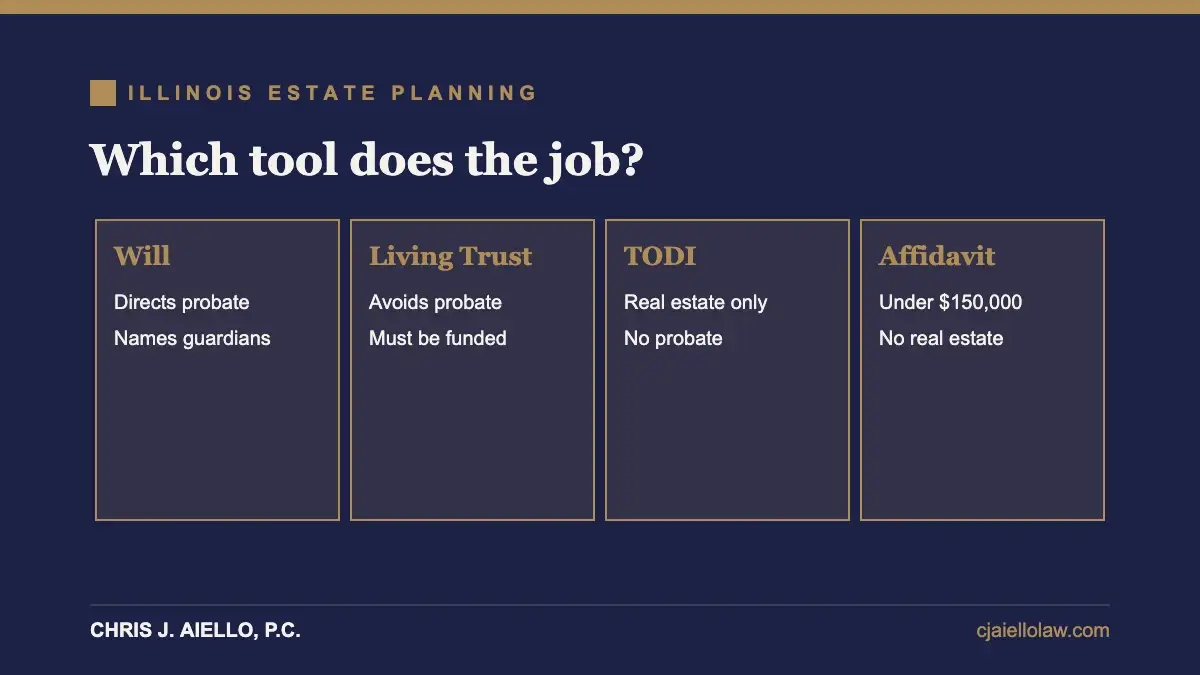
Which Tool for Which Job: The Illinois Decision Table
| Will | Revocable Living Trust | TODI | Small Estate Affidavit | |
|---|---|---|---|---|
| Avoids probate | No | Yes, if funded | Yes, for the real estate it covers | Yes, estates under $150,000 |
| Handles real estate | Through probate | Yes | Yes, all IL real property since 2022 | No |
| Works above $150,000 | Yes | Yes | Yes | No |
| Incapacity protection | No | Yes | No | No |
| Privacy | No, probate is public | Yes | Deed is public, no court file | Mostly |
| Estate tax planning | Limited | Yes, with proper structure | No | No |
| Names guardians for minors | Yes | No | No | No |
| Best for | Everyone, as the base document | Real estate, larger or blended estates, incapacity, tax | Single property, simpler estates | Small estates with no real estate |
How This Works in DuPage County
Probate here runs through the 18th Judicial Circuit at the DuPage Judicial Center, 505 N. County Farm Road in Wheaton, with filings through the DuPage Circuit Clerk's probate division under mandatory e filing. Trust funding deeds record with the DuPage County Recorder. When you are weighing a trust against probate, those are the offices your family will or will not be dealing with. A local attorney who appears in that courthouse knows the difference between the plan that reads well and the plan that administers well.
There is one more cost of skipping incapacity planning that deserves a plain statement. If you lose capacity without a trust or powers of attorney in place, your family cannot simply step in; they must ask a judge for authority over your affairs. Our guide to guardianship in Illinois and how the court process works shows exactly what that road involves and why a funded plan usually keeps your family off it.
Get a straight answer, not a sales pitch
Bring your asset list and your questions. We will tell you honestly whether you need a living trust, a TODI, or just a properly executed will, with flat fee pricing either way. Practicing in DuPage County since 1990.
Schedule a Consultation Trust ServicesSources: 755 ILCS 27, Real Property Transfer on Death Instrument Act; 755 ILCS 5/25-1 (small estate affidavit, as amended by P.A. 104-346); 760 ILCS 3 (Illinois Trust Code); 35 ILCS 405 (Illinois estate tax); Illinois Legal Aid Online.