Proving Who the Heirs Are in an Illinois Estate: The Affidavit of Heirship and the Order Declaring Heirship
An Illinois court can declare who a person's heirs are from a sworn affidavit, or from testimony that is written down and certified by the court (755 ILCS 5/5-3). An order declaring heirship is prima facie evidence of the family tree, which means the court treats it as proof unless someone shows otherwise. A form on its own proves nothing until a judge accepts it. A straightforward family can often use the affidavit. A tree with half-siblings, an undocumented marriage or a relative nobody can reach may call for testimony.
Short answer: an affidavit of heirship in Illinois is a sworn statement of the facts that show who a person's heirs are, given to the probate court so the court can declare heirship on the record. The court has to find who the heirs are before an estate can close, and many families reach this point holding a blank form that raised more questions than it answered.
This guide reads the Probate Act section on heirship and the sections around it, and it says where the statute stops and where a judge's own practice takes over.
What an Affidavit of Heirship Is, and What It Is Not
Under 755 ILCS 5/5-3, the court may ascertain and declare the heirship of a person who has died and enter it of record. The affidavit is one way to give the court the facts. It is a statement by any person who knows them, signed under oath or affirmation, describing the decedent's family in enough detail that a judge can say who the heirs are.
It is not the document that lets a family collect a small bank account without opening an estate. That is a small estate affidavit, a different instrument under a different part of the Probate Act, and our guide to collecting a small estate without probate in Illinois covers it. An affidavit of heirship proves the family tree inside an estate. It does not transfer anything by itself.
It is also not a challenge to a will. A dispute over who the heirs are is a different question from a dispute over a will, and for the second one see our guide to disputing a will in Illinois.
What Is the Court Deciding?
The court is deciding who the family is, not who gets how much. Heirship is a finding about relationships: the spouse, the children, a child who died before the decedent and left children of their own, and further out when the decedent had no spouse or descendants. Once the court has that list, the rules of descent in 755 ILCS 5/2-1 decide the shares, and our guide to dying without a will in Illinois walks through them.
The statute lets the court declare heirship at any time during the administration of the estate without further notice. If no administration has been granted, the court acts on the notice and in the manner it directs (5-3(a)).
Which Route Fits: An Affidavit or Testimony?
The statute names two sources of evidence. The table lays them side by side. Which one fits depends on the family, and the table is a starting point for the conversation with the attorney.
| Route | What goes in it | Who gives it | When it may fit | What the order is worth |
|---|---|---|---|---|
| Sworn affidavit (5-3(b)(1)) | The facts from which heirship can be ascertained: marriages, children, deaths, dates and places | Any person who knows the facts, signing under oath or affirmation before a notary, a judge or another officer the statute lists | A family tree that can be documented and nobody disputes | Prima facie evidence once the court enters the order (5-3(c)) |
| Testimony, written down and certified (5-3(b)(2)) | Evidence given in narrative form or by questions and answers, reduced to writing and certified by the court | A witness who testifies before the court | A tree that depends on someone's memory, or one the court wants to hear about directly | The same: prima facie evidence once the order is entered |
The statute does not say which route a judge prefers. That is a practical question, so ask the attorney what the assigned judge generally expects.
What Goes in the Affidavit, Line by Line
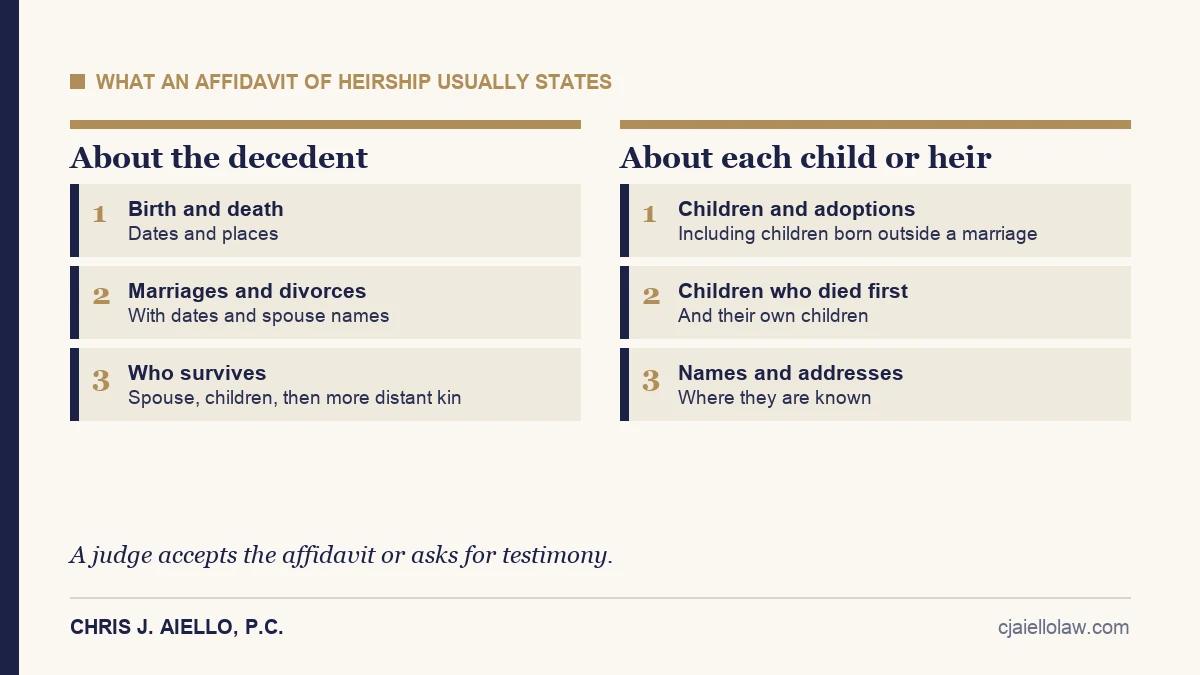
The statute asks for "the facts from which the heirship of the decedent can be ascertained." It does not hand over a checklist, so these are the facts a family usually needs to write down. Gather them before the first call.
- The decedent's full name, date and place of birth, and date and place of death.
- Every marriage and divorce, with dates and the name of the spouse, and whether a spouse was living at death.
- Every child, including children born outside a marriage and adopted children, with dates of birth and whether each was living at the decedent's death.
- Any child who died before the decedent, and that child's own children.
- If there was no spouse or descendant, the parents, brothers and sisters, and then more distant relatives, with the same detail.
- Current names and mailing addresses for each person, where known.
The statute includes a presumption for one hard case. Absent evidence to the contrary, the court may presume that the decedent, and anyone through whom heirship is traced, was not the mother or father of a child born outside a marriage. For a man, it may also presume that no such child was filiated to, acknowledged or legitimated by him (5-3(d)). If your family history includes such a child, say so, and tell the attorney.
Who Can Swear It, and Who Certifies It?
Any person who knows the facts may give the affidavit. It must be signed and sworn to or affirmed before a notary public, or before a judge of any court of record in the United States or its possessions or territories and certified by the clerk. Outside those, it can be taken before a United States consul, vice-consul, consular agent or secretary of legation, or a commissioned officer in active service of the United States, inside or outside the country (5-3(b)(1)). The officer's seal or designation is enough to show identity and official character.
For most families that means a notary. The person who signs should be someone with real knowledge, such as a surviving spouse or an adult child, because the court is relying on that person's word. Court forms are listed through the DuPage County Clerk of the Circuit Court, and the attorney can tell you which form the assigned judge accepts, which is safer than a copy from an unrelated site.
When an Affidavit May Not Be Enough
An affidavit works best when the facts are known and agreed. It is a weaker fit when:
- the decedent had half-siblings, or children from more than one relationship, and the family disagrees about the list;
- a marriage or divorce cannot be documented;
- an heir has not been in touch with the family in twenty years; or
- the family tree depends on one person's memory.
In those cases the court may take testimony instead, in narrative form or by questions and answers, which the court certifies. The statute treats the two routes as equals (5-3(b)). Testimony also gives the judge a chance to ask questions, and the certified record stays in the court file.
What Does the Order Declaring Heirship Do for You?
An order declaring heirship is prima facie evidence of the heirship (5-3(c)). In plain words, the court treats the order as proof of the family tree unless someone shows it is wrong. The statute also says any other legal method of proving heirship remains open to any interested party in any place or court where the question arises. An interested person includes an heir, a legatee or a creditor (755 ILCS 5/1-2.11). So the order is strong, and it is not the last word.
What it allows is practical. A separate section shows why the heirs' names matter once an administrator is appointed. Within 14 days after the order directing that letters issue, the administrator must mail the petition and that order to each heir who was not entitled to earlier notice. If an heir's name or address is not stated in the petition, the administrator must publish a notice once a week for three weeks. A person who appeared at the hearing in person or filed a waiver does not need to be sent a copy (755 ILCS 5/9-5). If heirship is wrong and has to be reopened, those notices and any distribution that followed may have to be revisited, which costs the family time. Our guide on probate administration in Illinois explains how this fits into the full sequence.
If an Heir Cannot Be Found
A tree with a missing branch can stall an estate, because the court cannot declare heirship for a person nobody can name or reach. The notice section that follows an appointment already anticipates this by requiring publication when an heir's name or address is not stated. Tell the attorney early, and write down everything the family knows about the person, including the last town and last contact.
How Does This Run in DuPage County?
An estate of a DuPage County resident is administered in the county of residence (755 ILCS 5/5-1), which for DuPage is the Eighteenth Judicial Circuit, Probate Division, at the DuPage Judicial Center, 505 N. County Farm Road, Wheaton. Civil cases are generally filed electronically through eFileIL, with some exceptions, and the attorney or the clerk can tell you how your filing goes in. Heirship is declared in the estate case itself, and the statute lets the court do it at any time during administration, so ask the attorney when the court will take it up and have the affidavit ready by then. An Illinois intestate probate attorney in DuPage County will line the affidavit up with the petition so the two tell the same story.
When to Bring in a Probate Attorney
Bring one in before you swear anything. An affidavit that is signed too early, with a fact missing, may be harder to fix than one that waits a week for the right document. If the family tree is simple, the attorney's role may be short. If it is not, the attorney can help decide whether testimony is the better route and can prepare the petition around it. A probate attorney in DuPage County can also tell you which documents to gather first.
Need to prove who the heirs are?
Chris J. Aiello, P.C. has guided DuPage County families through probate since 1990. Bring what you know about the family and we will tell you which route fits.
Schedule a ConsultationSources: 755 ILCS 5/5-3 · 755 ILCS 5/5-1 · 755 ILCS 5/9-5 · 755 ILCS 5/1-2.11 · 755 ILCS 5/2-1 · DuPage County Clerk of the Circuit Court · eFileIL
General information about Illinois law, current as of November 2026. This guide describes the sections cited; your family's facts may call for a different answer. It is not legal advice and it does not create an attorney-client relationship.