Executor Fees in Illinois: What Counts as Reasonable
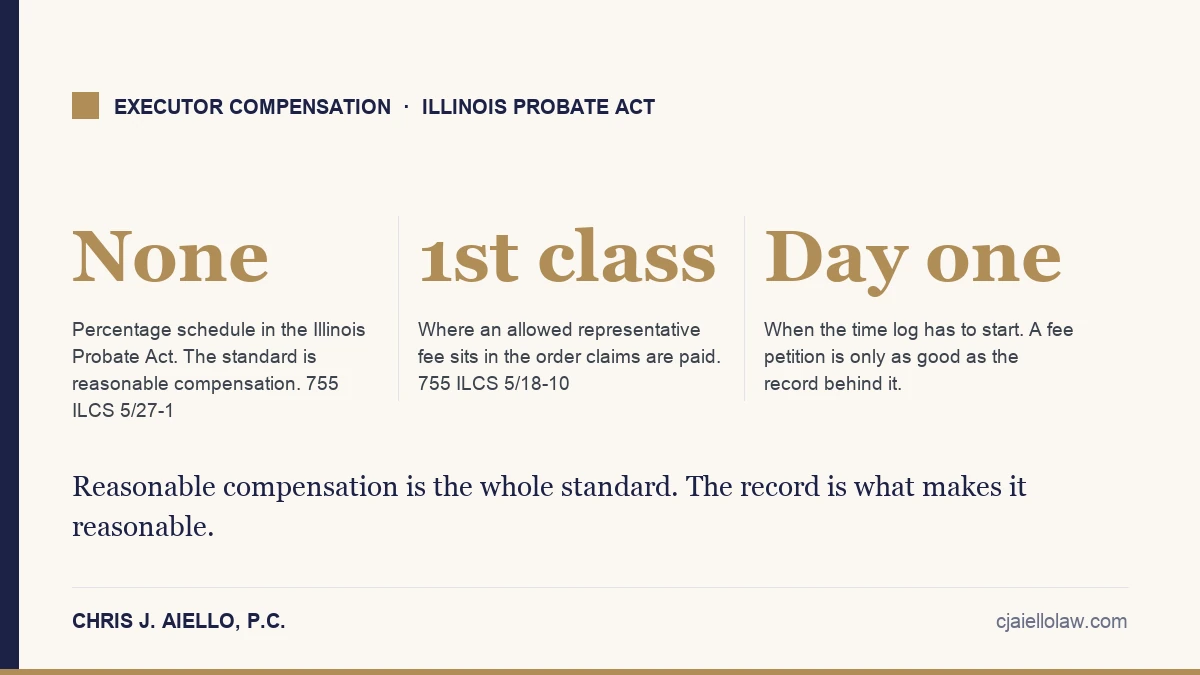
The Illinois Probate Act sets no percentage and no fee schedule. Section 27-1 says a representative is entitled to reasonable compensation for services, and that sentence is the whole standard. The percentage tables you find online come from states whose statutes set one, and Illinois is not among them. The fee is judged on what the work took rather than on what the estate was worth, and an allowed fee is paid as a first-class administrative claim under 755 ILCS 5/18-10. Who approves it depends on the track: in independent administration, the default in Illinois, the fee is approved by the interested persons and reported in the verified closing report, and the court only gets involved if somebody objects. In supervised administration it is petitioned and allowed by the judge. Two things decide the outcome either way: a contemporaneous time record kept from day one, and the people whose shares the fee comes out of being told about it as you go.
You took the job because nobody else would. Eight months later you have made forty phone calls, cleared a house, chased a pension administrator and taken two afternoons off work, and someone finally asks whether you are being paid for any of it. Executor fees in Illinois are real, they are allowed by statute, and they are approved on a record. If you want the wider duty list and the deadlines that go with the role, that lives in our guide to serving as executor of an estate in Illinois. This piece is about the money.
Illinois Has No Percentage Fee
Search the phrase and half of page one will hand you a number, usually two to five percent of the estate. Check where that came from. Several states do publish a statutory percentage schedule for a personal representative, and national content gets written once and aimed at everybody. Illinois is not one of those states. There is no percentage in the Probate Act, no sliding scale, and no rule of thumb that binds a judge.
That matters in both directions. An executor who assumes five percent of a $900,000 estate is owed to them is going to have a difficult hearing. So is a beneficiary who insists a fee must be capped at some number they read online. Neither figure exists in Illinois law.
What 755 ILCS 5/27-1 Says
The operative language in 755 ILCS 5/27-1 is short: a representative is entitled to reasonable compensation for his services. The rest of the section deals with narrow situations, including public administrators handling a veteran's federal benefits and certain state employees serving as guardians, where no fee is allowed at all.
The section also settles where an allowed fee sits when the money is distributed. Fees awarded under Section 27-1 are treated as a first-class claim for administrative expenses under 755 ILCS 5/18-10, alongside funeral and burial expenses. In an estate that cannot pay everyone, that placement is the difference between being paid and standing in line.
What Does a Court Weigh Here?
Reasonable is not a blank check and it is not a guess. In the petitions we have filed and the objections we have answered, the same considerations come up every time.
Time genuinely spent on estate business, described task by task. The difficulty of the work, which is a different thing from the size of the estate: a $300,000 estate with a contested claim and a hoarded house is more work than a $2 million estate holding three index funds. The skill the job called for, including anything the executor did that the estate would otherwise have paid a professional to do. The results, meaning what was preserved, collected or settled. And the plain question of whether the estate can bear the fee alongside everything else it owes.
Notice the absence. Estate value on its own is not the measure. It is context for the work, not a multiplier.
What Record Backs Each Factor?
Use this as the outline for the number you put in front of the beneficiaries, and for the petition if it ever has to go to a judge. The third column is the part executors skip and then cannot reconstruct.
| What the court is weighing | What it means in practice | The record that supports it | What defeats it |
|---|---|---|---|
| Time genuinely spent | Hours on estate business, not on family matters | A dated log with the task described, kept as you go | A total reconstructed from memory at the end |
| Difficulty of the work | Contested claims, a business, out-of-state property, a house to clear | Correspondence, filings, invoices, photographs of the condition | A routine estate billed as if it were complex |
| Skill the role required | Work a professional would otherwise have been hired to do | What the estate did not have to pay someone else to handle | Charging professional rates for errands |
| Results obtained | Assets recovered, claims defeated, property sold well | Closing statements, settlement terms, recovered account records | Value that arrived without any effort by the executor |
| Size and complexity of the estate | Context for the workload | The inventory and the accounting | Treating estate value as a percentage entitlement |
| What the estate can bear | Where the fee sits against claims and specific gifts | The claims list and the final account | A fee that would leave a first-class claim unpaid |
| Overlap with the attorney's work | The same task billed twice, from two directions | Separate records for each role | An executor log that mirrors the attorney's invoice |
How Does the Fee Get Approved?
Start the log on day one. Date, task, time, and a line of description. It takes a minute a day and it is the thing that turns a fee request into a fee that sticks.
Then find out which track you are on, because most writing on this subject gets it wrong. Illinois estates are usually administered independently, and 755 ILCS 5/28-1 lets an independent representative administer the estate without court order or filings except where the Article requires one or an interested person asks for one. So there is often no fee petition and no hearing. What there is instead: 755 ILCS 5/28-11 makes you accountable to all interested persons, requires an accounting mailed or delivered to them before discharge, and requires the verified closing report to state that the fees paid or payable to you and to your attorney have been approved by all interested persons, except as otherwise indicated. The receipt signed by anyone whose share the fee reduces has to say those fees are approved.
Read that backwards and it tells you how to run the file. Your fee is approved by the beneficiaries, not by a judge, so the work is persuading them as you go, not drafting a petition at the end. Get the number in front of them early, in writing, with the log attached.
The court comes in on two routes. Under 755 ILCS 5/28-5 any interested person can petition at any time for a hearing on any matter germane to the administration, and from that point the rest of the Act governs as if the estate were supervised. Section 28-11(a) lets an interested person request a court accounting the same way. In a genuinely supervised estate, the fee is petitioned and allowed by the judge in the ordinary course, supported by the log, the inventory and the account.
The wider sequence of filings this sits inside is set out in our walkthrough of Illinois probate administration step by step.
When Beneficiaries Object
Objections are rarely about the concept. They are about the presentation. Four patterns account for most of them.
A round number with nothing behind it. A request for $15,000 with no log reads as a figure someone picked, and it draws an objection from a beneficiary who would have accepted $18,000 backed by dates.
Work that was already billed by the attorney. If the same court appearance shows up on the executor's log and the attorney's invoice, expect to be asked which one the estate is paying for.
Self-dealing anywhere in the file. An estate car sold to a relative under value, or occupying the house rent-free while charging the estate for maintaining it, will cost more in credibility than the fee is worth.
Silence. An executor who sends nothing for a year and then presents a fee at the end has built the objection themselves. Where a fee dispute turns into a genuine fight over the administration, it moves into contested probate representation in DuPage County, and an unsupported fee can become evidence in a wider challenge to how the estate was run.
Send interested persons a short status note every few months and include the running time total. An objection is much harder to raise about a number people have watched grow than about one that appears at the end.
Should You Take the Fee at All?
Often the answer is no, and the reason is tax rather than modesty. Compensation for serving as executor is payment for services, so it is ordinary income to the person who receives it. An inheritance is generally not taxed as income to the beneficiary. A family executor who is also the residuary beneficiary is frequently taking money from one pocket and paying tax on the way to the other.
The calculation shifts when the executor is not a beneficiary, when they take a share alongside siblings who take the same share for none of the work, or when the estate is large enough that a deductible administrative expense is worth something to the estate. Run the numbers with a tax professional before you decide. We are describing the general shape of the question here, not giving tax advice.
Three Different Pots of Money
Keep these separate in your head and on the page. The executor's compensation under Section 27-1 is payment to the person doing the job. The attorney's compensation is its own allowance under 755 ILCS 5/27-2, which entitles the attorney for a representative to reasonable compensation on the same standard. Estate expenses are everything else the estate spends: filing fees, publication, appraisals, insurance on a vacant house, the dumpster.
Families routinely add all three together and call the total the fee, then blame the executor for the whole number. If you need the estate-wide picture rather than this one line item, we price it out in our guide to the cost of probate in Illinois.
How This Runs in DuPage County
A DuPage County estate is administered in the Eighteenth Judicial Circuit at the DuPage Judicial Center, 505 N. County Farm Road, Wheaton. Petitions and accountings are filed with the Clerk of the Circuit Court, and civil filings are normally submitted electronically through the state eFileIL system, with exemptions available for filers who cannot e-file.
Two habits carry either track. Attach the log itself rather than summarizing it, whether it is going to a beneficiary or into a court file, because dated tasks answer the questions a summary invites. And give notice generously: every interested person, early, in writing. Executors who do both give anyone far less to ask about.
When to Bring In an Attorney
If the estate is small, the heirs agree and the work was light, many executors waive the fee and close without the question ever being raised. Bring someone in when the fee is large enough to matter, when a beneficiary has already questioned how you are running things, when your own log overlaps with work the attorney billed, or when you are the executor and a beneficiary at once and the tax question is live.
That is the work an executor representation attorney in DuPage County does, and it is also what an estate and probate attorney serving DuPage County is for when the whole administration needs steadying rather than just the fee.
Before any of that matters, the estate has to have something in it. Our companion guide sorts which assets go through probate in Illinois and which pass outside it by how each one was titled on the day of death.
Working out what to ask for, or answering an objection?
Chris J. Aiello, P.C. has represented Villa Park and DuPage County executors since 1990. Bring your time log and the account, and we will tell you plainly what the number should be and who has to approve it.
Schedule a ConsultationSources: 755 ILCS 5/27-1 · 755 ILCS 5/27-2 · 755 ILCS 5/18-10 · 755 ILCS 5/28-1 · 755 ILCS 5/28-5 · 755 ILCS 5/28-11 · DuPage County Clerk of the Circuit Court · Illinois Courts eFileIL · Illinois Legal Aid Online: probate
General information about Illinois law, current as of September 2026. It is not legal or tax advice and it does not create an attorney-client relationship.