How to Make a Will in Illinois (and the Mistakes That Void One)
Making a will in Illinois is governed by a short list of strict rules, and the internet gets several of them wrong. A handwritten will is not automatically valid here. Your witnesses can accidentally forfeit their own inheritance. And the will you paid for does not keep your family out of probate court. This guide covers exactly how to make a will in Illinois that holds up, what it honestly costs in DuPage County, and the after death duty almost every family misses. Written by a DuPage County attorney practicing since 1990.
The Requirements of a Valid Illinois Will
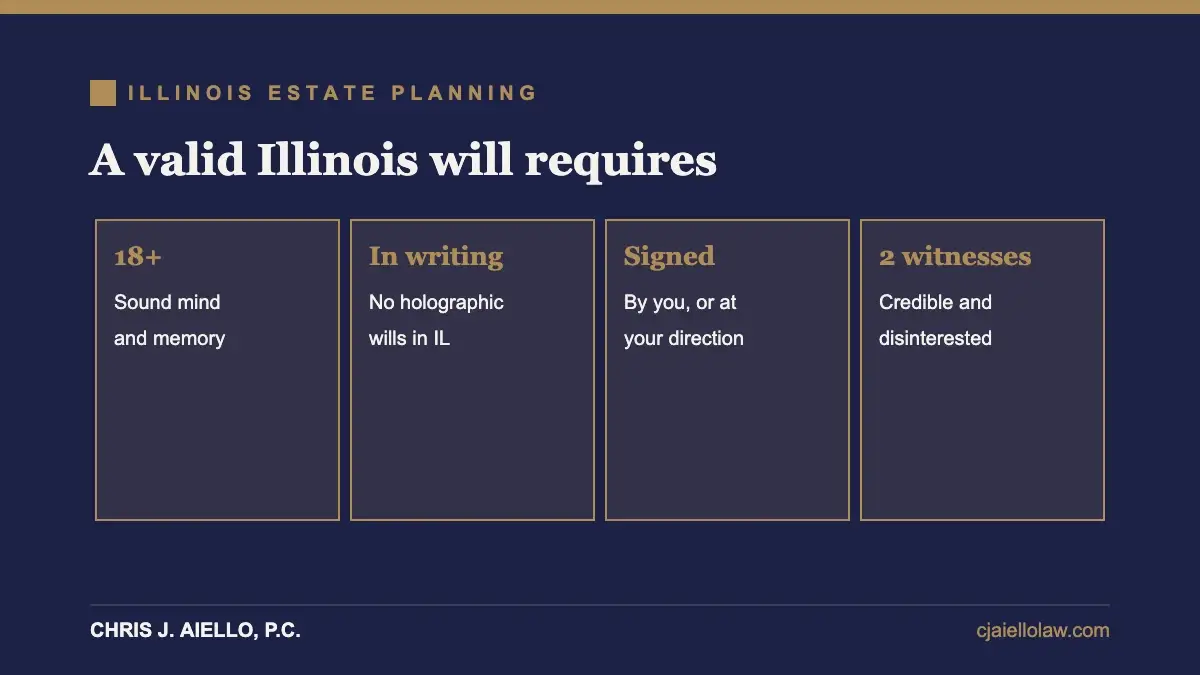
Illinois wills live or die by 755 ILCS 5/4-3, a statute almost no article about this topic actually cites. The requirements:
Age and capacity. You must be 18 or older and of sound mind and memory. The bar for capacity is lower than people assume: you need to know what you own, who your natural heirs are, and what the document does.
In writing. Illinois does not recognize oral wills. It recognizes written ones, and since 2021 a narrow electronic option covered below.
Signed. By you, or by someone else at your direction and in your presence, which protects people physically unable to sign.
Attested by two or more credible witnesses. This is where wills actually fail, so it gets its own section.
The Handwritten Will Myth
Roughly half the states accept holographic wills, documents fully handwritten and signed by the testator with no witnesses. Illinois is not one of them. A handwritten will that is properly witnessed by two people is perfectly valid. The same words with no witnesses are just a letter, and the estate passes as if no will existed, through intestacy. If a loved one died leaving an unwitnessed document, read our guide to dying without a will in Illinois, because that is legally what happened.
Witnesses: The Forfeiture Trap
Your two witnesses should be disinterested, meaning they receive nothing under the will. Illinois has an unusually sharp rule here in 755 ILCS 5/4-6: if a beneficiary serves as a required witness, the will remains valid, but that beneficiary forfeits everything above what they would have received with no will at all. The spouse of a beneficiary triggers the same problem. The practical rule costs nothing: use two neighbors, coworkers, or friends who are not in the document, and never anyone who inherits.
The Self Proving Affidavit: Not Required, Always Worth It
Illinois does not require a will to be notarized. But under 755 ILCS 5/6-4 you can attach a self proving affidavit, one notarized page signed at the same sitting, in which the witnesses swear to the execution formalities. Without it, when the will is eventually probated your witnesses may need to be located, years or decades later, to testify. With it, the will proves itself. Every will we draft includes one, and any competent form should too.
A Will Does Not Avoid Probate
This is the most common misconception we correct. A will is your instructions for probate, not a way around it. If your estate exceeds the small estate limits or includes real estate, your executor will open a case at the DuPage Judicial Center whether or not a will exists. If avoiding court is the actual goal, that is trust and TODI territory: see our guide to a living trust in Illinois for when each tool earns its cost.
The Job Only a Will Can Do: Guardians for Minor Children
Whatever else your plan includes, the nomination of a guardian for your minor children lives in your will and nowhere else. A trust cannot do it. For parents, this single clause outweighs everything else in the document, and it is the reason a will belongs in every plan even when a trust holds the assets. See our guardianship page for how nominations work when they are actually needed.
What a Will Honestly Costs in DuPage County
| Option | Typical cost | What you actually get |
|---|---|---|
| DIY form or software | $0 to $500 | The words, none of the counsel. Execution errors, witness mistakes, and generic terms are on you, and they surface only after death, when they cannot be fixed. |
| Attorney drafted simple will | About $300 to $1,000 | A will drafted to your situation, executed correctly with a self proving affidavit, witnesses handled, and guardian nominations done right. |
| Will plus powers of attorney | Modest package pricing | The will plus property and healthcare powers of attorney, the documents that protect you while you are alive. |
| Full plan with trust | $3,000 to $10,000+ | Trust, pour over will, POAs, deed work and funding. Justified by real estate, tax exposure, or complexity, not by a sales script. |
The honest framing: the cheap option's true price is the probate litigation it can cause. We have seen five hundred dollar savings turn into five figure court fights over a missing witness signature.
Electronic Wills Exist in Illinois
Since 2021, the Electronic Wills and Remote Witnesses Act, 755 ILCS 6, permits electronically signed wills with remote witnessing under specific formalities. It is real and occasionally useful, but a paper will executed in person remains the lower risk path, and it is what we recommend absent a reason.
After a Death: The 30 Day Duty Nobody Knows
Here is the whitespace no ranking article covers. Under 755 ILCS 5/6-1, whoever holds a deceased person's will must file it with the Circuit Clerk of the county where the person resided immediately after death. In DuPage County that is the Circuit Clerk at the Judicial Center in Wheaton, and willfully concealing a will is a crime. Filing the will is not the same as opening probate; it simply places the document on record. Families routinely miss this step for months.
Your will is also where you nominate a guardian for minor children, and that nomination carries real weight with the court. But naming someone in a document and a judge actually appointing them are two different steps. If you want to see the second half of that picture, read when a guardianship is needed in Illinois and how the appointment works.
A will also has limits when you are married, and surviving spouse rights under Illinois law explains the renunciation share a spouse can elect even when the will leaves them less.
Get it done right the first time
Flat, honest pricing on wills and complete estate plans from a DuPage County attorney practicing since 1990. One meeting, executed correctly, witnesses and affidavit handled.
Schedule a Consultation Wills & Estate PlanningSources: 755 ILCS 5/4-3, 5/4-6, 5/6-1, 5/6-4 (Illinois Probate Act); 755 ILCS 6 (Electronic Wills and Remote Witnesses Act); Illinois Legal Aid Online; DuPage County Circuit Clerk.