How Long Does Probate Take in Illinois?
If you have just been named executor or you are an heir waiting on an inheritance, the first question is almost always the same: how long is this going to take? The honest answer is that Illinois probate has a built-in floor you cannot rush past, and then a set of variable drivers that decide whether the estate closes in under a year or drags on for two. Understanding the difference between the fixed part and the variable part is the key to setting realistic expectations, and it is the part most online explanations get wrong.
Chris J. Aiello, P.C. has handled probate and estate matters for DuPage County families since 1990, and this guide reflects how the process actually runs in the 18th Judicial Circuit at the DuPage County Judicial Center in Wheaton.
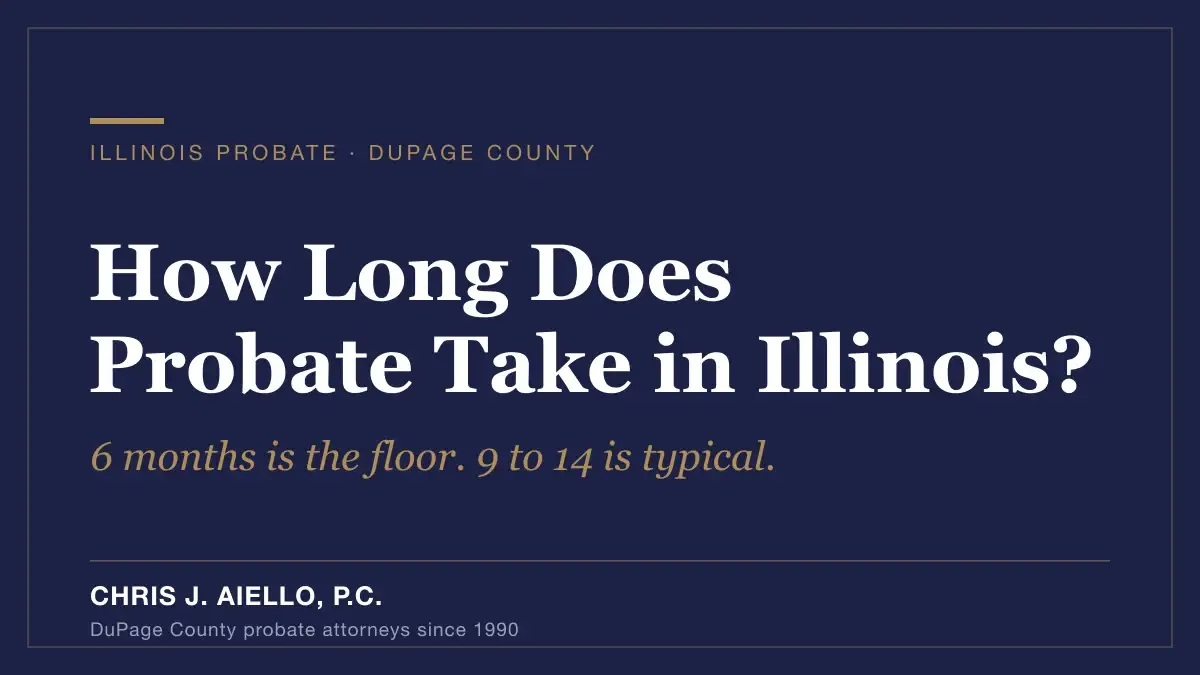
TL;DR: Six months is the legal floor for a formal Illinois probate estate, because the law forces a creditor claim period that must run before the estate can safely close. A straightforward, uncontested estate typically takes 9 to 14 months from opening to final distribution. Contested or complex estates (will contests, real estate sales, tax filings, missing heirs) run well beyond a year. Think of it as a fixed floor (the creditor clock) plus variable drivers that add time on top.
The 6-month creditor clock is really two clocks
The single biggest reason Illinois probate cannot simply close in a month or two is the creditor claim period. This is the "fixed floor," and most competing articles describe it incompletely. There are actually two overlapping clocks running at once.
Clock one: unknown creditors. When a decedent's estate is opened, the executor or administrator publishes a notice to creditors in a newspaper, once a week for three successive weeks. Under 755 ILCS 5/18-3, that publication starts a claim window that runs six months from the date of first publication. Any creditor who was not known and could not reasonably be found has until the end of that six-month window to file a claim. Once it closes, those claims are barred. This is the clock that sets the practical minimum length of a formal estate: even a simple estate cannot safely distribute and close until this period has run.
Clock two: known creditors. A creditor the executor actually knows about (or should reasonably know about) is entitled to more. Under the same section that governs published notice, 755 ILCS 5/18-3, the executor must also mail notice to known creditors, and a known creditor's claim is barred only by the later of six months from first publication or three months from the date notice is mailed or delivered to that creditor. In plain terms, mailing notice late to a known creditor can extend that creditor's deadline rather than shorten it, which is exactly the trap that stretches timelines. Layered on top is an absolute two-year bar under 755 ILCS 5/18-12: all claims against the estate are barred two years after the decedent's death, whether or not letters of office ever issue.
Why this matters for timing: the six-month unknown-creditor period is non-negotiable, so it functions as a hard floor. The known-creditor rules are where a careless executor accidentally adds months by sending notices late or missing creditors who then keep the estate exposed. Getting the notices out correctly and early is one of the most effective things an executor of estate attorney does to keep an estate moving.
Independent vs. supervised administration: the choice that adds or removes months
After the creditor clock, the biggest lever on timeline is how the estate is administered. Illinois offers two tracks under 755 ILCS 5 Article XXVIII.
Independent administration is the faster, default-preferred track, entered by court order under 755 ILCS 5/28-2. The representative can act without returning to court for a hearing at each step: the specific powers to act without a court order are enumerated in 755 ILCS 5/28-8, letting the representative sell personal property, pay approved claims, and make distributions without asking a judge to sign off on every action. Most uncontested DuPage estates run this way, and it is a major reason a clean estate can close in the 9-to-14-month range rather than dragging on.
Supervised administration puts the court in the loop for the significant steps. The representative must petition and often appear at a hearing for things like selling estate real estate, making distributions, and approving accountings. Each of those petitions and hearings adds calendar time, sometimes months, because they run on the court's schedule, not the estate's.
An estate can end up supervised for a few reasons: the will expressly requires it, an heir or interested party petitions to terminate independent administration under 755 ILCS 5/28-4 (common when there is distrust among beneficiaries), or the court orders it because of a conflict or concern. If you are heading toward a supervised estate because beneficiaries are at odds, that friction is often better addressed directly, and our contested probate practice exists for exactly that situation.
When you can skip probate entirely: the small estate affidavit
Not every estate has to go through formal probate at all. Illinois allows heirs to collect certain assets using a small estate affidavit under 755 ILCS 5/25-1. This is the fastest path by far: days or weeks instead of months.
You can generally use a small estate affidavit when the decedent's personal property does not exceed $150,000 (excluding vehicles registered with the Illinois Secretary of State) and there is no real estate in the estate. The $150,000 figure was raised from the prior threshold by Public Act 104-346, effective August 15, 2025. If the estate qualifies, heirs can present the sworn affidavit directly to banks and other holders of assets to release funds, with no court case, no letters of office, and no six-month creditor clock.
The two disqualifiers to watch are real estate (any real property in the estate almost always forces formal probate) and the dollar cap on personal property. If you are close to the line, it is worth a quick review before assuming you can skip the courthouse. For the bigger-picture strategies that keep estates out of probate before death, see how to avoid probate in Illinois.
How probate actually runs in DuPage County (18th Judicial Circuit)
DuPage County probate is handled through the 18th Judicial Circuit at the DuPage County Judicial Center, 505 N. County Farm Road, Wheaton. Cases are filed with the DuPage County Circuit Court Clerk, Probate Division, and Illinois now requires electronic filing statewide (see illinoiscourts.gov for the e-filing requirement), so the petition to open the estate is submitted through the state e-filing system rather than over the counter.
The estate formally begins when the court issues letters of office, the document that gives the executor or administrator legal authority to act for the estate (open the estate bank account, access accounts, deal with creditors, and eventually distribute assets). Nothing substantive can happen before letters issue, so how quickly the opening petition is prepared and accepted directly affects the front of the timeline.
From there, DuPage runs on a hearing cadence set by the court's calendar. Uncontested independent estates need very little court time. Supervised matters and any contested issues get set for hearings, and those dates are governed by the court's availability, which is why anything that pushes an estate into repeated hearings adds real weeks. Filing correctly at the probate stage, with complete paperwork, is the cheapest time you will ever save.
The 5 things that actually make Illinois probate drag
Every long probate is long for a specific procedural reason. Here are the five most common, each tied to the mechanism that adds the time.
1. A will contest. A challenge to the validity of the will triggers litigation with its own schedule of pleadings, discovery, and hearings. The window to bring a formal contest is set by 755 ILCS 5/8-1 (generally six months after the will is admitted to probate), and once filed, a contest can add many months or longer. This is the single biggest time risk, and it is the core of our will contests work.
2. Selling estate real estate. Real property frequently requires its own petition (especially in supervised administration), plus the ordinary realities of listing, marketing, and closing a sale. The estate usually cannot fully distribute until the property is sold and the proceeds are in hand.
3. Out-of-state or missing heirs. The court must be satisfied that all heirs are identified and properly notified before distribution. Locating a missing heir, or serving one who is out of state or abroad, adds time and sometimes requires additional court steps. This is common in intestate administration, where there is no will naming beneficiaries.
4. Federal estate tax or complex final returns. Larger estates that owe federal estate tax, or that have complicated final income tax returns, often hold back a distribution reserve and wait on tax clearance before closing. Executors are generally cautious about distributing everything before tax exposure is resolved.
5. Contested claims. A disputed creditor claim can turn into its own mini-litigation inside the probate case. Until a contested claim is resolved or barred, the executor cannot confidently finalize what is left to distribute.
Step-by-step Illinois probate timeline (month by month)
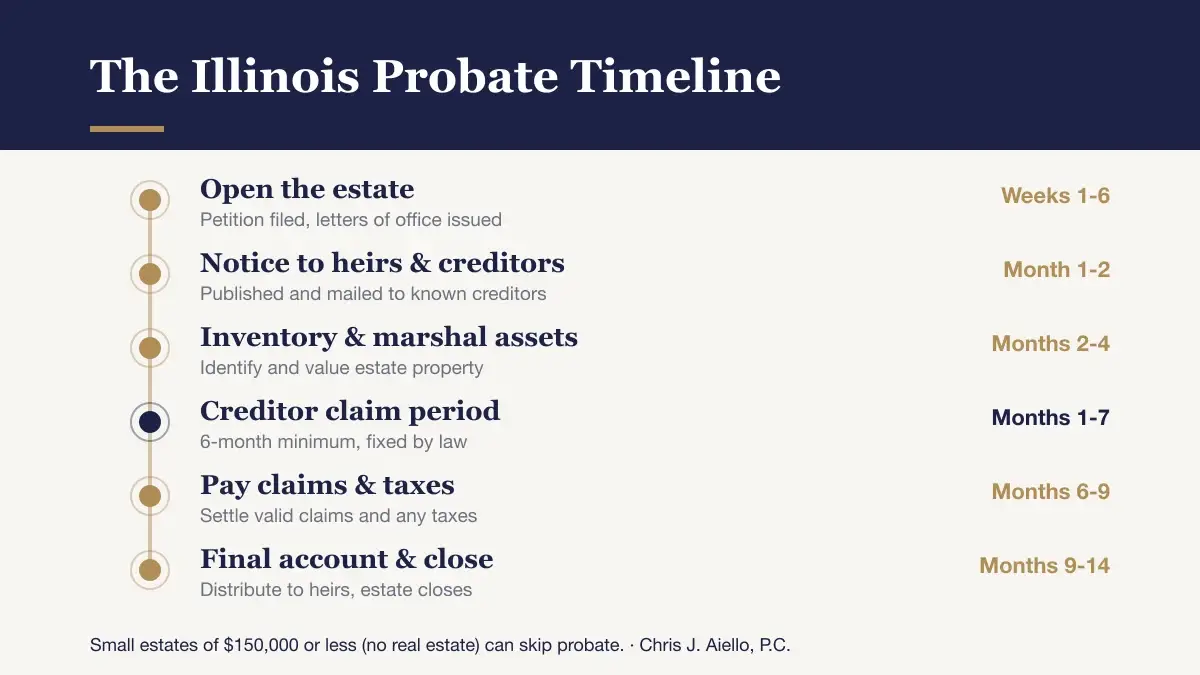
Here is how a typical uncontested DuPage County estate unfolds. The fixed rows are driven by statute or court process and cannot be compressed away. The variable rows depend on the assets, the heirs, and how the estate is managed. Ranges overlap because these steps run in parallel, not one strictly after another.
| Stage | Typical timing | Fixed or variable | What happens |
|---|---|---|---|
| Petition + letters of office | Weeks 1-6 | Fixed (must open before anything proceeds) | File the petition through Illinois e-filing at the DuPage Judicial Center; court issues letters of office giving the representative authority to act. |
| Notice to heirs and creditors + publication | Month 1-2 | Fixed (statutory notice required) | Mail notice to heirs and known creditors and publish notice to unknown creditors under 755 ILCS 5/18-3 to start the clock. |
| Inventory / marshaling assets | Months 2-4 | Variable (depends on asset complexity) | Locate, value, and secure estate assets; open the estate account; more accounts and property means more time. |
| 6-month creditor bar running | Months 1-7 | Fixed (six months from first publication, 755 ILCS 5/18-3) | The unknown-creditor claim period runs; the estate generally should not close until it expires. |
| Pay claims and taxes | Months 6-9 | Variable (contested claims or tax filings extend this) | Review, allow, or contest claims; pay valid claims and any taxes; file final returns. |
| Final account, distribution, closing | Months 9-14 | Variable (supervised estates and real estate sales add months) | Prepare the final accounting, distribute to heirs, and petition to close the estate. |
Read the table as a floor plus add-ons: the fixed rows put the earliest realistic close at roughly the end of the six-month creditor period, but the practical close for a normal estate lands in the 9-to-14-month band once inventory, claims, taxes, and distribution are all done. Every variable row is a place where a specific complication (a real estate sale, a tax filing, a missing heir) pushes the finish line out. For a full breakdown of the dollars behind these stages, see how much probate costs in Illinois.
The duty heirs miss most: file the will immediately
One duty catches families off guard before probate even starts. Under 755 ILCS 5/6-1, whoever has the decedent's will must file it with the circuit clerk of the proper county immediately upon the testator's death. There is no 30-day grace period for filing; the statute calls for prompt filing. The only place 30 days appears is on the other side of the rule: willfully concealing or secreting a known will for 30 days after learning of the death is a Class 3 felony. The filing duty applies whether or not anyone intends to open a probate estate right away.
People routinely miss this because they assume the will only matters once they decide to "do probate." In reality the filing duty is independent of that decision. Delay can create real problems: it raises questions about why the will was held back, and willfully holding a known will back for 30 days is itself a felony. In a family where relationships are strained, delay can also hand a challenger an argument. If a loved one has died and you are holding the original will, the safe move is to get it on file promptly, then decide on the administration path. If there is no will at all, the estate proceeds as intestate administration, and you can read what that means for heirs in what happens if you die without a will.
The timeline tells you when things happen; if you also want who files what and where, our walkthrough of each filing in the probate administration sequence pairs with this schedule.
The schedule above only runs on the assets a court controls. If you are not certain which of them that is, our breakdown of what belongs to the probate estate and what passes outside it sorts the folder before the clock starts.
Nothing on this schedule moves until the representative is appointed, and getting letters of office in Illinois covers that first order and the copies banks will ask for.
A claim the executor disputes can keep the estate open past the creditor window, and what happens to a disputed claim in an Illinois estate shows how the court handles one.
An estate that owes more than it holds still goes through the same claims window, and what happens when an Illinois estate is insolvent explains how the remaining money is divided among creditors.
Once the claims window has run, how to close an Illinois estate covers the final report and the order that ends the case.
Talk to a DuPage County attorney
If you are staring at an estate and trying to figure out how long it will take, the most useful thing you can do is get an accurate read on which variable drivers apply to your situation, because that is what turns a vague "it depends" into a real timeline. Chris J. Aiello, P.C. has guided DuPage County families through probate since 1990, from straightforward independent estates to contested matters, and we can tell you early whether a small estate affidavit fits or whether you are looking at a full formal administration.
External authority cites to embed: Illinois Probate Act at ilga.gov (755 ILCS 5/18-3, 18-12, Article XXVIII, 6-1, 8-1, 25-1); probate overview and small estate affidavit guidance at illinoislegalaid.org; statewide e-filing requirement at illinoiscourts.gov; DuPage County Circuit Court Clerk Probate Division at the county .gov site; ISBA public consumer guides on probate.