Real Estate Disputes in Illinois: Deadlines, Remedies, and Your First Moves

- Most disputes fall into six buckets: contract breaches, non-disclosure, boundary/easement, title defects, mechanics liens, and earnest money fights. The ladder is negotiate, mediate, litigate.
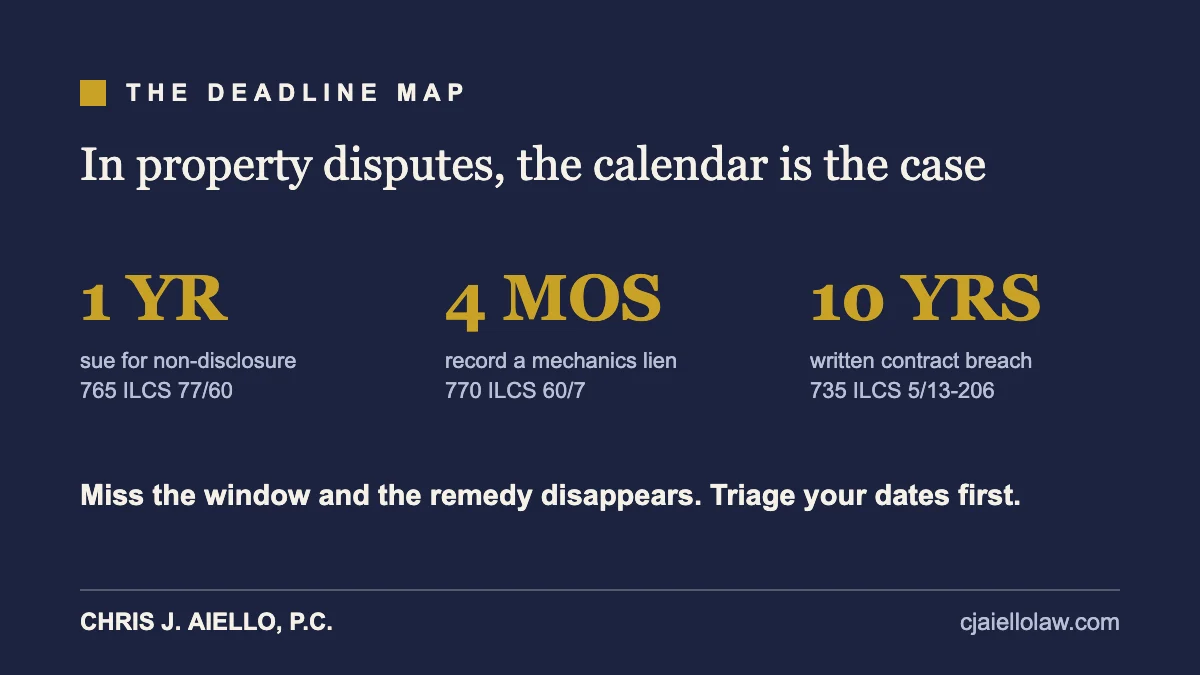
- Non-disclosure claims: 1 year from possession, occupancy, or recording, whichever is earliest (765 ILCS 77/60). The shortest and most-missed deadline in Illinois real estate.
- Written purchase contract breach: 10 years. Fraud and property damage claims: 5 years.
- Mechanics lien: record within 4 months of last work to bind third parties (770 ILCS 60/7).
- Courts can order specific performance, forcing a sale to close, because land is legally unique.
Real estate disputes in Illinois run on shorter clocks than almost anyone expects. Sue a seller for hiding a defect? You get one year, not five, not ten. A contractor protecting a lien? Four months to record it against third parties. Meanwhile the fight over a signed purchase contract can stay alive for a decade. Whether you are a buyer who found water in the basement, a seller whose buyer walked, or a neighbor staring at a fence two feet over the line, the deadline and the remedy depend entirely on which kind of dispute you have. This guide maps the common Illinois property disputes to their deadlines, their remedies, and the exact first moves that protect your position.
The Six Disputes That Cover Most Illinois Property Fights
Nearly every residential and small-commercial matter is one of these: (1) purchase contract breaches, a buyer or seller refusing to close, financing and inspection contingency fights, earnest money disputes; (2) failure to disclose defects, the leaking roof or wet basement the seller knew about; (3) boundary and easement conflicts, fences, driveways, encroachments, access rights; (4) title problems, clouds on title, competing claims, old liens that never released; (5) mechanics liens, contractors recording claims against the property; and (6) broker and commission disputes. Identifying your bucket first matters because the deadline and the remedy change completely from one bucket to the next.
The Deadline Map: What Expires When
- Seller non-disclosure: 1 year. Under the Residential Real Property Disclosure Act, no action may be commenced later than one year from the earliest of the date of possession, occupancy, or recording (765 ILCS 77/60). Buyers who wait to "see how bad it gets" routinely lose the claim entirely.
- Breach of a written purchase contract: 10 years (735 ILCS 5/13-206).
- Common-law fraud or misrepresentation, damage to property: 5 years (735 ILCS 5/13-205).
- Mechanics lien: 4 months after completion of work to record the claim so it binds other creditors and buyers, up to 2 years as against the owner, and suit to enforce within 2 years of completion (770 ILCS 60/7).
- Adverse possession and recovery of land: 20 years (735 ILCS 5/13-101). A neighbor's open, hostile, continuous use for two decades can ripen into ownership.
If more than one theory fits your facts, and non-disclosure cases usually also support a fraud theory, the deadlines differ per theory. Losing the 1-year statutory claim does not always end the case, but it forfeits the Disclosure Act's attorney-fee remedy, which is often the economic engine of the suit.
| Dispute type | Legal basis | Deadline | Typical remedy |
|---|---|---|---|
| Seller hid a defect | 765 ILCS 77 (Disclosure Act) | 1 year from possession/occupancy/recording | Actual damages + costs; attorney fees to prevailing party |
| Buyer or seller won't close | Written contract, 735 ILCS 5/13-206 | 10 years | Specific performance or damages; earnest money |
| Fraud / misrepresentation | Common law, 735 ILCS 5/13-205 | 5 years | Damages; rescission |
| Contractor lien on the property | 770 ILCS 60/7 | Record in 4 months (vs third parties); enforce in 2 years | Lien foreclosure or lien removal |
| Boundary / encroachment | Survey + deeds; 735 ILCS 5/13-101 | 20 years (adverse possession risk) | Quiet title; injunction; ejectment |
| Cloud on title | Quiet title action | Varies by underlying claim | Court order establishing ownership |
Remedies: What a Court Can Actually Order
- Specific performance. Because every parcel is legally unique, Illinois courts will order a breaching seller (and sometimes a buyer) to actually close the sale. This is the remedy that makes real estate contract litigation different from every other contract fight.
- Damages. The classic measure is the difference between contract price and market value, plus provable out-of-pocket losses. Under the Disclosure Act, a knowing violation or false disclosure supports actual damages and court costs, and the court may award reasonable attorney fees to the prevailing party (765 ILCS 77/55). That fee provision makes modest defect cases viable, and it cuts both ways if you sue and lose.
- Quiet title. A judgment that settles who owns what, wiping invalid claims off the record. The standard fix for old liens, competing deeds, and inheritance tangles.
- Injunctions and ejectment. Court orders stopping construction over a boundary line or removing an encroachment.
- Rescission. Unwinding the sale, returning price for deed, generally reserved for serious fraud.
- Earnest money awards. Most form contracts route a collapsed deal into a fight over the deposit; the contingency paragraphs and notice deadlines in the contract itself usually decide it.
Your First Week: The Moves That Protect the Case
- Freeze the evidence. The signed contract with every rider, the seller's disclosure report, inspection reports, the listing (screenshot it before it disappears), photos and video of the condition, texts and emails with agents and the other party, your survey, your title commitment.
- Run the deadline triage immediately. If a non-disclosure claim is possible, the 1-year clock from 765 ILCS 77/60 is likely already running. Date of possession, date of occupancy, date of recording: write down all three today, the earliest controls.
- Get the defect independently documented. A licensed inspector, plumber, or structural engineer report converts "the basement floods" into evidence with a repair number attached.
- Reread the contract's dispute machinery. Notice provisions, cure periods, mediation clauses (common in the standard multi-board residential form), attorney-fee clauses, earnest money escrow terms. Missing a contractual notice deadline can waive rights the statutes would otherwise give you.
- Order a survey for any boundary fight. A current staked survey either ends the argument or becomes Exhibit A. Do not build, remove, or block anything until you have it.
- Make the demand in writing. A letter that states the facts, the legal basis, the number, and a deadline resolves a meaningful share of these disputes without a complaint ever being filed, and it starts the paper trail that wins the ones that do get filed.
Honest take: the 1-year disclosure deadline kills more good cases than any courtroom argument ever will. Buyers discover a problem in month three, negotiate politely with the seller for a year, and arrive at a law office with a strong case that expired. The other honesty: not every defect is a lawsuit. The Disclosure Act reaches what the seller actually knew and misrepresented, not what nobody knew. If the facts and the fee math are not there, a straight-shooting lawyer should say so in the first meeting, not after a retainer.
Where Real Estate Disputes in Illinois Get Resolved
File where the property sits. For DuPage County property (Villa Park, Elmhurst, Lombard, Wheaton, Oak Brook, Downers Grove), that is the Eighteenth Judicial Circuit in Wheaton. Expect a resolution ladder, not a courtroom sprint: written demand, then negotiation or the mediation your contract may require, then suit if the other side will not move. Most disputes settle on the strength of documents and deadlines; the leverage belongs to whichever side organized theirs first. Litigation is the tool for the rest: the seller who will not answer, the buyer squatting on your earnest money, the neighbor who builds anyway. Because your litigator should also understand closings, title commitments, and the standard contract forms, this is an area where a DuPage County real estate litigation attorney who also closes transactions reads the file faster.
Related Problems, Related Fixes
If your dispute is still at the pre-closing stage, contingency notices, attorney review, repair credits, see our real estate contract disputes practice. If the problem is what the title search turned up, old liens, gaps in the chain, unreleased mortgages, start with title issues. And if the underlying fight is really about a broken agreement of any kind, our guide to breach of contract in Illinois covers the deadlines, elements, and remedies in depth.
The Calendar Is the Case
Real estate disputes in Illinois reward the party who acts early. Sort your dispute into its bucket, run the deadline triage the same week, preserve the documents, and put your demand in writing before positions harden. One year for non-disclosure, four months for a lien, ten for a written contract: the remedies are strong, but only inside the window.
If this page reached you through a Google search, that is the point. The firm's website sat quiet for years until it was rebuilt to answer questions like this one, and fifteen new clients came from search in the first thirty days. Property disputes were among them.
Property dispute? Find out where you stand this week.
Bring the contract, the disclosure report, and the timeline. We will tell you which deadlines apply, what your claim or defense is worth, and whether a demand letter or a lawsuit is the right tool.
Schedule a Free ConsultationSources: 765 ILCS 77/60 · 765 ILCS 77/55 · 770 ILCS 60/7 · 735 ILCS 5/13-101 · Illinois Courts: Circuit Court