Breach of Contract in Illinois: Deadlines, Damages, and What to Do First
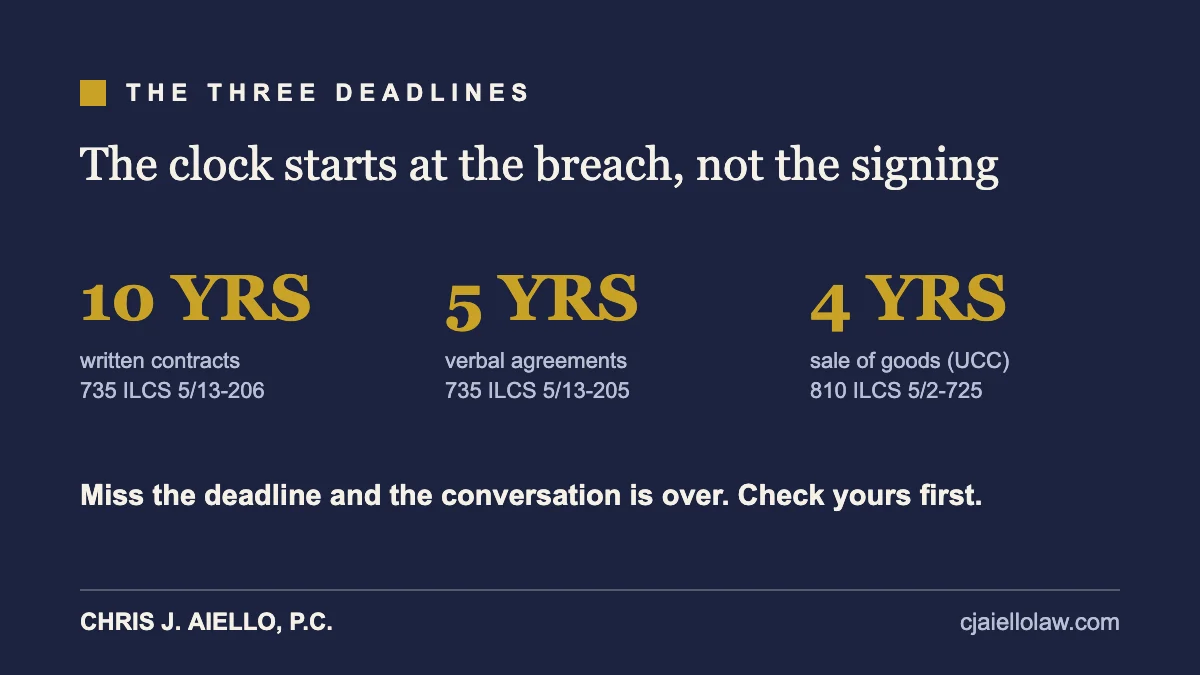
- Written contract: 10 years to file suit (735 ILCS 5/13-206). Verbal agreement: 5 years (735 ILCS 5/13-205). Sale of goods: 4 years under the UCC (810 ILCS 5/2-725), even if the contract is written.
- The clock starts at the breach, not the signing.
- You must prove four things: a valid contract, your own performance, their failure, and damages.
- Claims of $10,000 or less fit Illinois small claims court; larger claims go to the regular civil docket.
- Most cases settle after a demand letter and document exchange. Preserve everything now.
A breach of contract in Illinois gives you real options, but they come with clocks attached. You generally have 10 years to sue on a written contract, 5 years on a verbal one, and only 4 years if the deal was for the sale of goods. Most disputes never need a courtroom, and the ones that do are won or lost on documents you either kept or did not. This guide covers what actually counts as a breach, what you can recover, which court your case lands in, and the exact steps to take this week, whether you are the one owed or the one accused.
What Counts as a Breach of Contract in Illinois
A breach is a failure to do what the agreement requires without a legal excuse: not paying, paying late, delivering the wrong thing, missing a deadline that mattered, or walking away entirely. To win in an Illinois court you prove four elements: (1) a valid, enforceable contract existed, meaning offer, acceptance, and consideration; (2) you held up your end; (3) the other side did not; and (4) you were damaged as a result.
Two points people get wrong. First, the contract does not need to be a formal document. Emails, signed proposals, invoices, purchase orders, and even spoken agreements can be enforceable, though certain deals (real estate, agreements that cannot be performed within a year) must be in writing under the Statute of Frauds. Second, not every broken promise is worth suing over. Illinois distinguishes a material breach, one that defeats the purpose of the deal, from a minor one. A vendor delivering a day late with no real harm is a complaint; a vendor never delivering is a case.
The Three Deadlines That Decide Everything
- Written contracts: 10 years from the breach (735 ILCS 5/13-206). This covers written contracts, promissory notes, leases, and other written evidence of debt.
- Verbal and unwritten agreements: 5 years (735 ILCS 5/13-205). Half the time, for a deal that is harder to prove. Another reason to put things in writing.
- Sale of goods: 4 years (810 ILCS 5/2-725). If the contract is for goods (equipment, inventory, materials), the UCC's 4-year period controls even when the contract is written. The parties can shorten this by agreement to as little as 1 year, and many commercial contracts do. Read yours.
Nuances that change outcomes: the clock runs from the date of breach, not the date you signed or the date you discovered the problem, with limited exceptions. In installment contracts, Illinois treats each missed payment as its own breach with its own clock, so an old default does not necessarily kill claims on recent missed payments. And a written new promise to pay can restart the 10-year period.
Which Court Hears Your Case
Dollar amount picks the room. Claims of $10,000 or less qualify for small claims court under Illinois Supreme Court Rule 281: simplified procedure, faster timeline, and many parties handle it without counsel. Above that, you are on the regular civil docket of the circuit court in the county where the defendant lives or where the contract was made or performed. For a DuPage County dispute, that is the Eighteenth Judicial Circuit in Wheaton, and mid-size claims there typically pass through court-annexed arbitration before any trial, which resolves many of them within months instead of years. If your contract has a forum-selection or arbitration clause, it may override all of this. That clause is the first thing to check.
| Contract type | Deadline to sue | Your proof problem | Example |
|---|---|---|---|
| Written contract | 10 years (735 ILCS 5/13-206) | Least. The document speaks | Signed service agreement, lease, promissory note |
| Verbal agreement | 5 years (735 ILCS 5/13-205) | Most. Performance and witnesses must prove terms | Handshake deal with a contractor |
| Sale of goods (UCC) | 4 years, contracts can shorten to 1 (810 ILCS 5/2-725) | Delivery, acceptance, and warranty records | Equipment or inventory purchase |
What You Can Actually Recover
- Compensatory damages: the direct financial loss, the unpaid invoice, the cost of hiring a replacement vendor.
- Consequential damages: foreseeable downstream losses, such as profits lost because a delivery failed. Harder to prove; keep records.
- Liquidated damages: an amount the contract itself pre-set for a breach, enforced if reasonable.
- Specific performance: a court order forcing the other side to actually do the deal. Rare for services, common for real estate because every parcel is unique.
- Rescission: unwinding the contract and returning both sides to the starting position.
The nuance the overview articles skip: punitive damages are generally not available in an Illinois breach of contract action, no matter how badly the other side behaved, unless the conduct amounts to an independent tort like fraud. And Illinois follows the American rule on legal fees: each side pays its own lawyers unless the contract has a fee-shifting clause or a statute provides fees. That single clause often decides whether a $20,000 claim is worth pursuing.
What to Do This Week (Either Side of the Dispute)
- Find every document. The contract and all amendments, emails, texts, proposals, invoices, payment records, delivery confirmations. Do not rely on the other side's copies.
- Fix your dates. When was the contract made, when did performance start, and when exactly did the breach happen? That last date runs the statute of limitations.
- Read the boilerplate. Notice-and-cure provisions, mediation or arbitration clauses, forum selection, fee-shifting, liquidated damages. These paragraphs control your options.
- Quantify the damage in writing. A number with backup, not a feeling. Courts award proven losses.
- Do not perform yourself into a corner. If the other side materially breached, keep paying or performing only on advice; continuing as if nothing happened can waive the breach.
- Send a demand letter before filing. A specific, deadline-bearing demand from a law firm resolves a large share of contract disputes without a lawsuit, and it papers your good faith if you do end up in court.
If You Are the One Being Accused
A claim is not a judgment. Illinois defenses include: no valid contract ever formed; the Statute of Frauds required a writing that does not exist; the plaintiff breached first or never performed; the terms were modified or the breach waived; performance became impossible; the claimed damages are speculative. An early, well-documented defense often converts a lawsuit into a modest settlement. What you should not do is ignore the complaint; a default judgment takes your defenses off the table permanently.
Honest take: most breach cases should settle, and fast. Litigation is a tool for when the other side will not be reasonable, not a first move. If the amount in dispute is under five figures and your contract has no attorney-fee clause, a demand letter and a negotiated resolution will usually beat a lawsuit on math alone. Where suing clearly makes sense: a fee-shifting clause, a six-figure loss, a written contract with clean proof, or a defendant who will only move under court pressure. A DuPage County breach of contract attorney can tell you in one meeting which category you are in.
When the Contract Dispute Is About Property or a Business
Contract fights rarely travel alone. If the broken contract is a real estate purchase agreement, different remedies and much shorter collateral deadlines apply; we cover those in real estate disputes in Illinois and handle the transactional side through our real estate contract disputes practice. Partnership and shareholder fallouts, vendor disputes, and collection matters run through our broader civil litigation practice.
Move Before the Clock Does: Breach of Contract in Illinois Is Winnable Early
A breach of contract in Illinois is a solvable problem when you act while the evidence is fresh and the deadlines are open. Know your deadline (10, 5, or 4 years), gather the paper, put a number on the harm, and make a firm written demand before you file anything. Whether you are enforcing a deal or defending against a claim, the first conversation tells you what the case is worth and what it will take.
Broken contract? Get a straight answer first.
Bring the contract and the timeline. We will tell you whether you have a claim or a defense worth pursuing, what it is likely to recover, and what it will cost, before you commit to anything.
Schedule a Free ConsultationSources: 735 ILCS 5/13-206 · 735 ILCS 5/13-205 · 810 ILCS 5/2-725 · Illinois Courts: Circuit Court