Can You Refuse a Breathalyzer in Illinois?
- Yes, you can refuse. But Illinois has an implied consent law (625 ILCS 5/11-501.1): by driving, you already agreed to chemical testing after a DUI arrest.
- Two different tests. The roadside handheld test (PBT) before arrest is optional with no license penalty (625 ILCS 5/11-501.5). The station test after arrest is the one implied consent covers.
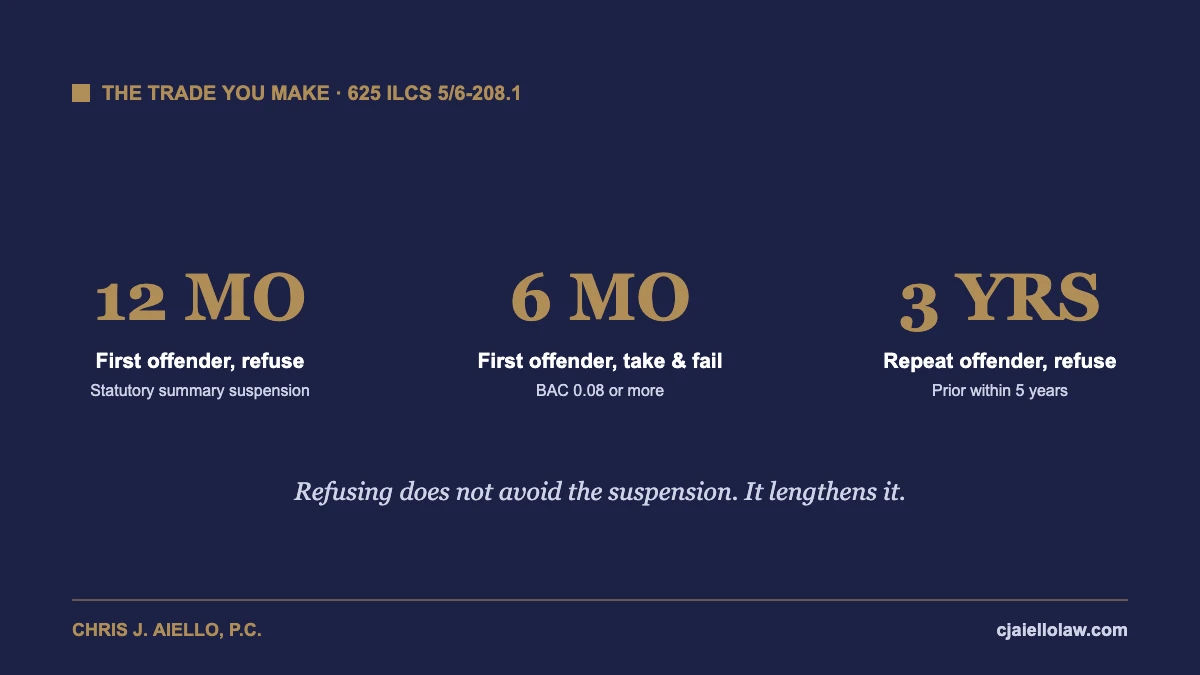
- Refusing costs you more license time. First offender: 12 months suspended for refusing vs 6 months for taking it and failing (625 ILCS 5/6-208.1).
- Refusal is not a secret. Prosecutors can tell the jury you refused (625 ILCS 5/11-501.2), and they argue it shows you knew you were over.
- The suspension is automatic and civil, separate from the criminal DUI. You have a short window to challenge it in court.
Yes, you can refuse a breathalyzer in Illinois. No officer will physically force air into a machine. But "can you" and "should you" are different questions, and the honest answer to the second one is: it depends on which test you are being asked to take and what your record looks like. Illinois runs two very different breath tests. One happens at the roadside, before any arrest, and you can decline it with no automatic penalty. The other happens at the station after a DUI arrest, and refusing that one triggers an automatic license suspension that is longer than the suspension you would get for taking the test and failing. This guide separates the two tests, shows you the exact suspension you trade by refusing, and explains whether refusal actually helps your case.
Two Different Breath Tests: Know Which One You Are Refusing
Almost every confused conversation about refusing a breathalyzer in Illinois comes from mixing up two tests that the law treats completely differently.
The roadside test (Preliminary Breath Test, or PBT). This is the small handheld device an officer may offer at the side of the road, before you are arrested, while they are still deciding whether they have enough to arrest you. Under 625 ILCS 5/11-501.5, this test is optional. The statute says in plain language that "the person may refuse the test," and refusing it carries no automatic license suspension. It is a screening tool to help the officer decide whether to arrest, not the official evidence.
The evidentiary test (the station breathalyzer or blood/urine test). This is the calibrated machine at the police station, or a blood or urine draw, requested after you have been arrested for DUI. This is the test Illinois implied consent law is about. Refusing this one is what triggers the automatic suspension.
The catch: officers do not always announce which test you are being offered, and the roadside stop moves fast. If you are not under arrest yet and an officer holds out a handheld unit, that is very likely the optional PBT. Once you are arrested and read a document called a "Warning to Motorist," you are now in evidentiary-test territory, and the rules below apply.
Illinois Implied Consent, in Plain English
Illinois implied consent lives in 625 ILCS 5/11-501.1. The idea is simple and it is not new: by driving on Illinois roads, you are "deemed to have given consent" to a chemical test of your breath, blood, or urine if you are lawfully arrested for DUI. You did not sign anything at the DMV that spelled this out, but the law treats your decision to drive as the agreement.
Implied consent does not mean you cannot say no. It means saying no has a price the state set in advance: an automatic driver's license suspension called a statutory summary suspension. That suspension is a civil, administrative penalty. It is handled separately from, and in addition to, the criminal DUI charge, and it applies even if you are never convicted of the DUI itself. We cover that process end to end in our guide to DUI license suspension in Illinois.
The Exact Suspension You Trade by Refusing
This is the number nobody puts in a clean table, so here it is. The lengths come straight from 625 ILCS 5/6-208.1. A "first offender" for this purpose generally means a driver with no DUI-related suspension, conviction, or disposition in the last five years.
| Your situation | You take the test and fail (0.08+) | You refuse the test |
|---|---|---|
| First offender | 6-month suspension | 12-month suspension |
| Not a first offender (prior within 5 years) | 1-year suspension | 3-year suspension |
Read the table the way a defense lawyer reads it. Refusing does not avoid a suspension. It doubles or triples it. A first offender who blows and fails loses driving for 6 months; the same driver who refuses loses it for 12. A repeat driver who fails loses a year; the one who refuses loses three. Refusal is a longer, harder suspension in every column.
The suspension takes effect automatically on the 46th day after the officer serves notice (625 ILCS 5/11-501.1), and you have 90 days to file a petition to rescind and get a court hearing (625 ILCS 5/2-118.1). Those first weeks are the window to fight it.
Refusing Can Cost You More Than License Time
The length of the suspension is not the whole price of a refusal. Two collateral consequences ride along with it, and for many drivers they matter more day to day than the raw number of months.
A commercial license is hit hard. If you hold a CDL, a chemical-test refusal (or a failed test) disqualifies your commercial driving privileges for at least 12 months, and 3 years if you were hauling hazardous materials, on top of the suspension of your everyday license (625 ILCS 5/6-514). A second disqualifying offense is a lifetime CDL disqualification. For anyone who drives for a living, that is the part of a refusal that can end a career, and it applies whether you refused or took the test and failed.
The longer clock is harder to drive around. A first offender can still drive during the suspension on a Monitoring Device Driving Permit with an interlock, whether they refused or failed (625 ILCS 5/6-206.1), so a refusal does not cost a first offender the permit itself. What it costs is time: you carry the interlock and its monthly fees for 12 months instead of 6. And if you are not a first offender, the gap is worse. Refusing pushes the suspension to 3 years, and repeat offenders are generally not eligible for the MDDP at all, so much of that time is served with no easy legal way to drive.
Does Refusing Help or Hurt My Case?
People refuse because they assume "no evidence means no case." In Illinois that assumption is usually wrong, for two reasons.
First, refusing does not make the DUI disappear. The state can still prosecute DUI on other evidence: the officer's observations, driving pattern, field sobriety tests, statements, video, and the odor and appearance the report describes. Illinois DUI is not only a "0.08 or more" charge; it is also an "under the influence to a degree that renders you incapable of safe driving" charge, which needs no number at all.
Second, refusing can be turned into evidence against you. That surprises people, so it is worth being precise about it. Under 625 ILCS 5/11-501.2, if a person under arrest refuses chemical testing, "evidence of refusal shall be admissible in any civil or criminal action or proceeding." Prosecutors use that to argue consciousness of guilt: the idea that you refused because you knew the result would sink you. Whether that argument lands depends on the facts, but the jury is allowed to hear that you said no.
So refusing is a genuine trade, not a free pass: you deny the state a clean number, but you accept a longer license suspension and hand the prosecutor a consciousness-of-guilt argument. There is no one-size answer to whether it helps. It depends on your record, your BAC if you were tested, and the strength of the rest of the case, which is exactly the judgment call a defense lawyer makes with the file in front of them.
What to Actually Do at a DUI Stop in Illinois
General guidance, not a script for beating a test, and not legal advice for your specific stop:
- Be polite and calm. Hand over your license, registration, and proof of insurance. Nothing below requires being rude, and rudeness only helps the report.
- Know that the roadside handheld test is optional. You may decline the preliminary breath test before arrest with no automatic license penalty (625 ILCS 5/11-501.5). Field sobriety tests (walk-and-turn, one-leg stand, eye test) are also generally something you can decline before arrest.
- Understand the "Warning to Motorist." After a DUI arrest, the officer reads or gives you this document. It is telling you the implied-consent consequences of refusing the evidentiary test. That is your signal you are now in the situation the table above describes.
- Do the suspension math before you decide. A first offender facing 6 months for a fail versus 12 for a refusal is a different calculation than a repeat driver facing 1 year versus 3.
- Say you want to speak with a lawyer. You can state clearly that you do not wish to answer questions and want an attorney. Do not argue the law with the officer at the roadside; that is the courtroom's job.
- Write down everything afterward. Times, what was said, which tests were offered, whether you were told you were under arrest. Those details drive both the suspension challenge and the DUI defense.
Honest take: there is no universal right answer to "should I blow." Anyone who tells you "always refuse" or "always take it" is selling a slogan, not advice. For a true first offender who has clearly had very little, taking the test and passing can end the stop; refusing guarantees a 12-month suspension either way. For a driver who is well over the limit or who has a prior, the math changes, and so does the calculation about giving the state a clean number. What is not a judgment call: get a DuPage County DUI defense lawyer on the phone fast, because the suspension clock starts running on its own and the window to fight it is short.
The Suspension and the DUI Are Two Separate Fights
This trips people up, so it is worth stating plainly. After a refusal or a failed test you are facing two proceedings at once. The statutory summary suspension is the civil, automatic loss of your license, and it can be challenged with a petition to rescind in the circuit court. The criminal DUI is the separate charge that carries the fines, possible jail, and the record. You can win one and lose the other. For what the criminal side can cost and when a DUI stops being a misdemeanor, see our guides on how much a DUI costs in Illinois and when a DUI becomes a felony in Illinois.
Conclusion: Refusal Is a Trade, Not an Escape
Can you refuse a breathalyzer in Illinois? Yes. Should you? That depends on which test, your record, and what the night actually looked like. The roadside handheld test is optional. The post-arrest evidentiary test is covered by implied consent, and refusing it trades a 6-month suspension for a 12-month one as a first offender, or a 1-year suspension for 3 years if you are not, while handing the prosecutor an argument in court. Whatever you decide in the moment, the smartest move afterward is fast: the suspension is automatic, and the window to challenge it does not wait.
Arrested for DUI, or facing a license suspension? Get a straight answer now.
Whether you refused or you blew, there are two clocks running and a short window to fight the suspension. Bring us the arrest paperwork and the timeline. We will tell you where you stand on both the license and the charge before you decide anything.
Schedule a Free ConsultationSources: 625 ILCS 5/11-501.1 · 625 ILCS 5/11-501.5 · 625 ILCS 5/6-208.1 · 625 ILCS 5/11-501.2 · 625 ILCS 5/2-118.1 · 625 ILCS 5/6-206.1 · 625 ILCS 5/6-514
Related: How the firm rebuilt its website and added 15 new clients in 30 days