First DUI in Illinois: What Actually Happens
- A first DUI is a Class A misdemeanor: up to 364 days in county jail and up to a $2,500 fine (625 ILCS 5/11-501). Most first offenders get court supervision, not a conviction.
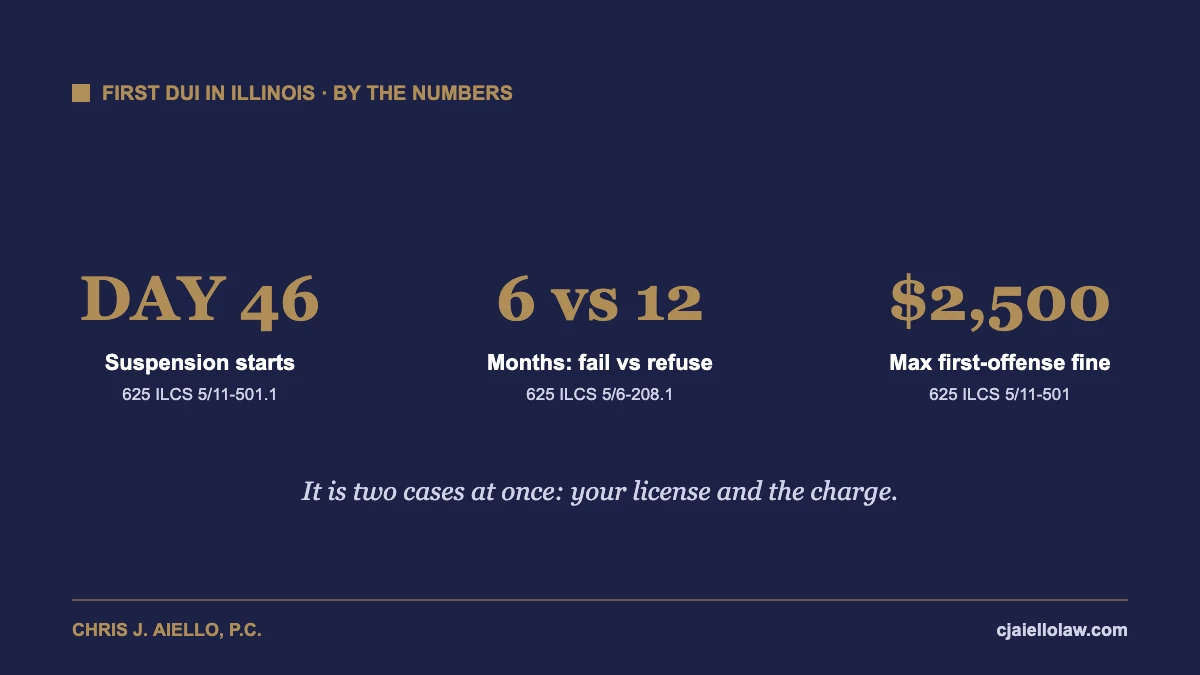
- The license suspension is automatic and separate from the criminal case. It starts on the 46th day after arrest: 6 months if you failed the test, 12 months if you refused (625 ILCS 5/6-208.1).
- You usually get to keep driving through an MDDP permit with a breath-interlock device installed within 14 days (625 ILCS 5/6-206.1).
- Court supervision avoids a conviction and a revocation, but a DUI supervision stays on your driving record permanently and cannot be expunged.
- You have a short window to challenge the suspension. File the paperwork fast.
A first DUI in Illinois is a Class A misdemeanor, and the single most confusing part is that it is really two cases at once. There is the criminal charge, which can carry up to a year in jail and a $2,500 fine, and there is a separate, automatic hit to your driver's license that starts on the 46th day after your arrest whether or not you are ever convicted. The good news for most first offenders: the law is built to keep you driving and to keep a conviction off your record if you handle the next few weeks correctly. This guide walks through both tracks, the exact dates, the penalties, how the charge actually gets challenged, court supervision and its one big catch, when a first DUI turns into a felony, and what to do this week.
The Two Cases You Are Actually Facing
Almost nobody explains this, and it is the thing that trips up every first-timer. One DUI arrest opens two separate proceedings that run on different clocks.
- The criminal case. The State charges you with DUI under 625 ILCS 5/11-501. This is the one with a courtroom, a judge, and penalties like jail, fines, and supervision. You are innocent until the State proves the case.
- The statutory summary suspension. This is a civil, automatic administrative action against your driver's license, handled by the Secretary of State, not the criminal judge. It happens because you either failed or refused the chemical test, and it takes effect on its own timeline no matter what happens in the criminal case. We cover it in depth in our guide to DUI license suspension in Illinois.
You can beat the criminal charge and still lose your license for months, or keep your license and still have to answer the charge. Treat them as two problems, because the law does.
What the Penalties Actually Are
A first DUI is a Class A misdemeanor (625 ILCS 5/11-501). The ceiling is real but rarely hit on a clean first offense:
- Jail: up to 364 days in county jail. There is no mandatory minimum on a standard first offense, and first offenders very rarely serve jail time.
- Fine: up to $2,500, plus court costs and assessments.
- The 0.16 aggravator: if your BAC was 0.16 or higher, the law adds a mandatory minimum $500 fine and 100 hours of community service on top (625 ILCS 5/11-501). This is not optional and the judge cannot waive it.
- Conviction consequences: a DUI conviction triggers a separate one-year revocation of your license by the Secretary of State and stays on your public record permanently. This is exactly why court supervision matters, covered below.
The License Timeline: Everything Turns on Day 46
The suspension is automatic, but it is not instant, and the gap is your window to act.
- Day of arrest: the officer serves you a Notice of Summary Suspension and usually takes your physical license.
- Days 1 to 45: you can still drive on the receipt. This is the window to file a Petition to Rescind the summary suspension in the criminal court and to get an MDDP set up.
- Day 46: the summary suspension takes effect (625 ILCS 5/11-501.1). From here the length depends on what you did at the roadside:
| What happened at the test | First-offender suspension | Can you still drive? | Statute |
|---|---|---|---|
| You took the test and failed (BAC 0.08+) | 6 months | Yes, with an MDDP and a breath-interlock device | 625 ILCS 5/6-208.1; 6-206.1 |
| You refused the test | 12 months | Yes, with an MDDP and a breath-interlock device | 625 ILCS 5/6-208.1; 6-206.1 |
| You are convicted of the DUI itself | 1-year revocation (separate action) | Not automatically; requires a hearing to reinstate | 625 ILCS 5/11-501; 6-208 |
Two things people get backwards. First, refusing the test does not help you here. It doubles the suspension from 6 months to 12 and is often used as evidence anyway. Second, the suspension and a conviction revocation are different penalties from different bodies. You can serve a summary suspension and then, if convicted, face a revocation after it.
How You Keep Driving: the MDDP
Most first offenders do not stop driving. Under 625 ILCS 5/6-206.1, a first offender under a summary suspension can get a Monitoring Device Driving Permit (MDDP) that lets you drive for any purpose, any time, as long as the vehicle has a breath alcohol ignition interlock device (BAIID) installed. The device must be installed within 14 days of the permit issuing, and you pay the installation and monthly monitoring costs yourself. The one real difference a refusal makes here is the clock, not the permit: a first offender still gets the MDDP, but the underlying suspension runs 12 months instead of 6, so you carry the interlock and its monthly fees for twice as long. Set this up during the 45-day window so there is no gap in your ability to drive.
What Happens Step by Step
The process is more routine than it feels at 2 a.m. on the side of the road.
- Arrest and booking. You are tested, processed, and served the suspension notice.
- Bond and release. Most first DUIs are released on a recognizance or low bond. You get a first court date, usually a few weeks out.
- Arraignment. You appear, hear the formal charge, and enter a plea of not guilty. Your lawyer files appearances and discovery demands here, and this is the moment to file the Petition to Rescind the summary suspension if you are challenging it. That petition must be heard promptly, so it goes in early.
- Pretrial and status dates. Your lawyer gets the police reports, the squad video, the breath-machine records and calibration logs, and the field-sobriety notes. Most DUI cases are won or lost in this paperwork, not at trial.
- Disposition. The large majority of clean first offenses resolve here, most often as court supervision rather than a conviction, sometimes as a reduction, occasionally by dismissal if the stop or the testing was bad. A small number go to trial.
How a First DUI Actually Gets Challenged
A clean first DUI is not automatically a conviction, and it is not automatically supervision either. Whether a case gets reduced, dismissed, or knocked into doubt usually comes down to how the arrest was made and how the evidence was collected. These are the same grounds that support the Petition to Rescind the summary suspension, which is why the license track and the criminal track get fought together. The common pressure points:
- The stop itself. An officer needs a specific, articulable reason to pull you over and reasonable grounds to move from a traffic stop to a DUI investigation. If the stop was not justified, the evidence that followed it can be challenged.
- The breath machine. Evidentiary breath instruments have to be certified and regularly accuracy-checked, and the operator has to be licensed and follow the required observation period. Missing certification or calibration records can undercut a failed-test reading.
- Field sobriety tests. These are only reliable when administered exactly to the standardized protocol, on suitable ground, and with medical conditions, footwear, and nerves accounted for. Deviations weaken what the officer says the tests showed.
- Rising blood alcohol. Alcohol keeps absorbing after your last drink, so a reading taken an hour or more after driving can read higher than your actual level behind the wheel.
- Probable cause to arrest. Everything from the stop through the roadside tests has to add up to probable cause. If it does not, the arrest and the chemical test that followed it are open to attack.
None of these are magic words. They are documented facts a lawyer digs out of the police reports, the squad video, and the machine logs, which is why the discovery demands in the first few weeks matter more than anything said in a courtroom later.
Court Supervision, and Its One Real Catch
Court supervision is the outcome most first offenders want, and it is worth understanding exactly. Under 730 ILCS 5/5-6-1, the judge can defer the conviction and place you on supervision with conditions such as an alcohol evaluation, a treatment or education class, and a fine. Under 730 ILCS 5/5-6-3.1, if you complete supervision successfully, the court discharges you and dismisses the charge, and by statute that dismissal is not a conviction. That is the whole point: no conviction means no one-year license revocation and nothing that reads as a DUI conviction on a background check.
Here is the catch every marketing page skips: supervision keeps a DUI off your criminal conviction record, but the DUI stays on your Secretary of State driving record permanently and cannot be expunged or sealed in Illinois. It is not a clean slate on your driving history, and a second DUI later will be treated as a second. Supervision is also a one-time tool for DUI. Under 730 ILCS 5/5-6-1, you are only eligible if you have never been convicted of or assigned supervision for a DUI before. Use it wisely.
When a First DUI Is Not a Misdemeanor
A "first" DUI can still be charged as an aggravated DUI, which is a felony, if certain facts are present, regardless of it being your first arrest (625 ILCS 5/11-501(d)). The common triggers:
- Driving on a suspended or revoked license, or with no license or no insurance.
- A crash that caused great bodily harm or a death.
- A child under 16 in the vehicle in some circumstances.
- Driving a school bus with passengers.
Aggravated DUI runs from a Class 4 up to a Class 2 or higher felony depending on the facts, with real prison exposure. If any of these apply to you, this is no longer a routine first offense; read our guide to when a DUI becomes a felony in Illinois.
Honest take: on a clean first DUI, the fight is usually not "jail or no jail," it is "supervision or conviction," and it is often won in the paperwork weeks before any trial, on how the stop was made and whether the breath machine was properly certified. The single most expensive mistake first offenders make is treating the 45-day license window as optional and losing the chance to challenge the suspension or line up an MDDP. Move on the license track now, even while the criminal case is just getting started. A Villa Park DUI defense attorney can file both pieces at once.
What a First DUI Really Costs
Between the fine, the interlock installation and monthly monitoring, the alcohol evaluation and classes, the reinstatement fees, and the near-certain jump in your car insurance, the out-of-pocket total on a first DUI usually runs well into the thousands even when you never see a jail cell. We break the numbers down in what a DUI actually costs in Illinois.
What to Do This Week
- Find your arrest paperwork and read the suspension notice. Note the arrest date. Day 46 is your line in the sand.
- Write down the timeline while it is fresh: where you were coming from, what the officer said, whether you were read warnings, whether you were offered and took a test, and any medical conditions that affect testing.
- Do not talk about the case with anyone but a lawyer, and stay off social media about it.
- Line up an MDDP so you do not lose the ability to drive on day 46. Budget for the interlock install within 14 days of the permit.
- Get an alcohol evaluation early. Judges look favorably on defendants who start the required steps before they are ordered to.
- Decide whether to challenge the suspension. A Petition to Rescind must be filed and heard quickly. If the stop or the testing was flawed, this is where you claw the license back.
- Talk to a DUI lawyer before your first court date, not after. The most valuable moves, the rescission petition and the discovery demands, happen at the very start.
Conclusion: The First Two Weeks Decide the Case
A first DUI in Illinois is a serious charge, but for most first offenders it is a manageable one if you respect the calendar. Handle the license track and the criminal track as two separate problems, protect your ability to drive with an MDDP, aim for the court supervision that keeps a conviction off your record, and understand its one real limit. The people who come out of a first DUI cleanest are the ones who acted in the first two weeks, not the ones who waited for a court date.
Arrested for a first DUI? The clock is already running.
Bring your arrest paperwork and the timeline. We will tell you where both cases stand, how to keep you driving, and whether court supervision or a fight over the stop is the right play, before your first court date.
Schedule a Free ConsultationSources: 625 ILCS 5/11-501 · 625 ILCS 5/11-501.1 · 625 ILCS 5/6-208.1 · 625 ILCS 5/6-206.1 · 730 ILCS 5/5-6-1 · 730 ILCS 5/5-6-3.1