Aggravated DUI in Illinois: The Factors, the Felony Class, and the Prison Time
- An aggravated DUI is a felony. It is a regular DUI elevated by an aggravating factor listed in 625 ILCS 5/11-501(d).
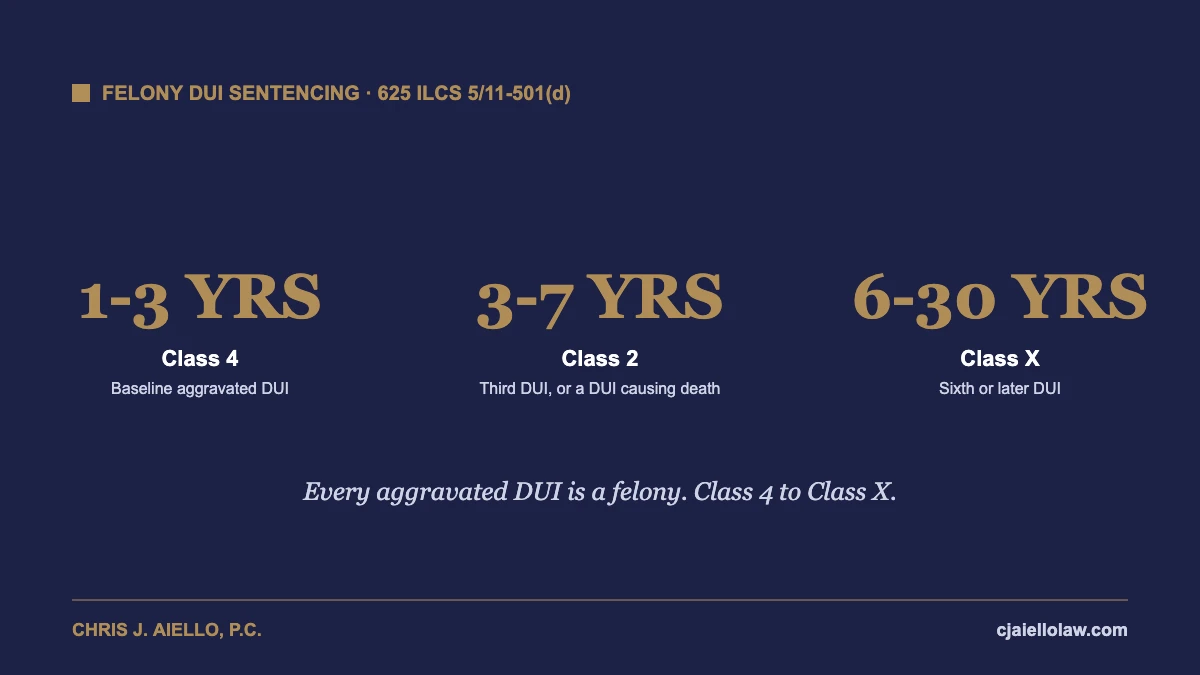
- Felony classes run from Class 4 (1 to 3 years) up to Class X (6 to 30 years), depending on the factor.
- A third DUI is automatically a Class 2 felony (3 to 7 years). A fourth and fifth cannot receive probation; a sixth is a Class X felony.
- Injury, death, no valid license, no insurance, a child passenger, a school bus, or a for-hire vehicle each turn a DUI aggravated, even on a first offense.
- Even where probation is allowed, the floor is 480 hours of community service or 10 days in jail, and a mandatory prison term cannot be suspended or reduced.
An aggravated DUI in Illinois is not a separate crime with its own label so much as an ordinary DUI that the law promotes to a felony because of something about how it happened. One aggravating factor, a third offense, an injury, a missing license, an uninsured car, a child in the back seat, and a charge that would have been a Class A misdemeanor becomes a felony carrying real prison exposure. The factors are listed in one statute, 625 ILCS 5/11-501(d), and each one maps to a specific felony class with a specific sentencing range. This guide gives you that map: what triggers an aggravated DUI, which felony class each trigger carries, how many years that class means, and when the law takes probation off the table entirely.
What Makes a DUI "Aggravated" in Illinois
A standard first DUI in Illinois is a Class A misdemeanor, capped at up to one year in jail. It becomes an aggravated DUI, a felony, the moment one of the factors in 625 ILCS 5/11-501(d)(1) is present. There are twelve of them, and they fall into three plain-English buckets:
- How many times. A third or later DUI is aggravated no matter what else happened.
- Who got hurt. A crash that caused great bodily harm, permanent disability, disfigurement, or death makes the DUI aggravated.
- The circumstances of the drive. No valid driver's license, no liability insurance, driving on a license already revoked or suspended for a prior DUI, a school bus with passengers, a 20-mph school zone, a child under 16 in the car, or a for-hire vehicle with passengers.
The key point people miss: it is the factor, not the count. A driver with a clean record and a first-ever DUI is charged with an aggravated felony DUI if that first stop involved, say, no insurance or a serious injury. If you are still trying to work out whether your charge is a felony at all, start with our companion guide on whether a DUI is a felony in Illinois, then come back here for the factor-by-factor breakdown.
The Factor-to-Felony-Class-to-Prison-Time Matrix
This is the table nobody publishes cleanly. Each aggravating factor in 625 ILCS 5/11-501(d)(1) is matched to its felony class and the prison range that class carries under the Unified Code of Corrections (730 ILCS 5/5-4.5). Ranges are the term a judge must work within if a prison sentence is imposed; several of these factors also allow probation, and several do not.
| Aggravating factor (625 ILCS 5/11-501(d)(1)) | Felony class | Prison range if incarcerated | Key mandatory add-on |
|---|---|---|---|
| Third DUI ((A)) | Class 2 | 3 to 7 years | If BAC 0.16+: 90 days jail + $2,500 min fine. Probation still possible |
| Fourth DUI ((A)) | Class 2, no probation | 3 to 7 years | If BAC 0.16+: $5,000 min fine |
| Fifth DUI ((A)) | Class 1, no probation | 4 to 15 years | If BAC 0.16+: $5,000 min fine |
| Sixth or later DUI ((A)) | Class X | 6 to 30 years | Class X requires prison; no probation |
| Crash causing great bodily harm, permanent disability, or disfigurement ((C)) | Class 4 | 1 to 12 years (special range) | Judge may grant probation, but the range if imprisoned is 1 to 12 |
| Crash causing death ((F)) | Class 2 | 3 to 14 years (one death); 6 to 28 years (two or more) | Probation only if the court finds extraordinary circumstances |
| Prior DUI reckless-homicide or prior injury/death DUI ((D)) | Class 3, no probation | 2 to 5 years | Probation and conditional discharge barred |
| Driving a school bus with passengers ((B)) | Class 4 | 1 to 3 years | |
| DUI in a 20-mph school zone causing bodily harm ((E)) | Class 4 | 1 to 3 years | |
| Driving on a license revoked/suspended for a prior DUI ((G)) | Class 4 | 1 to 3 years | |
| No valid driver's license or permit ((H)) | Class 4 | 1 to 3 years | |
| No liability insurance ((I)) | Class 4 | 1 to 3 years | |
| Crash causing bodily harm to a child-under-16 passenger ((J)) | Class 4 | 1 to 3 years | $2,500 fine + 25 days community service |
| Second DUI while transporting a person under 16 ((K)) | Class 2 | 3 to 7 years | $2,500 fine ($5,000 if the child was hurt) + 25 days community service |
| DUI transporting passengers in a for-hire vehicle ((L)) | Class 4 | 1 to 3 years |
Two things the table makes obvious that prose hides. First, the same conduct can carry wildly different exposure: a fourth uninsured DUI stacks the third-offense escalation on top of the no-insurance factor, and the more serious factor controls. Second, a death is not automatically the longest sentence on the page. A sixth DUI with no injury (Class X, 6 to 30 years) can carry a higher ceiling than a single-death crash (Class 2, 3 to 14 years). Illinois punishes the repeat pattern as hard as it punishes the tragic single event.
The Repeat-Offense Ladder
The count-based factor climbs fast, and Illinois writes no time limit into it. Because 625 ILCS 5/11-501(d)(1)(A) counts a "third or subsequent" violation with no lookback window in the text, an old conviction still counts. A DUI from twenty years ago is treated the same as one from last year for deciding whether today's charge is a third, fourth, or fifth. The ladder:
- Third DUI: Class 2 felony, 3 to 7 years. Probation is still on the table, but a BAC of 0.16 or higher forces a mandatory 90 days in jail and a $2,500 minimum fine on top of anything else.
- Fourth DUI: Class 2 felony, and the statute bars probation and conditional discharge. Prison is the outcome.
- Fifth DUI: Class 1 felony, 4 to 15 years, also non-probationable.
- Sixth or later DUI: Class X felony, 6 to 30 years. Class X is the most serious non-murder class in Illinois and always requires a prison term.
If you want the dollar side of this (fines, fees, insurance, interlock, and the multi-year total a felony DUI actually costs), we break it down in what a DUI costs in Illinois.
Why Some Aggravated DUIs Cannot Get Probation
For a Class 4 aggravated DUI, a judge often has room to impose probation instead of prison. For several factors, the legislature removed that room on purpose:
- Fourth and fifth DUI: 625 ILCS 5/11-501(d)(2)(C) and (D) state that a sentence of probation or conditional discharge "may not be imposed."
- Sixth or later DUI: a Class X felony, which requires prison by law.
- A prior DUI reckless-homicide or a prior injury/death DUI ((D)): Class 3 and non-probationable under (d)(2)(J).
- A crash causing death ((F)): probation is available only if the court makes a specific finding of extraordinary circumstances, and absent that finding the sentence is 3 to 14 years, or 6 to 28 for two or more deaths.
Even where probation IS allowed, it is not a walk. Any aggravated DUI sentence of probation or conditional discharge carries a mandatory floor of at least 480 hours of community service or 10 days in jail under 625 ILCS 5/11-501(d)(3). And once a mandatory term of imprisonment or community service attaches, 625 ILCS 5/11-501(f) says the court cannot suspend or reduce it.
How the Aggravating Factor Gets Challenged
Because the aggravating factor is what sets the felony class, it is also the state's element to prove, and every element can be contested. Defending an aggravated DUI is less about the impaired-driving question and more about whether the specific factor in 625 ILCS 5/11-501(d)(1) actually applies. The attack tracks the type of factor.
- Count-based factors (a third, fourth, fifth, or later DUI, under (A)). The enhancement rides entirely on the prior-offense record. Driving abstracts carry out-of-state entries, court supervision that may not legally count as a conviction, and clerical errors. If a claimed "third" is really a second, the class drops and probation can reopen. The prior-offense count is proved by records, and records can be wrong.
- Injury and death factors ((C) and (F)). These require the state to prove causation, that the impaired driving was the proximate cause of the great bodily harm, permanent disability, disfigurement, or death, not merely present at the scene. A crash the driver did not cause, or a harm that would have happened regardless, undercuts the factor even where impairment is conceded. The severity label is contestable too: "great bodily harm" under (C) is a higher bar than ordinary bodily harm, and where the harm falls decides the class.
- Status factors (no valid license (H), no insurance (I), driving on a DUI-revoked or suspended license (G)). Each turns on a record of license or insurance status on the date of the stop. A valid license the abstract failed to reflect, or coverage that was in force but missed on the ticket, removes the factor and returns the charge toward a misdemeanor.
- The stop and the test. The aggravating factor never reaches the class question if the underlying DUI evidence is suppressed. The basis for the stop, the administration of field sobriety testing, and the calibration and maintenance records for the breath instrument are all challengeable, and a successful challenge to the DUI itself takes the aggravation with it.
None of this promises a result. It is the map of where an aggravated DUI is actually fought: at the factor that sets the class, long before the case reaches sentencing.
What to Do If You Are Charged With Aggravated DUI
A felony DUI charge is not a felony conviction, and the gap between the two is where the defense lives.
- Pin down the exact factor charged. Read the charging instrument. Aggravated DUI is a family of offenses; the factor listed decides your class, your range, and whether probation exists at all. Everything else follows from that line.
- Do not assume the count is right. Prior-offense enhancements ride on the driving abstract, and abstracts contain errors, out-of-state entries, and dispositions that may not legally count. A "third" that is really a second changes the class.
- Protect the license track separately. The criminal case and the Secretary of State suspension are two different clocks running at once. Missing one does not pause the other.
- Preserve everything from the stop. Squad video, body camera, breath-machine calibration and maintenance logs, the reason for the stop, and the basis for the blood or breath test. Aggravated cases are won on the admissibility of that evidence.
- Do not talk to insurers or investigators without counsel. Statements meant to be helpful routinely supply the missing element of the state's case.
- Move now. Evidence gets overwritten, witnesses fade, and the license deadline does not wait for you to decide.
Honest take: the aggravating factor is the whole ballgame. Two DUIs with identical driving can end in probation or in a Class X prison term depending on one line in the complaint, and that line is often the softest part of the state's case. Prior-offense counts get miscalculated, injury descriptions get inflated from "bodily harm" to "great bodily harm," and license or insurance status is not always what the ticket says. The first job of a defense is not the trial, it is attacking the factor that sets the class. A DUI defense attorney in DuPage County can tell you in one meeting whether the factor charged actually holds, because that answer is worth years.
Conclusion: Know Your Factor, Know Your Exposure
An aggravated DUI in Illinois is defined by one thing: the factor that pushed it into felony territory. That factor sets your class, your prison range, and whether probation is even legally possible. Find the factor in 625 ILCS 5/11-501(d)(1), read it against the matrix above, and you know where you stand before you walk into a courtroom. Then get someone to attack it.
Charged with an aggravated DUI? Find out if the factor holds.
Bring the charging paper and your driving record. We will tell you the exact class you are facing, whether probation is on the table, and where the state's aggravating factor is weakest, before you decide anything.
Schedule a Free ConsultationSources: 625 ILCS 5/11-501 · 730 ILCS 5/5-4.5-25 (Class X) · 730 ILCS 5/5-4.5-30 (Class 1) · 730 ILCS 5/5-4.5-35 (Class 2) · 730 ILCS 5/5-4.5-40 (Class 3) · 730 ILCS 5/5-4.5-45 (Class 4)