What an Illinois Successor Trustee Must Tell the Beneficiaries, and When

For a trust that became irrevocable after the Illinois Trust Code took effect, 760 ILCS 3/813.1 puts the trustee on a clock (while a trust is still revocable, the trustee's duties are owed to the settlor). Within 90 days of the trust becoming irrevocable, or of accepting the trusteeship if no one was acting (a successor who follows an acting trustee owes the acceptance and contact notice), the trustee must tell each qualified beneficiary that the trust exists, that they may request a copy of the trust instrument, and whether they may receive or request accountings. Within 90 days of accepting office, the trustee must also send their name, address and telephone number, with an exception for a corporate successor whose contact details do not change. After that the trustee sends an accounting at least annually to current beneficiaries and presumptive remainder beneficiaries, and a final one when the trust ends. A qualified beneficiary is a narrower group than everyone named in the trust, and older trusts follow a different section.
Short answer: a successor trustee in Illinois has a notice due within 90 days, a second notice about who the trustee is, and an accounting every year. The section does not say the notice must be in writing, but a letter is the form that leaves proof. Here is the situation that sends people searching. A parent has died, the trust has just become irrevocable, a sibling is named trustee, and nobody knows whom to tell or when. This guide explains the trustee duty to notify beneficiaries in Illinois, puts the deadlines in date order, and says what the notice should contain.
It is written for the trustee who just accepted office. It sticks to what the Trust Code says, and where the sections reviewed say nothing, the guide says so.
Who Counts as a Qualified Beneficiary
The notice duty runs to "qualified beneficiaries," not to every person who is mentioned in the trust. Under 760 ILCS 3/103, a qualified beneficiary is each current beneficiary and each presumptive remainder beneficiary. A current beneficiary is a person who, on the date it is determined, is a distributee or permissible distributee of trust income or principal. A presumptive remainder beneficiary is a person who would receive a distribution if the trust ended on that date, or if the interests of everyone currently eligible ended without ending the trust.
A simple example shows the line. A trust leaves everything to three children after the parent's death. All three are current beneficiaries and receive the notice. If a child has died and the trust passes that share to the child's own children, those grandchildren may be presumptive remainder beneficiaries and also receive it. A person who would take only if several other things went wrong first is usually outside the group. Sorting the list is the first job, and a trust with contingent or charitable interests can take more care than this example suggests.
The Trustee Notice Calendar
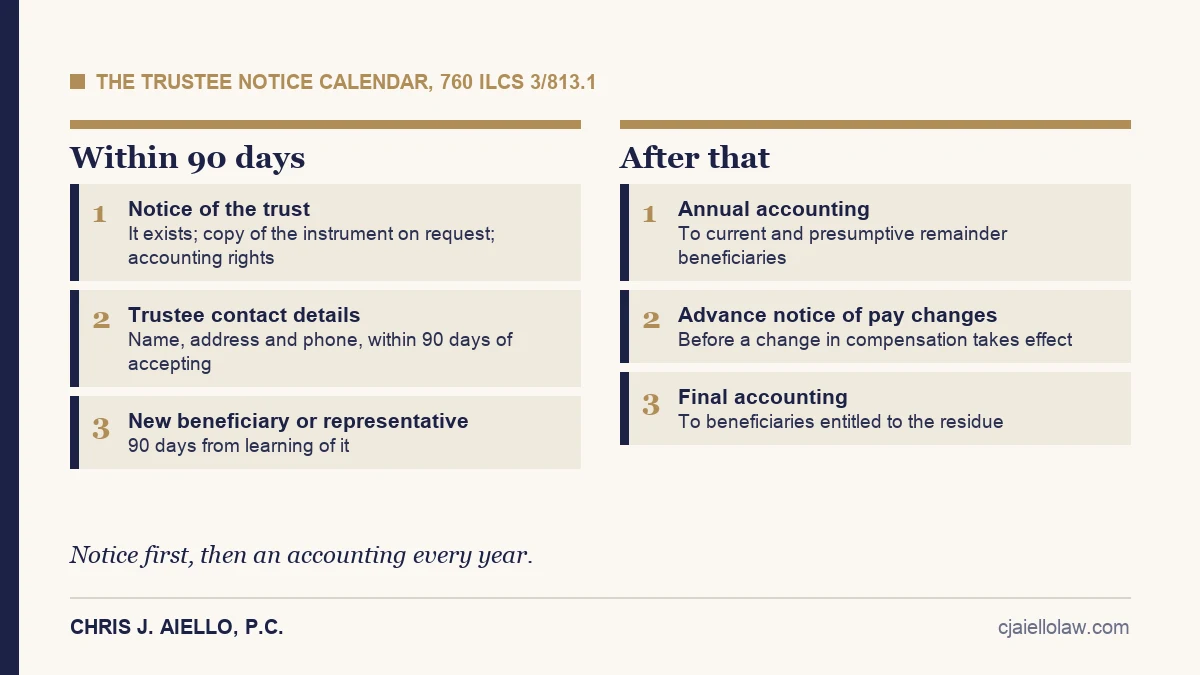
The table puts the duties in 760 ILCS 3/813.1 in the order a trustee meets them. Timing and wording come from the section itself; where it names no deadline, the table says so.
| Trigger | Who is notified | What and when | Section |
|---|---|---|---|
| Trust becomes irrevocable (or the trustee accepts office if no trustee was acting) | Each qualified beneficiary | Within 90 days: the trust exists; the right to request a complete copy of the trust instrument; whether the beneficiary may receive or request accountings | 813.1(b)(1) |
| Accepting the trusteeship | Each qualified beneficiary | Within 90 days: that the trustee accepted, with the trustee's name, address and telephone number (a corporate successor by merger with unchanged contact details has discretion over timing and manner) | 813.1(d)(1)(A) |
| Trustee learns of a new qualified beneficiary, or that a qualified beneficiary gained or lost a representative | The new qualified beneficiary, or the beneficiary or the new representative | Within 90 days of learning it, the same notice described in the first row | 813.1(b)(1) |
| Each year | All current beneficiaries and all presumptive remainder beneficiaries | A trust accounting, at least annually | 813.1(b)(2), (3) |
| Change in the trustee's rate or method of compensation | Each qualified beneficiary | Notice in advance of the change | 813.1(d)(1)(B) |
| Change in the trustee's address, telephone or contact information | Each qualified beneficiary | No later than 90 days after the change takes effect | 813.1(d)(3) |
| Another trustee becomes incapacitated, dies, is disqualified or is removed | Each qualified beneficiary | The trustee who continues acting notifies within 90 days after the event | 813.1(d)(2) |
| The trustee resigns | Each qualified beneficiary | The trustee must notify them of the resignation; the section gives no number of days | 813.1(d)(1)(C) |
| A qualified beneficiary asks for the trust instrument | The requesting qualified beneficiary | Promptly furnish a complete copy, on reasonable request | 813.1(b)(6) |
| The trust terminates | Beneficiaries entitled to the residue | A trust accounting | 813.1(b)(4) |
The section also contains a safe harbor. Under 813.1(b)(7), a trustee is deemed to have fully discharged the duty to inform and account if the trustee gives the required first notice to each qualified beneficiary and the required annual and termination accountings to each beneficiary entitled to one. That is the finish line to work toward.
What the Notice Should Say
The statute lists three things the first notice must cover, and the acceptance notice adds contact details. A short letter can carry all of it. The section does not say the notice must be in writing, but a letter to each qualified beneficiary, with proof of delivery kept, is the practical way to show it was given.
- The name of the trust and the date it became irrevocable, so the beneficiary knows which trust is meant.
- A statement that the trust exists.
- A statement that the beneficiary may request a complete copy of the trust instrument (or, if the instrument so provides, only the portion that sets out the terms in which the beneficiary has an interest).
- A statement of whether the beneficiary has a right to receive or request trust accountings.
- The trustee's name, address and telephone number, and the date the trustee accepted.
- The trustee's signature and the date of the letter.
On delivery, 813.1(h) presumes receipt where the trustee has procedures in place requiring mailing or delivery of notices, and extends that to electronic delivery for as long as the beneficiary has agreed to receive it electronically. Mail by a method that leaves a record, and file a copy of each letter with the trust records.
Accountings and How Often
After the first notices comes the rhythm. A trustee sends a trust accounting at least annually to all current beneficiaries and to all presumptive remainder beneficiaries, and a final one to the beneficiaries entitled to the residue when the trust ends (813.1(b)(2) to (4)). If an asset has no readily available market value, the trustee may decide whether to estimate its value or carry it at a nominal figure, and whether to hire an appraiser (813.1(b)(8)).
Two further points help. When a trusteeship ends, the former trustee sends the accounting, unless a co-trustee remains in office, and a personal representative or guardian may send it for a deceased or incapacitated trustee (813.1(c)). And a trustee may ask a court to approve a current or final accounting, with the reasonable costs paid by the trust (813.1(i)). An executor works from a different set of papers, which the guide to what an Illinois executor owes beneficiaries lays out.
What the Trustee Does Not Have to Announce
The duty is real and it is bounded. Section 813.1(j) says the section does not impose on a trustee a duty to inform any beneficiary in advance of transactions relating to the trust property. A change in the trustee's compensation is a separate duty, noticed in advance under (d)(1)(B). A trustee also need not disclose information that applicable law prohibits disclosing, and where a trustee is bound by confidentiality restrictions on an asset, the beneficiary must agree to the same restrictions before receiving information about it (813.1(f)).
Three more limits are worth knowing. A request under the section has to concern a single trust that is identified well enough for the trustee to find its records (813.1(e)). A trustee may give notice and information to a beneficiary who is not a qualified beneficiary, but is not required to (813.1(b)(5)). And a qualified beneficiary can waive the right to information in a signed writing delivered to the trustee, and can later withdraw the waiver for future accountings (813.1(g)).
The trust itself has less room to change these duties than people expect. Section 105 lists the duties a trust instrument cannot override for trusts that became irrevocable after the Code took effect, including the first notice, the annual accounting to current beneficiaries, the termination accounting and the right to request the portions of the instrument that set out the terms in which the beneficiary has an interest. The annual accounting to presumptive remainder beneficiaries is not on that list, so read the instrument for what it says on that one point.
Older Trusts Follow Older Rules
Section 813.1 is prospective only. By its own terms it applies to trusts that became irrevocable after the Code's effective date (January 1, 2020, per the section's source note) and, subject to Section 603, to revocable trusts, other than where the trustee accepted office before that date. A trust that became irrevocable earlier, or a revocable trust whose trustee accepted office earlier, follows 760 ILCS 3/813.2, which asks for an annual account showing receipts, disbursements and the inventory of the trust estate to the income beneficiaries, and a final account on termination. The 90-day notice in 813.1 is not part of that older section. When the date the trust became irrevocable is unclear, find it before choosing which section applies.
When to Bring in Legal Help
A call is worth making when the list of qualified beneficiaries is uncertain, when a beneficiary is already asking for the instrument, when the 90 days have passed with no notice sent, or when the trust holds assets that are hard to value. If notice was missed, the text of 813.1 reviewed for this guide states no penalty for lateness; the sensible step is to send the notice now with a short explanation and take advice on the rest. Trust administration help in DuPage County can cover reading the instrument, drafting the notices and accountings, and standing with the trustee if a court becomes involved. If the same family also has a court case open, our probate practice in DuPage County works alongside. If you are comparing structures, a will versus a trust in Illinois shows why the two work so differently after death.
Just became a trustee and not sure who gets the notice?
Chris J. Aiello, P.C. has guided DuPage County families through trust administration since 1990. Bring the trust and a list of the people named in it, and we will tell you who to notify, what to send and when.
Schedule a ConsultationSources: 760 ILCS 3/813.1 · 760 ILCS 3/813.2 · 760 ILCS 3/103 · 760 ILCS 3/105 · Illinois Courts · DuPage County Clerk of the Circuit Court
General information about Illinois law, current as of October 2026. This guide describes the Trust Code sections cited; your trust's facts may call for a different route. It is not legal advice and it does not create an attorney-client relationship.