What an Illinois Executor Owes Beneficiaries: Records, Notices and Updates
An Illinois executor owes the people with an interest in the estate three things in writing: notice of the case, copies of the inventory and an accounting, and honest answers to reasonable requests. Under 755 ILCS 5/6-10 the heirs and legatees named in the petition get a copy of the petition and the order within 14 days of the order (with publication if a name or address is missing), under 28-6 any interested person gets the inventory on written request, and under 28-11 an independent representative is accountable to all interested persons for the administration. The sections of the Probate Act reviewed for this guide set no deadline for answering a records request, so the safe course is a dated written reply within a few days, even if it only says what you will send and when. A trust works under a different notice regime, with its own 90-day rule.
Short answer: an Illinois executor owes interested persons notice of the case, the inventory and an accounting, plus prompt, honest answers to reasonable requests. Here is how that plays out. A sibling emails that she wants "everything," a nephew asks for the bank statements, or a legatee wants to know why nothing has been distributed. Executors tend to read these requests as an accusation. They are better read as a test of whether the file is in order. This guide explains what information an executor must give beneficiaries in Illinois, what is usually shared on request, and how to answer so the conversation stays out of court.
It is written for the DuPage County executor on the receiving end of a request, and it sticks to what the Probate Act says. Where the statute says nothing, the guide says so rather than inventing a rule.
Who Counts as an Interested Person
Most of the duties in the Probate Act run to "interested persons." Under 755 ILCS 5/1-2.11, that is anyone with a financial interest, property right or fiduciary status that may be affected by the proceeding, expressly including an heir, a legatee, a creditor, and a person entitled to a spouse's or child's award. A beneficiary named in the will is a legatee. A child or spouse who would inherit if there were no will is an heir. Both are on the list.
Two edge cases come up often. If a trustee of a trust is an interested person, the statute says no notice or accounting goes to the trust's beneficiaries as beneficiaries; the trustee gets it. And if a minor or a person with a disability would be an interested person but a personal fiduciary is acting for them under 28-3, the personal fiduciary is the interested person, although notices to the ward go to both.
What to Hand Over, and When
The Act puts specific papers in the hands of specific people at specific times. The table sorts them into what the statute requires, what an interested person can ask for, and what the statute does not address.
| Request or document | What the Probate Act says | How to respond |
|---|---|---|
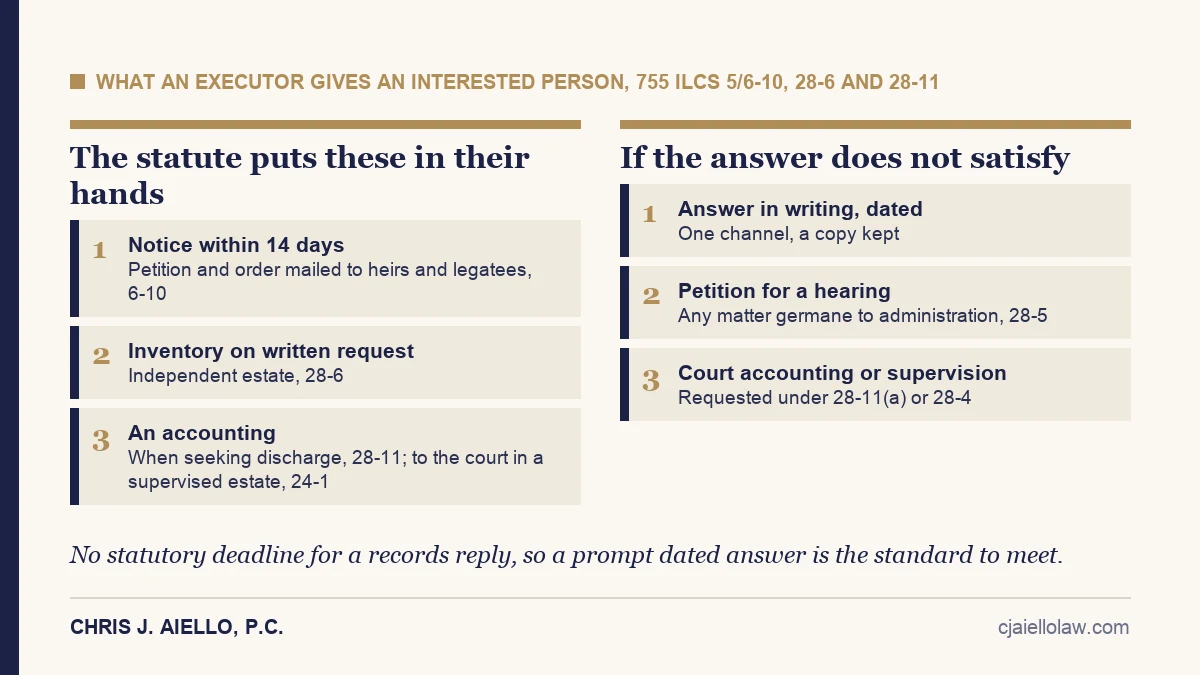
| Notice of the estate and the will | Within 14 days after the order admitting the will and appointing the representative, mail the petition and the order to each heir and legatee whose address is stated in the petition (6-10). In an intestate estate, the administrator mails the petition and order within 14 days to each heir who was not entitled to notice of the hearing (9-5). If a name or address is unknown, publish once a week for three weeks. | Mail it, keep the proof of mailing, and file that proof with the clerk |
| A copy of the will | Whoever holds the will must file it with the clerk right after death (6-1). The notice package under 6-10 is the petition and order; the statute does not say the will itself must be mailed. | Send a copy anyway if asked, or point to the clerk's file. It costs nothing and removes suspicion |
| The inventory | In an independent estate, a copy goes to each interested person at least 30 days before the verified closing report is filed, and sooner to any interested person on written request (28-6). In a supervised estate, a verified inventory is filed with the court within 60 days after letters issue (14-1). | Answer a written request promptly with the inventory as it stands |
| An accounting | An independent representative is accountable to all interested persons and mails or delivers an accounting when seeking discharge (28-11). In a supervised estate, a verified account is presented to the court (24-1). | Provide it when due; offer a status summary sooner if the estate is moving slowly |
| Bank records and receipts | No section reviewed for this guide gives a beneficiary a right to raw bank statements on demand. The accounting is the document that must be backed by evidence, and a court can require that evidence. | Share the accounting and be ready to show the backup if the request is reasonable, or if a court asks |
| Tax filings | Not addressed as a separate duty in the sections reviewed for this guide. The closing report must state that death taxes were determined and paid or otherwise provided for, or that the estate is not subject to them (28-11(b)). | Ask us before sharing returns; a summary of the tax result usually answers the real question |
Read the middle column as a floor, not a ceiling. Nothing stops an executor from sharing more than the statute requires, and an executor who shares the inventory and a plain status update early usually receives fewer demands later.
How to Answer a Records Request
Because the sections of the Act reviewed for this guide set no deadline for answering a records request, the standard you are held to is reasonableness, and a judge deciding whether you were reasonable looks at the file. A few habits make that file look good.
- Reply in writing, dated, within a few days, even if the reply only says what you will send and when.
- Use one channel. Pick email or mail and stay on it, so there is a single thread to point to.
- Send what the statute already requires first: the notice package, then the inventory, then the accounting when it exists.
- Keep a copy of everything sent and a note of the date and the method.
- Keep the tone neutral. An answer that sounds defensive reads worse on paper than the facts do.
If one person keeps asking for the same thing in new words, answer once, fully, and say that the answer stands unless something changes. The dated trail is what you will want later.
What You Can Decline or Route Through the Court
An executor is not obliged to run a private information service. The Act gives a beneficiary a formal route when informal answers do not satisfy: under 28-5, at any time during independent administration an interested person may petition the court for a hearing and order on any matter germane to the administration of the estate. Under 28-11(a), an interested person can also request a court accounting as in supervised administration. And under 28-4 an interested person may petition to terminate independent administration, subject to its exceptions, which move the estate to the supervised track.
That makes the practical line clear. For routine requests, answer them. For a request that is unreasonable in scope, such as every statement for every account the decedent ever held, you can offer the accounting and the supporting records for the estate period and let the court decide what more is owed. Routing a dispute to the court is not a failure; it is how the Act expects disagreements about administration to be settled. If the situation has already reached a petition against you, removing an executor in Illinois describes how that process works.
Executor Duties Are Not Trustee Duties
If the estate also involves a trust, keep the two regimes apart. A trustee operates under the Illinois Trust Code, where 760 ILCS 3/813.1 requires notice to each qualified beneficiary of the trust's existence and of the right to request a copy of the trust instrument, within 90 days in the circumstances the section lists, whether the beneficiary has a right to receive or request trust accountings, and annual accountings to current and presumptive remainder beneficiaries. That is trustee law, not executor law, and it follows different timing. The post-death trust steps are covered on our page for trust administration in DuPage County.
Keeping the File a Court Would Want to See
The best answer to any future dispute is a file that explains itself. Keep the proof of mailing for every notice, the inventory, the dated correspondence with each beneficiary, the estate bank statements, and the receipts for every payment. The full probate administration sequence in Illinois shows when each step comes due, and the executor's role in an Illinois estate covers the day-to-day duties around it.
When to Bring in a Probate Attorney
A call to an attorney is worth making when a request comes from someone who is already angry, when a beneficiary is asking for documents the statute does not clearly cover, or when the first letter from the other side has arrived. Legal guidance for an Illinois executor includes reviewing what you plan to send before you send it, drafting the reply, and presenting the file if the matter goes to court. For earlier questions, a DuPage County probate attorney can step in at any stage.
Got a records request you are not sure how to answer?
Chris J. Aiello, P.C. has guided DuPage County executors through beneficiary questions since 1990. Bring the request and the file and we will tell you what to send and what to hold for the court.
Schedule a ConsultationSources: 755 ILCS 5/6-10 · 755 ILCS 5/9-5 · 755 ILCS 5/6-1 · 755 ILCS 5/1-2.11 · 755 ILCS 5/14-1 · 755 ILCS 5/28-6 · 755 ILCS 5/28-11 · 755 ILCS 5/24-1 · 755 ILCS 5/28-5 · 755 ILCS 5/28-4 · 760 ILCS 3/813.1 · DuPage County Clerk of the Circuit Court · Illinois Courts · Illinois Legal Aid Online: probate
General information about Illinois law, current as of October 2026. This guide describes the Probate Act sections cited; your estate's facts may call for a different route. It is not legal advice and it does not create an attorney-client relationship.