What an Illinois Estate Accounting Has to Show, Line by Line
An estate accounting tells the interested people what came into the estate, what went out, and what is left. Under 755 ILCS 5/24-1 a supervised estate's verified account states the receipts and disbursements since the last accounting and all real and personal estate on hand, backed by whatever evidence of disbursements the court requires. An independent representative owes the same honesty to every interested person under 28-11 but files no accounting with the court unless someone asks for a court accounting, though a verified closing report is filed at discharge. The habit that makes either version easy is the same: one estate bank account, a receipt for every payment, and a running ledger from day one.
Most executors do not think about the accounting until a sibling asks for it or the court sets a date. By then the records are in a shoebox and the bank statements run across two years. Knowing what an estate accounting in Illinois has to include, and what it must be able to prove, lets you keep the books in the right shape from the first week.
This guide is written for the DuPage County executor or administrator who wants to see the finished product before building it. It follows the Probate Act sections that govern accounts, shows a sample layout with made-up round numbers, and says which entries need a voucher.
Who Gets an Accounting, and When
Start with the people entitled to see it. The Probate Act calls them interested persons. Under 755 ILCS 5/1-2.11, an interested person is anyone with a financial interest, property right or fiduciary status that the action may affect, and the definition expressly includes an heir, a legatee, a creditor, a person entitled to a spouse's or child's award, and the representative. When a trustee of a trust is an interested person, the same section says no accounting goes to the trust's beneficiaries in their capacity as beneficiaries; the trustee receives it.
When the accounting is due depends on the type of administration.
- Supervised administration. Section 24-1 requires a verified account within 60 days after the 12 months following the issuance of letters, or within such further time as the court allows, and again whenever the court requires until administration is complete. The court may excuse the account if written consents of all interested persons are filed.
- Independent administration. Under 28-11(a), an independent representative is accountable to all interested persons for the administration and distribution of the estate but need not present an account to the court unless an interested person requests a court accounting as in supervised administration. A representative who wants to be discharged mails or delivers an accounting to all interested persons and files a verified report in court.
So an independent estate can run without a single accounting filed in court, and still owe every heir and legatee an honest picture of the money. The duty to account exists on both tracks; what differs is who receives the paper and when. How long an Illinois probate stays open explains why many estates pass the one-year mark.
The Sections an Accounting Contains, in Order
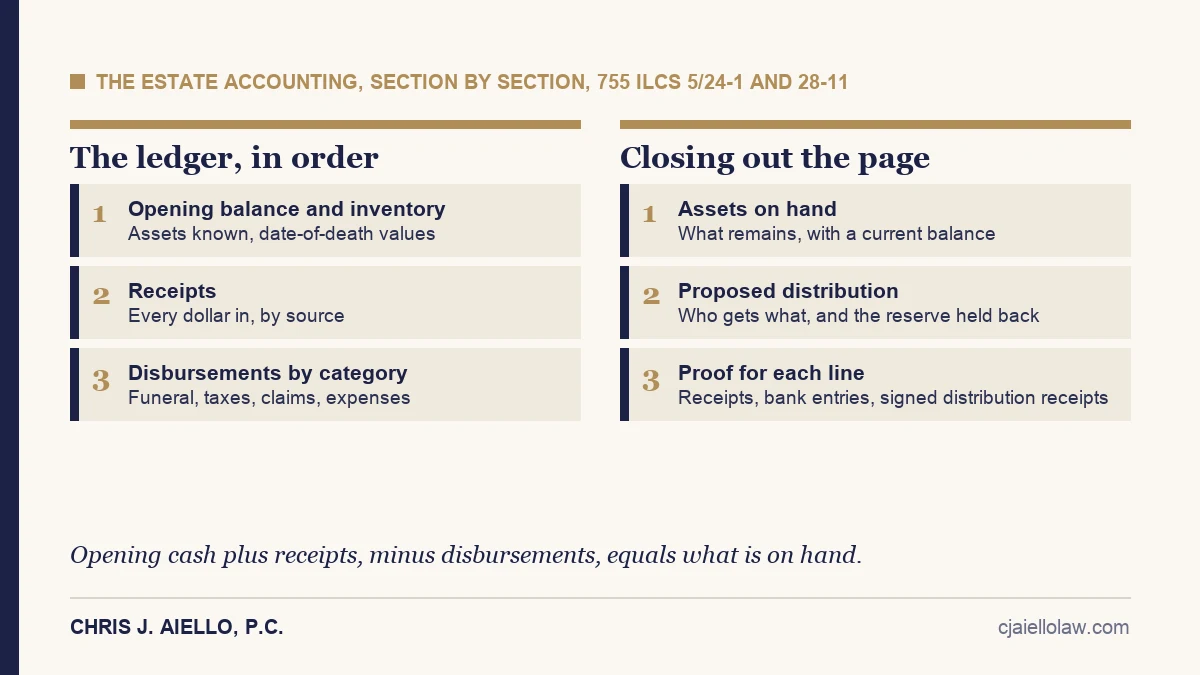
Section 24-1 gives the core requirement in one sentence: the account states the receipts and disbursements of the representative since the last accounting and all real and personal estate on hand, accompanied by the evidence of disbursements the court may require. Everything else is a way of organizing those three things so a reader can follow them. The layout below uses invented round figures, labeled as an illustration only, to show how a clean accounting reads.
| Section | What goes in | Illustration only | What backs it up |
|---|---|---|---|
| 1. Opening balance and inventory | The assets that came to the representative's knowledge, with date-of-death values, and the cash in the estate account at the start of the period | Inventory total $400,000, opening cash $0 | The inventory (14-1 for supervised, 28-6 for independent), date-of-death statements, appraisals |
| 2. Receipts | Every dollar that came in during the period, by source: final wages, refunds, account balances, sale proceeds, rents, interest | $12,000 in refunds and wages, $300,000 from the house sale | Deposit records, closing statement, check copies, payer letters |
| 3. Disbursements by category | Every payment out, grouped: funeral, taxes, claims paid, administration expenses, repairs and upkeep, fees | $9,000 funeral, $14,000 claims, $6,500 expenses | Receipts, invoices, cancelled checks or bank entries, tax payment confirmations |
| 4. Assets on hand | What remains at the end of the period, with the current value or balance | $282,500 cash in the estate account, one vehicle held for transfer | Month-end bank statement, titles, account statements |
| 5. Proposed distribution | Who gets what from the assets on hand, and what is being held back for expenses still to come | Equal thirds of the balance after an $8,000 reserve, to three legatees | The will or the intestate shares, receipts signed by each distributee |
The figures above are not from a real estate. They exist so the arithmetic is visible: opening cash plus receipts, minus disbursements, equals what is on hand, and what is on hand is what gets distributed or reserved. If the totals do not tie out on the page, a beneficiary or a judge will notice before you do.
Which Entries Need a Voucher or a Receipt
The statute leaves the level of proof to the court: the account is accompanied by "such evidence of the disbursements as the court may require." In practice, plan on being able to produce a receipt for any payment a reader might question. A simple rule keeps you safe.
- Pay every estate expense from the estate bank account, never from your own pocket or in cash, so each payment leaves a bank entry.
- Keep the invoice or receipt for each payment and note what it was for on the back or in the ledger.
- Get a signed receipt from every person who receives a distribution, stating the date and the amount.
- Keep the tax payment confirmations and the closing statement for any property that was sold.
- If you paid something personally and are reimbursing yourself, list it as its own line with the original receipt attached.
The estate account matters more than anything else on the list. When estate money passes through an account that also holds personal funds, every entry has to be explained. When it passes through a dedicated estate account, the bank statement is most of the accounting already. What counts as reasonable executor pay covers the one line item that most often draws questions, and it belongs in the disbursements section like any other payment.
Independent and Supervised: What Changes
The contents of the accounting are much the same on both tracks. What changes is the audience and the filing.
- In supervised administration the verified account goes to the court, notice of the hearing goes to unpaid creditors and other interested persons as the court directs, and under 24-2 an approved account binds the persons given notice, absent fraud, accident or mistake. No notice is required to a person who exhibits a receipt in full or waives notice.
- In independent administration the representative sends the accounting to the interested persons and files no accounting with the court unless someone requests one; at discharge, a verified report is filed. The inventory goes to each interested person at least 30 days before the verified closing report is filed, and any interested person is given a copy of the inventory on written request, under 28-6.
Either way, the accounting is not a one-time event. The same ledger feeds the first account in a supervised estate, any later account the court requires, any court accounting an interested person requests, and the accounting that accompanies the closing report. The closing set for an Illinois estate shows where the final accounting fits at the end of the case.
Questions a Beneficiary May Raise, and How to Answer Them
A beneficiary reading an accounting usually asks about three things: a large payment they do not recognize, a difference between the inventory value and the sale price, and the date a distribution will arrive. Calm, specific answers keep the conversation out of court.
- A payment they do not recognize. Point to the invoice and the check. Ask which line they mean, answer in writing, and send the backup if it helps.
- A value that changed. The inventory states values as of the date of death; a later sale price is a receipt, not a correction. Show both numbers and the closing statement.
- A distribution date. Explain what still has to happen first: the creditor claims period, taxes, and the reserve for expenses still to come.
If a question cannot be settled by conversation, the statute gives the interested person a route. Under 28-5, at any time during independent administration an interested person may petition the court for a hearing and order on any matter germane to the administration of the estate, and under 28-4 an interested person may petition to end independent administration, subject to the exceptions in that section. Those are the paths to expect, and an organized ledger is the best protection against needing them. If an accounting question has already hardened into a dispute about your conduct, removing an executor in Illinois explains what that process looks like.
When to Bring in a Probate Attorney
You can keep the ledger yourself. The points where an attorney pays for the time are the verified account itself, which is signed under oath, the decision about what to reserve before a final distribution, and any request from a beneficiary that turns formal. Guidance for an Illinois executor includes preparing the accounting, reviewing the ledger before anyone else sees it, and answering a records request in a way that does not create a new problem. For estates that have been open for months with the books in disarray, a DuPage County probate attorney can step in at any stage and rebuild the record from the bank statements.
Want a second set of eyes on the books?
Chris J. Aiello, P.C. has helped DuPage County executors prepare accountings that hold up since 1990. Bring the bank statements and the inventory and we will tell you what the accounting still needs.
Schedule a ConsultationSources: 755 ILCS 5/24-1 · 755 ILCS 5/24-2 · 755 ILCS 5/28-11 · 755 ILCS 5/28-6 · 755 ILCS 5/28-5 · 755 ILCS 5/28-4 · 755 ILCS 5/1-2.11 · 755 ILCS 5/14-1 · DuPage County Clerk of the Circuit Court · Illinois Courts · Illinois Legal Aid Online: probate
General information about Illinois law, current as of October 2026. The sample figures are an illustration, not a real estate. Your estate's facts may call for a different approach. This guide is not legal advice and it does not create an attorney-client relationship.