Closing an Illinois Estate: The Final Report, the Receipts, and the Order of Discharge
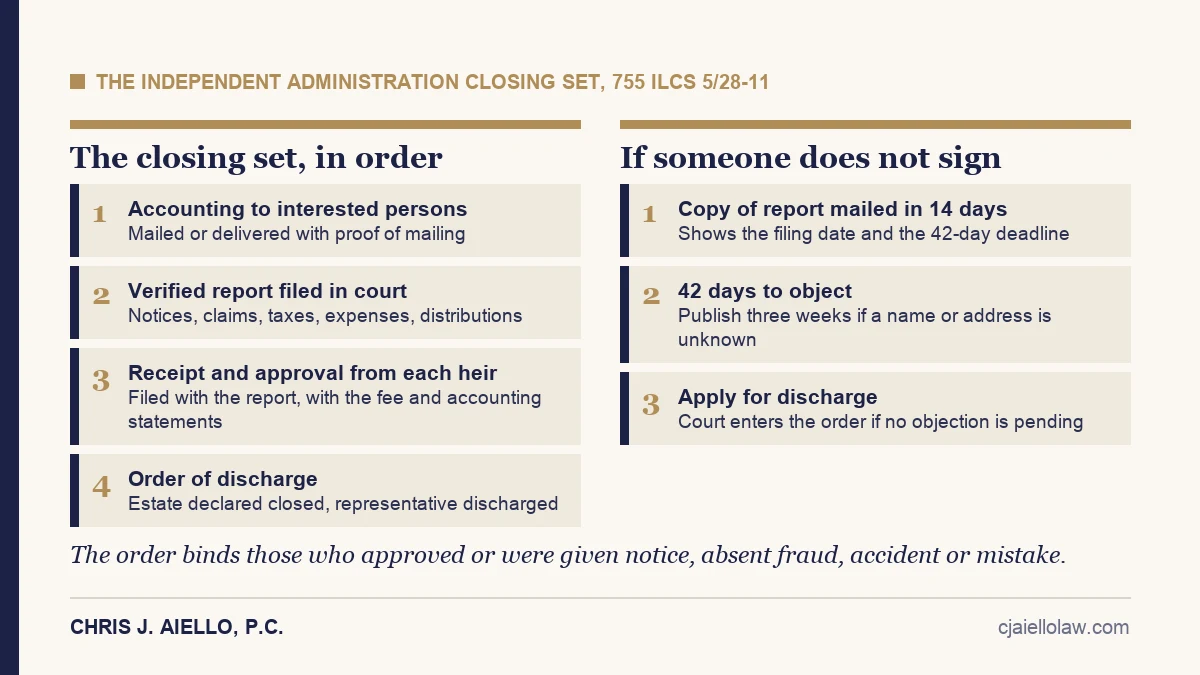
An independent administration closes with four things: an accounting and inventory sent to the interested persons, a verified closing report filed with the court, a signed receipt and approval from each heir or legatee (or a notice period that runs without objection), and an order discharging the representative and declaring the estate closed. Under 755 ILCS 5/28-11 that order binds each person whose receipt or approval was filed or who was given notice, except a ward for whom no personal fiduciary is acting, and absent fraud, accident or mistake. The estate is not ready to close until the creditor claims window has run. A closed estate can be reopened for a newly discovered asset under 5/24-9.
The debts are paid, the house is sold, and the checks have gone out. You may think the work is finished, but in Illinois closing an estate is its own step with its own paperwork, and an executor who skips it stays personally accountable. The court case does not end on a feeling that everything is done. It ends when a judge signs an order discharging the representative.
This guide is for the DuPage County executor or administrator at that last mile. It follows the independent administration closing set, because that is how most Illinois estates run, and it explains who signs what and what the final order does and does not protect.
Check That You Are Ready to Close
Closing too early is the common mistake. Before you prepare any closing paper, confirm four things.
- The creditor claims window has run. Under 755 ILCS 5/18-3 the published notice sets a claim date that is not less than six months after first publication or three months after mailing or delivery of notice to a known creditor, whichever is later. Until that date passes you cannot know the total of what the estate owes. How long an Illinois probate stays open covers the timing.
- Every claim that was filed has been paid, compromised, dismissed or formally disallowed, and where the estate was short, paid in the order the statute sets.
- Taxes are dealt with. The closing report must state that death taxes have been determined and paid or provided for, or that the estate is not subject to them.
- The assets are collected and distributed, and the remaining expenses are paid or provided for.
If a claim is still open or an asset is still being sold, closing now means filing a report that cannot truthfully be signed. The full probate administration sequence in Illinois shows where closing falls in the overall order of work.
The Closing Set, in Order
Section 28-11 sets the closing procedure for an independent representative, and 28-6 adds that a copy of the inventory goes to each interested person at least 30 days before the verified report is filed. In plain terms, the set has four parts, and the table shows who signs each one and what it accomplishes.
| Document | Who signs or sends it | What it does | What you keep |
|---|---|---|---|
| Inventory (at least 30 days before the report, 28-6) and accounting mailed or delivered to interested persons | The representative | Shows receipts, disbursements and what remains, so each person can see what happened to the estate | Proof of mailing or delivery for each recipient |
| Verified report filed with the court | The representative, under oath | States that notices were given, claims were handled, taxes and expenses were paid, and the remaining assets were distributed | The file-stamped report and the date it was filed |
| Receipt and approval from each heir or legatee | Each person receiving a share | Confirms payment or distribution in full, and, where the fees or the size of the estate affect their share, that the fees are approved, an inventory was received and the accounting was approved | The signed originals, filed with the report |
| Order discharging the representative and declaring the estate closed | The judge | Ends the representative's authority and binds the persons who approved or were given notice | A certified copy of the order |
The sections below take them in turn. Ask the DuPage County Clerk of the Circuit Court which forms the Eighteenth Judicial Circuit expects before you draft, because local practice shapes the exact pleadings.
The Final Report and the Accounting Inside It
Under 28-11(b), an independent representative who wants to be discharged mails or delivers an accounting to all interested persons and files a verified report in court. The report states, substantially, that:
- the notices to heirs and legatees, or to heirs in an intestate estate, were given as the Act requires;
- the creditor notice under 18-3 was published, reasonable care was used to identify creditors, and all known creditors were notified;
- copies of an inventory and an accounting were mailed or delivered to the extent required;
- each claim filed was allowed, disallowed, compromised, dismissed or is barred, and the allowed claims were paid in full or, if the estate was short, by priority;
- death taxes were determined and paid or provided for;
- administration expenses and other liabilities were paid and administration was completed, or the report says how any remainder is provided for;
- the remaining assets were distributed to the people entitled to them;
- the fees paid or payable to the representative and the attorney were approved by all interested persons, except as the report indicates; and
- the name and post office address of each person entitled to notice of the filing.
The report is only as good as the records behind it. A representative who kept a running ledger of receipts and disbursements, with the paper for each, writes this in an afternoon. One who kept none rebuilds it from bank statements. The fee approval item connects to how executor fees are set in Illinois, and the report simply records whether the interested persons approved them.
Getting Each Distributee's Receipt and Approval
A signed receipt does real work. Under 28-11(c), notice of the filing of the report does not have to go to heirs and legatees whose signed receipts for payment or distribution in full are filed with the report. The same is true of creditors whose written approvals are filed or whose claims were paid according to the statutory priority or a compromise the creditor agreed to. If no one needs notice, 28-11(d) says the court shall enter an order discharging the representative and declaring the estate closed.
There is a catch in the wording. A receipt from a person whose share is affected by the fees must also state that the fees are approved. A receipt from a person whose distribution is affected by the size of the estate must also state that an inventory was received and an accounting approved. A bare "received $50,000" receipt does not carry those statements, so the receipt form matters. Where a trustee of a trust is an interested person, the trust's beneficiaries do not need separate notice.
What if one person will not sign? The estate can still close, by the longer route in 28-11(e). Within 14 days after filing the report, the representative mails a copy to each person entitled to notice who has not waived it, with the filing date and a statement that if no objection is filed within 42 days the representative will be discharged and the estate closed. If a person's name or address is not stated in the report, or the estate was opened on a presumption of death, the representative publishes a notice once a week for three successive weeks in a newspaper in the county where the letters issued, with the first publication within 14 days of filing.
After the 42 days pass, the representative applies for discharge. With no objection pending, the court shall enter the order. If an objection is pending, the court orders notice to all interested persons and may require a verified account of the administration. Under 28-5 any interested person can also petition the court at any time during independent administration for a hearing on any matter germane to it, so a beneficiary who disagrees has a way to be heard before the estate closes.
The Order of Discharge: What It Ends and What It Does Not
The order has two effects. It ends the representative's authority, and it binds the people who approved or were given notice, which is what protects a representative who followed the process. Under 28-11(f), in the absence of fraud, accident or mistake, an order discharging the independent representative and declaring the estate closed is binding on each person whose receipt or approval was filed with the report and on each person who was given notice as required by subsection (e). The one exception named in the statute is a ward for whom no personal fiduciary is acting.
Read what that sentence does not say. A person who neither signed nor received proper notice is not bound. A closing built on a report that was false, or on a mistake about what the estate held, can be challenged under the fraud, accident or mistake language. And the binding effect is tied to notice having been given as the statute requires, so an executor who skipped a notice cannot count on the order to protect against the person who was left out. That is why the mailing proofs and the publication proof are worth keeping for years.
Two further points are worth knowing. First, independent administration is not the only track. In supervised administration, 755 ILCS 5/24-1 requires a verified account presented to the court, though the court may excuse the account when all interested persons file written consents. Second, an independent estate can be moved to the supervised track: under 28-4, an interested person may petition to terminate independent administration. Two exceptions apply: where the will directs independent administration, termination requires good cause, and where the petitioner is a creditor or a legatee other than a residuary legatee, it requires that termination be necessary to protect the petitioner's interest. After an order of termination the representative is governed by the supervised provisions.
If an Asset Turns Up After Closing
An account, a refund or a piece of property can surface after discharge. Section 24-9 allows a closed estate to be reopened to administer a newly discovered asset or an unsettled portion of the estate, on the petition of any interested person. If the petition asks for the former representative or a successor designated by the will, the court may order such notice as it directs or hear the petition without notice. If it asks for a different representative, notice must be given as the court directs to the former representative and to everyone entitled to administer, or to nominate someone to administer, equally with or ahead of the petitioner. On the hearing the court may vacate the order of discharge or issue letters of office as the case requires, and a new bond based on the value of the newly discovered asset or the unsettled portion must be furnished.
The practical lesson is to search before you close. Check for unclaimed property, final refunds, an old retirement account in the decedent's name alone, and anything that arrived by mail after the date of death. An asset titled to the decedent that surfaces later is exactly what 24-9 is for, and reopening costs time and a new bond that a thorough search could have spared you.
When to Bring in a Probate Attorney
The closing set is the part of the estate where a small error does the most lasting damage, because the order of discharge is only as strong as the receipts and notices behind it. Support for an executor closing an estate means drafting the report, preparing receipts that carry the statutory statements, running the 42-day notice period when someone will not sign, and presenting the order. For the work that comes before closing, a DuPage County probate attorney can step in at any stage, including when the estate has been open for months and the file needs organizing.
Ready to close an Illinois estate?
Chris J. Aiello, P.C. has taken DuPage County estates from letters to discharge since 1990: the closing report, the receipts, the notices and the order. Bring the account statements and the file and we will tell you what is left before the estate can close.
Schedule a ConsultationSources: 755 ILCS 5/28-11 · 755 ILCS 5/28-6 · 755 ILCS 5/28-5 · 755 ILCS 5/28-4 · 755 ILCS 5/24-1 · 755 ILCS 5/24-9 · 755 ILCS 5/18-3 · DuPage County Clerk of the Circuit Court · Illinois Courts eFileIL · Illinois Legal Aid Online: probate
General information about Illinois law, current as of October 2026. This guide describes independent administration; your estate's facts may call for a different route. It is not legal advice and it does not create an attorney-client relationship.