The House Was Never Put in the Trust: What an Illinois Family Does Next
An asset that was never retitled into the trust usually does not follow the trust. It follows the will, or the intestacy rules if there is no will. If the will is a pour-over will, it can direct the asset to the trustee (755 ILCS 5/4-4), but a house in the parent's sole name normally has to be handled through probate first. A small estate affidavit (755 ILCS 5/25-1) reaches personal property up to $150,000, excluding registered vehicles, and never a house. Confirm what is in the parent's name alone, file the will, pick the route, and leave the asset untouched until you have.
Short answer: when a parent dies with a trust but the deed, the brokerage account or the bank account was never changed into the trust's name, that asset not in trust after death in Illinois is treated as the parent's own property. Unless the paperwork shows otherwise, the trust does not own it on the day of death, so the trustee cannot simply act on it. The sibling named as trustee usually learns this at the worst moment, standing in front of a deed that still carries only the parent's name.
This guide is for that trustee or adult child. It lays out how to confirm the asset is outside the trust, which route applies, what a pour-over will can and cannot do, and what to leave alone until the route is chosen. It sticks to what the Probate Act says and flags anything the sections reviewed leave open.
How to Confirm the House Really Is Outside the Trust
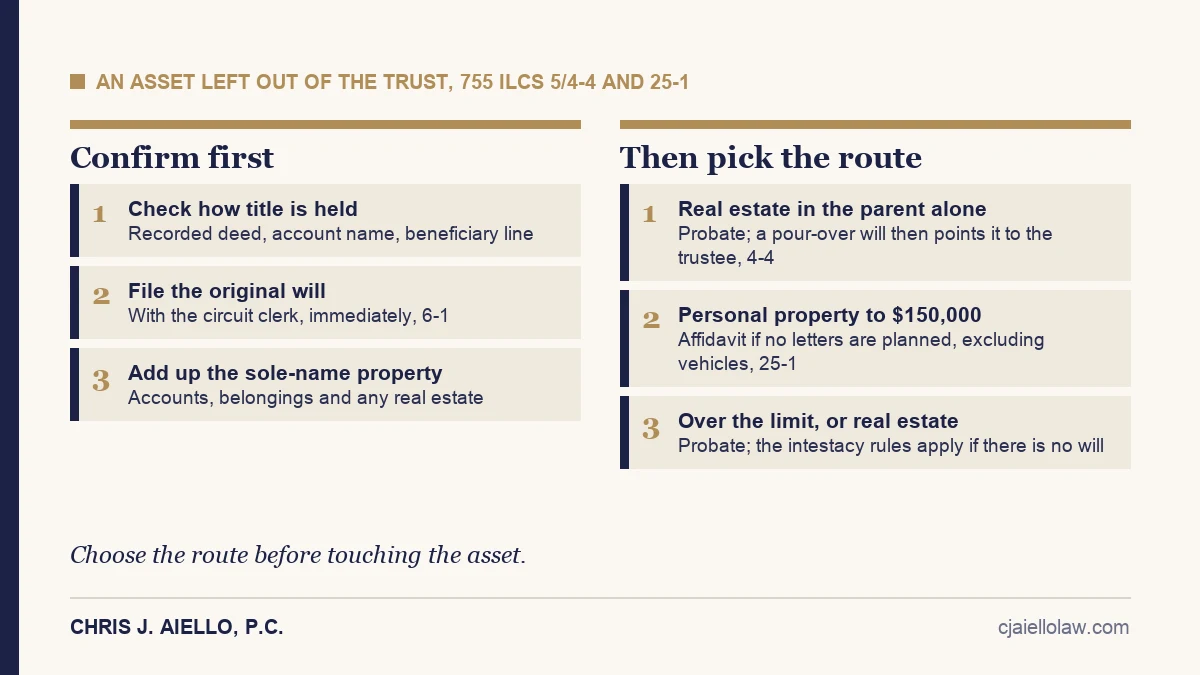
Do not assume from the trust document alone. A trust can list a house on a schedule of assets and still never own it, because a schedule is a list, and title is what the county records and the financial institutions show. Three checks usually settle the question.
- Title. Get a copy of the recorded deed from the county recorder's office. If the owner shown is the parent (alone, or the parent and a spouse who has also died), and not the trustee of the trust, the house is outside the trust.
- Account paperwork. For each bank or brokerage account, look at the name on the statement and the beneficiary or payable-on-death line. An account titled to the trustee is in the trust. An account titled to the parent alone, with no named beneficiary, is not.
- The assignment pages. Some trust packets include a general assignment of personal property. Read it with the trust. A declaration by the owner that the owner holds identifiable property as trustee can create a trust (760 ILCS 3/401(2)), so whether a schedule or an assignment reaches a particular house is a question for the attorney, not something to assume either way.
Property with a named beneficiary, a joint owner or a recorded transfer on death instrument passes by that document and is a separate subject. Our guide to what assets go through probate in Illinois sorts those from the ones that need a court.
Which Route Applies to Which Asset
Once you know what sits in the parent's name alone, the route follows the asset, its value and whether there is a will. The table is the working version. Each row stays conditional because the facts of one estate can change the answer.
| What was left out | Likely route | What to expect |
|---|---|---|
| A house or land titled in the parent's name alone | Probate. With a pour-over will, the court-admitted will then points the property to the trustee. | A petition to admit the will and appoint an executor, then letters of office. An affidavit cannot move real estate. |
| A bank or brokerage account in the parent's name alone, no beneficiary | Affidavit if all personal property is within the limit and no letters are outstanding or planned; otherwise probate. | The institution decides whether it accepts the affidavit. The person signing it takes on personal responsibility for debts. |
| Household items and other personal belongings of modest value | Usually counted toward the same affidavit limit as the accounts. | Add everything in the parent's name before you decide the route. |
| Personal property that pushes the total over $150,000, excluding registered vehicles | Probate | The affidavit route is closed for the whole estate, not just the excess. |
| Real estate, or personal property over the limit, when there is no will | Probate under the intestacy rules | There is no pour-over will to send the asset to the trust, so the heirs named by statute take it. |
If the same parent also had assets that were titled correctly, those stay with the trustee and follow the trust. The trust document governs them, and a trustee in that position also has notice and accounting duties to the beneficiaries.
What a Pour-Over Will Does, and What It Does Not
A pour-over will is a short will that leaves everything the parent owned at death to the trustee of a trust. Section 4-4 of the Probate Act allows it. A testator may leave real and personal estate to the trustee of a trust that was in existence when the will was made and that the will identifies, and the estate then follows the terms of the trust instrument, including later written amendments unless the will says otherwise. The section adds that the existence, size or character of the trust's assets does not matter to the validity of the gift. That last sentence is why an empty or nearly empty trust can still receive a pour-over.
What the section does not do is move title by itself. The will has to be filed and admitted first. Under 755 ILCS 5/6-1, anyone holding the original will must file it with the clerk of the court in the proper county immediately upon the testator's death, and the section makes willfully hiding a will for 30 days after the death is known to the person a Class 3 felony. Under 755 ILCS 5/6-4, a will is admitted to probate on proof of its execution, ordinarily the statements of the two attesting witnesses. So the practical order is: file the will, open the estate, receive letters of office, and then the property passes to the trustee under the will. Letters of office are what the court issues to the executor so that someone has authority to act.
Two limits are worth saying plainly. The pour-over does not avoid probate for the asset it catches, because the will is the thing that sends it. And the sections reviewed do not give a trustee a way to claim sole-name real estate without a court process. If you were told one exists, ask the attorney to show you the authority.
When an Affidavit Can Do the Job
Some estates are small enough to skip probate for the personal property. Section 25-1 lets a person holding a decedent's personal estate release it on a sworn small estate affidavit when no letters of office are outstanding, no petition for letters is contemplated or pending, and the decedent's personal estate passing under a will or by intestacy does not exceed $150,000, not counting motor vehicles registered with the Secretary of State. The statute speaks of personal estate, which is why a house never fits.
That personal exposure is the part families miss. Our small estate affidavit guide walks through who qualifies and the payment order. If there is a trust and a pour-over will, the question to ask before using an affidavit is whether the total, counting everything in the parent's name, is under the limit and whether any of it is real estate. If real estate is in the mix, probate is already needed, and splitting the personal property off may gain little.
What the Successor Trustee Should Not Do Yet
The urge to fix this fast is strong, and it is where families create problems. Until the route is chosen, hold off on the following.
- Do not sign a new deed, a listing agreement or a sales contract for the house. Nobody yet has the authority to sell it.
- Do not move accounts, close them or write checks on them. The parent's signature authority ended at death.
- Do not give away, sell or clear out the contents before the family agrees on a list and a value.
- Do not tell anyone the trust "covers" the asset. If it turns out not to, that statement becomes the thing people remember.
Some things cannot wait. Keep the house insured, keep the taxes and the mortgage current if there is one, and secure the property. Once an executor holds letters, 755 ILCS 5/20-1 directs the representative to take possession of the decedent's real estate during administration, to pay taxes, mortgages and other liens, and to keep the buildings in tenantable repair, and it allows insurance. A home occupied by an heir or legatee as a residence is generally left out unless the will or the court provides otherwise. Until then, someone in the family needs to cover those costs and keep receipts.
Documents to Gather Before the First Call
A first meeting goes much further with paper in hand. Bring what you can find of the following.
- The trust document and any amendments, and the original signed will if you hold it.
- The recorded deed, or the property tax bill if you cannot find it.
- The latest statement for every bank, brokerage and retirement account, with any beneficiary forms.
- Certified copies of the death certificate.
- The mortgage statement, the homeowner policy and any known debts.
- A list of the people named in the trust and the people who would inherit if there were no will.
If the parent set up a trust but the house was never retitled, the lesson for the next family is about funding the trust during life, and our living trust guide covers that side.
When to Bring in Legal Help
Call before anything is signed or listed if a house is involved, if the trust and the will do not point the same way, if the total of the parent's sole-name property is near the affidavit limit, or if a beneficiary is already pressing for a distribution. Help settling a trust in Illinois can include reading the trust against the will, working out which assets are in and which are out, and handling the court filings when probate is needed. Our probate practice handles the court side. If the parent had a recorded transfer on death instrument for the house, read how a TODI works in Illinois first, because it may have moved the house already.
Found a deed that was never put in the trust?
Chris J. Aiello, P.C. has guided DuPage County families through trusts and probate since 1990. Bring the trust, the will and the deed, and we will tell you which route applies and what to do first.
Schedule a ConsultationSources: 755 ILCS 5/4-4 · 755 ILCS 5/6-1 · 755 ILCS 5/6-4 · 755 ILCS 5/20-1 · 755 ILCS 5/25-1 · 760 ILCS 3/401 · Illinois Courts · DuPage County Clerk of the Circuit Court
General information about Illinois law, current as of November 2026. This guide describes the Probate Act sections cited; your family's facts may call for a different route. It is not legal advice and it does not create an attorney-client relationship.