TODI in Illinois: How a Transfer on Death Instrument Works, and What Breaks It
A TODI is a recorded document that moves Illinois real estate to a named beneficiary at your death without probate, under the Real Property Transfer on Death Instrument Act, 755 ILCS 27. Since Public Act 102-68 took effect on January 1, 2022, it covers all Illinois real property, not just residential. It has to be signed by the owner, attested by two credible witnesses, acknowledged before a notary, and recorded with the county recorder before the owner dies. Miss the recording and it does nothing at all. Revocation only counts if the revoking document is itself recorded, and an agent under a power of attorney cannot sign or revoke one for you.
The transfer on death instrument is the quietest tool in Illinois estate planning. For a DuPage County homeowner whose only real asset is the house, a TODI keeps the largest item in the estate out of court, at a fraction of what a trust costs to set up and fund. It is also the tool we most often see done wrong, because the forms are freely available and the failure modes stay invisible until the owner has died and nobody can fix them. This guide covers what the statute requires, what the DuPage recording step looks like, and the five ways a TODI falls apart.
Know What a TODI Is Under Illinois Law
The Act was originally the Residential Real Property Transfer on Death Instrument Act, effective January 1, 2012. Public Act 102-68 broadened it and renamed it. The short title on the books today is the Real Property Transfer on Death Instrument Act, and Section 10 sets the reach: residential transfers for owners dying on or after January 1, 2012, and any real property for owners dying on or after January 1, 2022. Farmland, a rental duplex in Lombard, a small commercial building, all eligible now.
Three features define how it behaves. It is revocable no matter what the document says (755 ILCS 27/25). It is nontestamentary, so it cannot be admitted to probate as a will or a codicil (27/30). And it is effective without notice to, delivery to, acceptance by, or consideration from the beneficiary (27/50), which means you can name your daughter and never mention it to her.
One more line gets skipped: Section 95 says a TODI or its revocation shall be prepared only by a licensed attorney, then adds that an owner may prepare his or her own and that a document is not void for failing to be attorney-prepared. That is the legislature calling this legal work while leaving a do-it-yourself door open. The door is where most failures come from.
Get the Execution Right: Owner, Two Witnesses, Notary
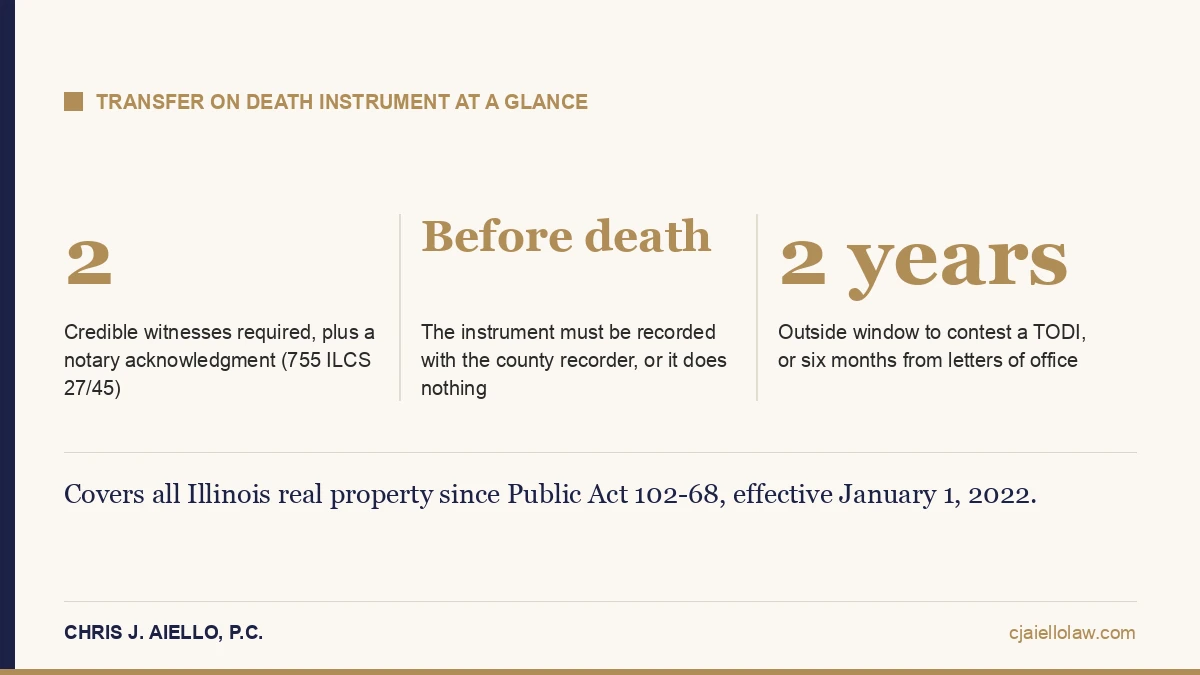
Section 45 is unusually specific. The instrument must be signed by the owner, or by someone in the owner's presence and at the owner's direction. It must be attested in writing by two or more credible witnesses. The signatures of the witnesses along with the owner's signature must be acknowledged in front of a notary public.
That is a will-style execution, not a deed-style one, and it catches people who assume a notary alone is enough because that is all a normal Illinois deed needs. Section 35 adds the capacity rule: the capacity required to make or revoke a TODI is the same as the capacity required to make a will. It also states flatly that an agent under a durable power of attorney does not have authority to create or revoke a TODI on the owner's behalf, even if the power of attorney purports to grant it.
Record It With the DuPage County Recorder Before Death, or It Does Nothing
Section 40 requires that the instrument be recorded before the owner's death in the office of the recorder of the county where the property sits. This is the requirement that fails most often, and it fails silently. A perfectly executed TODI sitting in a desk drawer transfers nothing.
For DuPage County property, that means the DuPage County Recorder at 421 N. County Farm Road in Wheaton, open 8 a.m. to 4:30 p.m. Monday through Friday. The county's published fee schedule lists deeds at $86.00 as of this writing, and fees change, so confirm on the recorder's own page before you go. If the property straddles a county line, or the owner holds parcels in more than one county, the instrument gets recorded in each county where any part of the real property is located.
Use This Checklist Before You Record
| Requirement | Statute | What goes wrong when it is missed |
|---|---|---|
| Contains the essential elements of a recordable deed and states the transfer occurs at the owner's death | 755 ILCS 27/40(a)(1)-(2) | Recorder rejects it, or a title company refuses to insure the beneficiary later |
| Signed by the owner and attested by two or more credible witnesses | 27/45 | Invalid execution; the property falls back into the probate estate |
| All signatures acknowledged before a notary | 27/45 | Same as above, and the most common defect in self-prepared forms |
| Recorded in the correct county before the owner's death | 27/40(a)(3) | The instrument is ineffective, full stop, no matter how well it was drafted |
| Contingent beneficiary named in case the first one dies first | 27/65(a)(3) | With a single beneficiary who predeceases, the property passes to the owner's estate and back into probate |
| Prepared by a licensed attorney or by the owner personally | 27/95 | A TODI prepared by a non-attorney third party invites a challenge |
Five Things That Break a TODI
The beneficiary dies first and there is no backup. Under 27/65(a)(3), if the owner named one beneficiary and that person does not survive, the real property passes to the owner's estate. Probate, which the whole document existed to avoid. There is one saving rule: if the deceased beneficiary was a descendant of the owner, that person's own descendants take the share per stirpes under 27/65(a)(5). Naming a stranger or a sibling gets no such protection.
Someone tries to revoke it informally. Section 55 is titled, in part, revocation by act or unrecorded instrument, not authorized. Tearing up the copy does nothing. A later will saying the house goes to someone else does nothing. Revocation requires either another TODI or an express instrument of revocation, executed with the same formalities and recorded before death.
Joint owners misunderstand what happens on the first death. Section 70 handles joint ownership, and the answer depends on whether all of the joint owners signed. Where all of them execute the instrument, it is revocable by the last surviving joint owner regardless of any contrary agreement between them. Couples who assume the first death locks the arrangement in place are frequently wrong.
Creditors arrive. Under 27/85, a TODI beneficiary is subject to creditor, administrative, funeral and burial, and statutory claims to the same extent as the beneficiary of a trust that was revocable at the settlor's death. The house is not shielded. Where more than one property passes by TODI, liability is apportioned in proportion to the net values.
Someone contests it. Section 90 gives a two-year outside window: an action to set aside or contest a TODI must be commenced within the earlier of two years after the owner's death or six months from the date letters of office are issued in a probate case. A bona fide purchaser or mortgagee for value who buys before a lis pendens is recorded takes free and clear.
Understand What a TODI Does Not Do
It does nothing for incapacity. A TODI operates only at death, so if the owner needs someone to sell or refinance the house during a long illness, that requires a power of attorney or a trust. It does not clear the mortgage: under 27/65(b) the beneficiary takes subject to every conveyance, encumbrance, mortgage, lien, and option the property was subject to at the owner's death. It carries no warranty of title, even if the document says otherwise (27/65(c)). And where two or more beneficiaries take concurrent interests, they hold in equal undivided shares with no right of survivorship (27/65(a)(2)), which is how three siblings end up co-owning a house none of them agrees on selling.
For everything a TODI cannot reach, the rest of the estate still needs a plan. A TODI moves one asset. Bank accounts, vehicles, and personal property are not covered, and if those total under the small estate limit there is a simpler route, which our guide to the Illinois small estate affidavit walks through. For the wider menu of options, see how to avoid probate in Illinois.
After Death: the Notice of Death Affidavit
When the owner dies, the beneficiary does not automatically appear on the county's records. Section 75 lets any beneficiary taking under a TODI file a notice of death affidavit with the recorder in the county where the property is located, confirming title after death. It has to include each beneficiary's name and address if known, the legal description, the street address and parcel identification number if known, and the date and recording document number of the TODI.
That affidavit is what a title company looks for when the beneficiary sells or refinances. Filing it promptly is cheap. Reconstructing the chain years later, after the beneficiary has also died, is not.
Our honest take: a TODI is the right tool for a narrow case, and a bad fit for most of the rest. If you own one Illinois property, you know exactly who should get it, there is a clear backup beneficiary, and the rest of your estate is small, it is hard to beat. If you have minor beneficiaries, a blended family, property in several states, a beneficiary with creditor or divorce problems, or a real chance of a contest, a trust does the work a TODI cannot. We have seen more than one family spend far more untangling a homemade TODI than a proper plan would have cost.
Recording a TODI keeps the house out of probate, but it does not keep it out of the taxable estate. Illinois still counts the property at its date of death value when the return is prepared, which surprises families who assumed the deed settled everything. If the estate is anywhere near the state threshold, read how Illinois taxes an estate at death before treating the TODI as the whole plan.
Deciding between a TODI and a trust for your DuPage property?
Chris J. Aiello, P.C. has handled real estate and estate matters for Villa Park and DuPage County families since 1990. Talk with an estate planning attorney serving Villa Park and DuPage County and we will tell you plainly which one your situation calls for.
Schedule a ConsultationRelated reading: living trusts in Illinois, our side-by-side on a will versus a trust, and our revocable and irrevocable trust services in Villa Park.
Sources: 755 ILCS 27/1 · 755 ILCS 27/10 · 755 ILCS 27/35 · 755 ILCS 27/40 · 755 ILCS 27/45 · 755 ILCS 27/55 · 755 ILCS 27/65 · 755 ILCS 27/75 · 755 ILCS 27/90 · DuPage County Recorder fee schedule · Illinois Legal Aid Online: TODI basics