Illinois Inheritance Tax: What Heirs Actually Pay
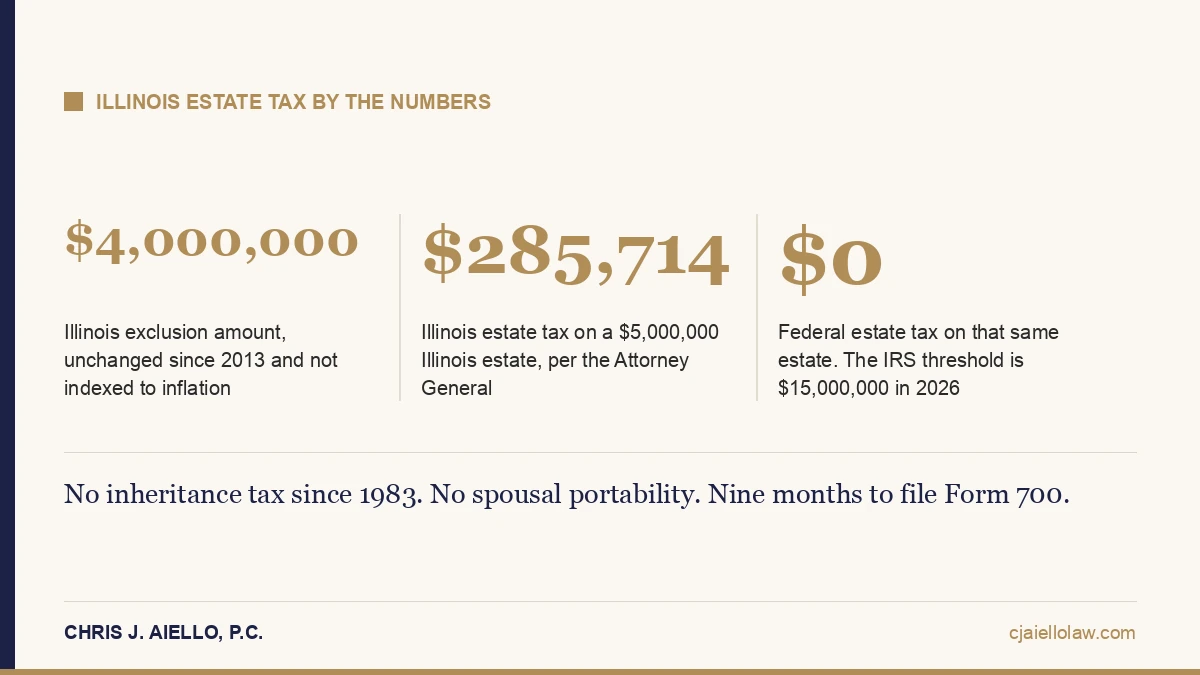
Illinois has no inheritance tax. The old one was repealed for people who died on or after January 1, 1983, and an heir writes no check to the State of Illinois for the inheritance itself. What Illinois does have is an estate tax, paid by the estate before anything reaches the beneficiaries, and it starts once the gross estate passes $4,000,000 (35 ILCS 405/2). That threshold has not moved since 2013, it is not indexed to inflation, and Illinois does not let a widow or widower carry over a spouse's unused exemption the way the federal system does. On the Attorney General's own numbers, a $5,000,000 Illinois estate owes $285,714 to Illinois and $0 to the IRS.
Almost every call we get about the Illinois inheritance tax starts from a wrong premise. A DuPage County family hears that a relative's estate is "worth about five million," someone at the funeral mentions a death tax, and the beneficiaries start doing arithmetic on what they are personally going to lose. The short answer is that heirs in Illinois owe nothing to the state on an inheritance. The longer answer is that the estate itself might owe a great deal, and because the estate pays first, the check still comes out of what the beneficiaries were going to receive. Here is how the math really runs, with the statute and the Attorney General's published figures behind every number.
The Illinois Inheritance Tax Was Repealed in 1983. The Estate Tax Was Not.
Two different taxes get confused constantly, so start by separating them. An inheritance tax is charged to the person receiving property, and the rate usually depends on how closely related that person was to the decedent. An estate tax is charged to the estate as a whole, before distribution, and the relationship of the heirs is irrelevant to the calculation.
Illinois abandoned the first model decades ago. The Attorney General's office still notes that an Illinois Inheritance Tax Release may be needed only for a decedent who died before January 1, 1983. For every death since, there is no Illinois inheritance tax at all.
What survived is the Illinois Estate and Generation-Skipping Transfer Tax Act, 35 ILCS 405. It is administered by the Attorney General rather than the Department of Revenue, the return is Form 700, and the money is paid to the Illinois State Treasurer. If you are an heir, the practical consequence is simple: nobody is going to send you a bill, but the executor may be sending a large one out of assets you were counting on.
The Illinois Estate Tax Exemption Is $4,000,000, and It Has Not Moved Since 2013
Section 2 of the Act sets the exclusion amount at $4,000,000 for anyone dying on or after January 1, 2013. That section was last amended in 2012. Bills to raise it get filed most sessions and none of them has become law, so ignore any article that quotes you a higher Illinois figure. The Attorney General's current instruction fact sheet states it plainly: the exclusion amount for Illinois estate tax purposes is $4,000,000, and it is a taxable threshold, not a credit against tax.
Two details in that sentence do most of the damage in real cases. First, the test is the gross estate after adding back adjusted taxable gifts, not the net figure the family thinks of as the inheritance. Life insurance the decedent owned, retirement accounts, and the full value of DuPage real estate all count, and a paid-off house in Elmhurst or Oak Brook plus a decent retirement account clears $4,000,000 more often than people expect. Second, the federal exemption is far higher. The IRS filing threshold is $15,000,000 for deaths in 2026. An estate can be completely invisible to the IRS and still owe Illinois six figures.
Run Your Number Through the Attorney General's Own Examples
These are not our estimates. They are the computation examples published in the state's estate tax instruction fact sheet, which is the same document the Attorney General's Estate Tax Section works from.
| Estate value (all Illinois property) | Illinois estate tax | Federal estate tax | What the heir owes the state |
|---|---|---|---|
| $2,000,000 | $0 | $0 | Nothing |
| $3,000,000 | $0 | $0 | Nothing |
| $3,000,100 plus $1,000,000 in adjusted taxable gifts | $28 | $0 | Nothing |
| $4,000,000 | $0 | $0 | Nothing |
| $5,000,000 | $285,714 | $0 | Nothing directly, but the estate shrinks by $285,714 before distribution |
| $5,000,000, half in Illinois and half in Florida | $142,857 | $0 | Nothing directly, tax apportioned by the Illinois share |
| $13,610,000 with a surviving spouse and an Illinois QTIP election of $9,610,000 | $0 | $0 | Nothing |
Read the last two rows twice. Where the assets sit and what elections get made on a timely return change the answer by hundreds of thousands of dollars on identical estate values.
The Cliff Is Real: One Million Over the Line Costs $285,714
An estate at exactly $4,000,000 owes zero. An estate at $5,000,000 owes $285,714. That is roughly 28.6 cents on every dollar of the excess, which is far steeper than most families brace for, and the reason is structural. Illinois calculates its tax through an interrelated computation tied to the pre-2001 federal state death tax credit table, so the rate ramps quickly once the threshold is crossed rather than easing in.
The planning implication is blunt. A married DuPage couple with $4,500,000 between them has a real Illinois problem and no federal one whatsoever. Charitable gifts, lifetime gifting, and the way title is held all move that number, and every one of those moves has to happen while both spouses are alive. Once a death occurs, the options narrow to elections on the return. If you are anywhere near the line, this is the conversation to have with an estate tax planning attorney in Villa Park before it becomes an executor's problem.
Illinois Killed Portability, So Married Couples Need the QTIP Election
Federal law lets a surviving spouse carry over the unused portion of a deceased spouse's exemption. Illinois does not. The Attorney General's fact sheet says it in one line: portability and carry-over of the unused federal exemption to the surviving spouse is inapplicable to the Illinois estate tax.
What Illinois offers instead is a separate Illinois QTIP election under 35 ILCS 405/2(b-1). The estate can elect qualified terminable interest property treatment on a timely filed Illinois return, independent of any federal election, which is how that $13,610,000 example in the table produces zero tax. It is a powerful tool and it has one hard condition attached: the election must be made on a timely filed Form 700, with the box checked and the dollar amount and the surviving spouse's Social Security number filled in. Miss the return, miss the election.
This is also why the old advice about titling everything jointly so it passes automatically can backfire on a larger estate. Joint titling keeps assets out of court, and our guide to avoiding probate in Illinois covers when that makes sense, but avoiding probate is not the same thing as avoiding the Illinois estate tax. A trust structure exists partly to capture both spouses' exemptions, which is one of the practical reasons we walk families through how a living trust is set up in Illinois rather than treating it as an upsell.
What an Heir Personally Owes After the Estate Pays
Once the estate has settled its own tax, most beneficiaries owe nothing further. Illinois does not tax the receipt of an inheritance, and inherited cash or property is generally not treated as taxable income on a federal return either. Three exceptions catch people out.
- Inherited traditional retirement accounts. Money coming out of an inherited IRA or 401(k) is taxable income to the beneficiary when it is withdrawn, because it was never taxed going in. This is the single most common surprise.
- Income the estate earns after the date of death. Rent, dividends, and interest generated during administration are income, and they get reported either by the estate or by the beneficiary who receives them.
- Gain on a later sale. Inherited assets generally take a new cost basis at the date-of-death value, so selling the Villa Park house soon after death often produces little or no gain, while holding it for a decade and then selling can produce a real one.
None of that is Illinois inheritance tax. It is ordinary income tax reaching the same dollars from a different direction, and it belongs in a conversation with your tax preparer as well as your attorney.
Who Files Form 700, Where, and by When
If the gross estate exceeds $4,000,000 after adjusted taxable gifts, the estate representative must file Illinois Form 700 whether or not the IRS wants a federal return. For a DuPage County estate the original return, with a copy of the federal return, goes to the Office of the Illinois Attorney General, Revenue Litigation Bureau, Estate Tax Section, at 115 S. LaSalle Street in Chicago. Cook, Lake, and McHenry County estates file at the same address. Everywhere else in Illinois files in Springfield.
The tax is due nine months after the date of death. Extensions are available on application, and the Attorney General also recognizes federal extensions, but the request should still be filed within that nine-month window. Payment goes to the Illinois State Treasurer, not to the Attorney General, on the Treasurer's estate tax payment form.
Nine months sounds generous until you price a house, collect date-of-death account statements, and get an appraisal on a closely held business. If you are serving as executor and the numbers are anywhere near the threshold, start the valuation work in month one.
Our honest take: the $4,000,000 threshold is the most under-planned number in Illinois estate work. Families see a $15,000,000 federal exemption in a national article, decide they are nowhere close, and never look at the state figure that is a quarter of the size and has been frozen since 2013. In DuPage County, where a long-owned house carries real value, the households that get caught are ordinary ones with a paid-off home, a retirement account, and a life insurance policy nobody counted. Add those three together before you decide this does not apply to you.
The tax picture and the transfer picture are separate problems, and families often solve only one. If a house is the main asset and probate is the worry rather than the tax, how a transfer on death instrument works in Illinois covers the deed based route, what it costs to record in DuPage County, and the five mistakes that void one.
Families usually find this guide the same way you did, by typing the question into Google. That only works because the site was rebuilt to be found. The short version of how a dead website turned into a steady source of estate clients is on the site if you are curious how a small firm competes with the big directories.
Not sure whether your estate crosses the $4,000,000 line?
Chris J. Aiello, P.C. has advised Villa Park and DuPage County families on estates since 1990. Sit down with an estate planning attorney serving DuPage County and we will run your actual numbers, not a national average.
Schedule a ConsultationRelated reading on the planning side: our comparison of a will versus a trust in Illinois and what estate planning costs in Illinois.
Sources: 35 ILCS 405/2 · 35 ILCS 405/3 · Illinois Attorney General: Estate Taxes · Illinois Estate Tax Instruction Fact Sheet (PDF) · Illinois State Treasurer: Estate Tax · IRS: Estate Tax filing thresholds