Your Child With a Disability Turns 18 in Illinois: What Your Options Are Besides Guardianship
At 18 a young person is a legal adult, and parents generally lose automatic authority over medical, financial and school decisions. Guardianship is one option, not the default. Illinois courts are told to use it only as necessary and only to the extent of the person's actual limits (755 ILCS 5/11a-3(b)). Less restrictive options include powers of attorney, a supported decision-making agreement under 755 ILCS 9 and, if a court is needed, a limited guardianship. The right choice depends on what the young adult can understand and decide. Starting about a year before the birthday leaves time to choose without a rush.
Short answer: when a disabled child turns 18 in Illinois, guardianship is one of several paths, and often not the first one to try. Parents have usually made medical, school and money decisions for years. On the birthday, the law treats the child as an adult who makes their own. This guide is for the parent of a 16 or 17 year old who wants to know what to put in place and what guardianship alternatives in Illinois exist.
It reads the Probate Act sections on guardianship, the Illinois Supported Decision-Making Agreement Act and the Power of Attorney Act, and it says where those texts stop.
What Changes Legally on the 18th Birthday?
Illinois defines a person with a disability, for guardianship purposes, as a person 18 years or older who is not fully able to manage their person or estate because of conditions the statute lists, including a developmental disability (755 ILCS 5/11a-2). Because the definition starts at 18, the court process is built around the adult, not the minor.
In practice, parents should expect that doctors, schools and banks may deal with the young adult directly. The Supported Decision-Making Agreement Act refers to protected health information under HIPAA and education records under FERPA, which shows these are the records a young adult controls. Whether a given provider will talk to a parent without a document in place varies, so plan for the document, not the exception.
The Options in Order of Least Restriction
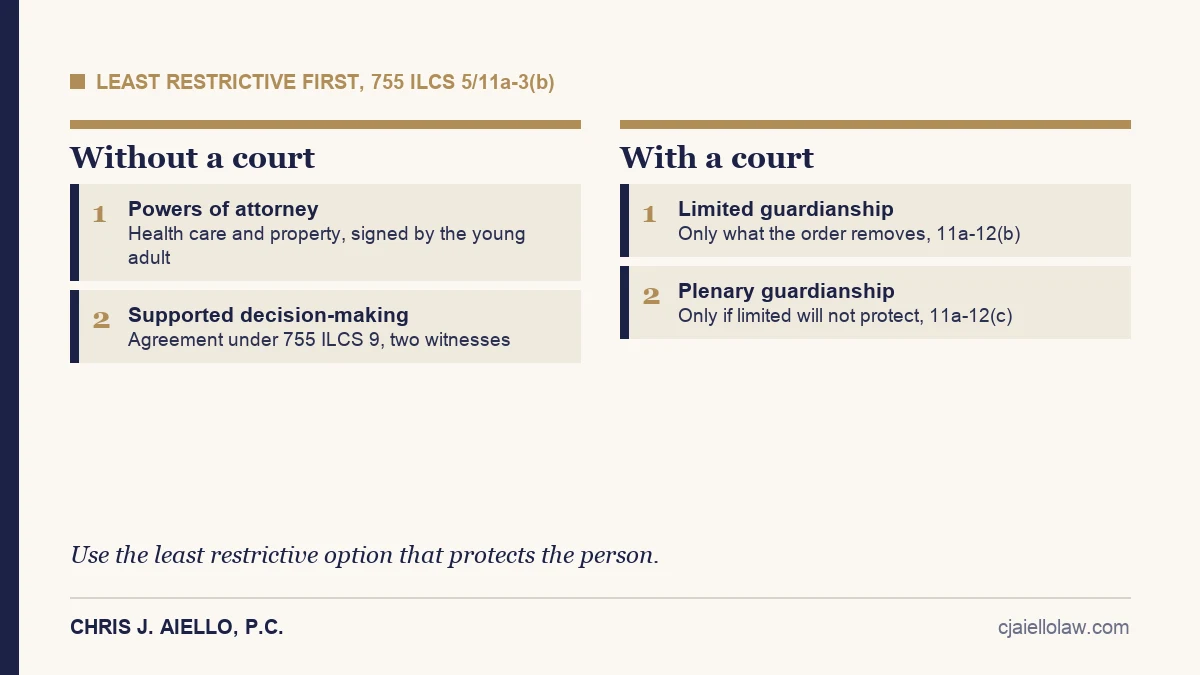
Illinois law tells the court to use guardianship only as necessary to promote the person's well-being, protect them from neglect, exploitation or abuse, and encourage the maximum self-reliance and independence. It is ordered only to the extent of the individual's actual mental, physical and adaptive limitations (755 ILCS 5/11a-3(b)). That principle gives a useful order to work through. The table is a starting point, and each cell depends on the facts.
| Option | What the young adult must be able to do | Who signs | Court | What stays with the young adult |
|---|---|---|---|---|
| Nothing formal | Make and communicate their own choices with informal family help | No one | No | All decisions, though providers may decline to share information with parents (HIPAA and FERPA records are the young adult's to control) |
| Powers of attorney (health care and property) | Understand what they are signing and who they are choosing. The Act sets no separate capacity test, so a lawyer assesses this at the signing | The young adult as principal; the agent | No | The right to revoke while able to understand what revoking means, and the ability to act alongside the agent |
| Supported decision-making agreement | Choose a supporter and sign in front of 2 witnesses 18 or older; the current Act covers adults with an intellectual or developmental disability | The young adult and the supporter; the supporter cannot be a witness | No | The decisions themselves; the supporter helps and is not allowed to decide |
| Limited guardianship | Not applicable: the court finds the person lacks some but not all capacity | The court appoints the guardian | Yes, with a hearing | Everything the order does not remove |
| Plenary guardianship | Not applicable: the court finds the person totally without capacity and that limited guardianship will not protect them | The court appoints the guardian | Yes, with a hearing | Little; the guardian holds the authority the statute gives |
Can a Young Adult With a Disability Sign a Power of Attorney?
Sometimes, and the answer depends on the person. A power of attorney lets the young adult choose an agent, often a parent, for health care or for property and finances. The statutory short form for health care exists for this. The Act defines an incapacitated principal by reference to the Probate Act definition or a physician's written determination (755 ILCS 45/2-3), but it sets no separate capacity test. The statutory form (755 ILCS 45/3-3) tells the signer to ask a lawyer about anything they do not understand, and the witness certifies the principal is of sound mind and memory. That judgment is made at the signing, so ask the attorney to meet the young adult and, if there is any doubt, to document what the person understood.
If a young adult cannot sign a valid power of attorney, that is one signal that a supported agreement or a limited guardianship deserves a closer look. It is not proof by itself.
What Supported Decision-Making Looks Like in Illinois
Illinois has a statute for it: the Supported Decision-Making Agreement Act, 755 ILCS 9, which describes its purpose as a less restrictive alternative to guardianship. Under the version now in effect, the agreement is between an adult with an intellectual or developmental disability, called the principal, and a supporter. The supporter may help the person understand information and options, gather records, find services and carry out decisions. The supporter is prohibited from making decisions for the principal or exerting undue influence (section 35). Signing an agreement cannot be used as evidence of capacity or incapacity and does not stop the person from acting independently (section 15).
The agreement is signed and dated by the principal and supporter in front of 2 or more witnesses who are at least 18, and the supporter cannot be a witness (section 45). Certain people cannot serve as supporters, including paid support staff who are not immediate family and anyone convicted of listed offenses such as fraud or theft (section 20). An amendment, Public Act 104-663, takes effect January 1, 2027 and changes several sections, including who counts as a principal. If you sign before then, ask whether the new text affects your agreement. The Guardianship and Advocacy Commission at gac.illinois.gov is directed by the Act to provide public information and training materials on the supporter role.
When Limited Guardianship Fits
If the less restrictive tools do not provide enough protection, a court can decide. The petition goes to the circuit court, which sets a hearing within 30 days and generally appoints a guardian ad litem to report on the respondent's best interests (755 ILCS 5/11a-10). The respondent can ask for a lawyer, and the court must appoint one on request. If the court finds the person lacks some but not all capacity and guardianship is necessary, it must appoint a limited guardian and write an order stating the duties and powers and the legal disabilities that apply (755 ILCS 5/11a-12(b)). For the person, a limited guardian has only the authority the order specifically confers. For the estate, the guardian holds the statutory estate powers except what the order reserves to the young adult. Either way, the appointment is not a finding of legal incompetence (11a-14). A plenary guardian is appointed only if the person is totally without capacity and limited guardianship will not provide sufficient protection.
The sections reviewed do not say how far in advance a family can prepare the paperwork, because the definition starts at 18. Ask the attorney about timing. For the full process, see our guide to guardianship in Illinois.
A 12-Month Checklist Before the Birthday
- Twelve months out: ask the school and the doctor what records and decisions will move to the young adult, and gather the diagnosis and evaluation reports.
- Nine months out: talk with your child about who they trust to help with decisions, and write down what they can already do on their own.
- Six months out: meet an attorney to choose among powers of attorney, a supported agreement and a court process.
- Three months out: ask the doctor and the school whether they will accept the documents you plan to use.
- Birthday: have signed documents in place where the plan calls for them, and review benefits with the agency that pays them.
When to Bring in an Attorney
A call is worth making when you are unsure whether your child can sign a document, when providers are asking for paperwork, or when benefits and a future trust are part of the picture. Planning for a child with a disability often includes a trust so that money left to the child does not cost a benefit, and the guardianship practice page explains the court route in more detail.
Your child turns 18 soon?
Chris J. Aiello, P.C. has helped DuPage County families plan since 1990. Bring the diagnosis and the paperwork, and we will walk through which options fit.
Schedule a ConsultationSources: 755 ILCS 5/11a-2 · 755 ILCS 5/11a-3 · 755 ILCS 5/11a-10 · 755 ILCS 5/11a-12 · 755 ILCS 5/11a-14 · 755 ILCS 9 · 755 ILCS 45/2-3 · 755 ILCS 45/3-3 · Guardianship and Advocacy Commission
General information about Illinois law, current as of November 2026. This guide describes the sections cited; your family's facts may call for a different answer. It is not legal advice and it does not create an attorney-client relationship.