ABLE Account or Special Needs Trust: How an Illinois Family Decides
An ABLE account and a special needs trust do different jobs, and a family can use both. An ABLE account is a savings account owned by the person with the disability, with an annual contribution limit tied to the federal gift tax exclusion and, for SSI, a $100,000 balance exclusion. A special needs trust is managed by a trustee and can hold larger sums, such as an inheritance or a life insurance payout. The source of the money, the amount and who should control spending usually decide where each dollar goes. Do not hand a check to the person directly, and ask before opening either one. Federal law lets a state claim Medicaid repayment from an ABLE account at death, but Illinois law bars Illinois state agencies from making that claim against an Illinois ABLE account. Payback still applies to first-party and pooled trusts.
Short answer: the choice between an ABLE account vs a special needs trust in Illinois is rarely either-or. A grandparent leaves money, a life insurance policy pays out, or a parent has finally decided to set something aside, and the person who will use it receives SSI or Medicaid. The question is where the money should sit so that it helps and does not cost a benefit. This guide is a decision aid for that family.
It reads the federal ABLE statute, the Social Security Administration's rule for ABLE accounts, the federal trust provisions and the Illinois Treasurer's program page, and it says where those sources stop.
Which One Should This Money Go Into?
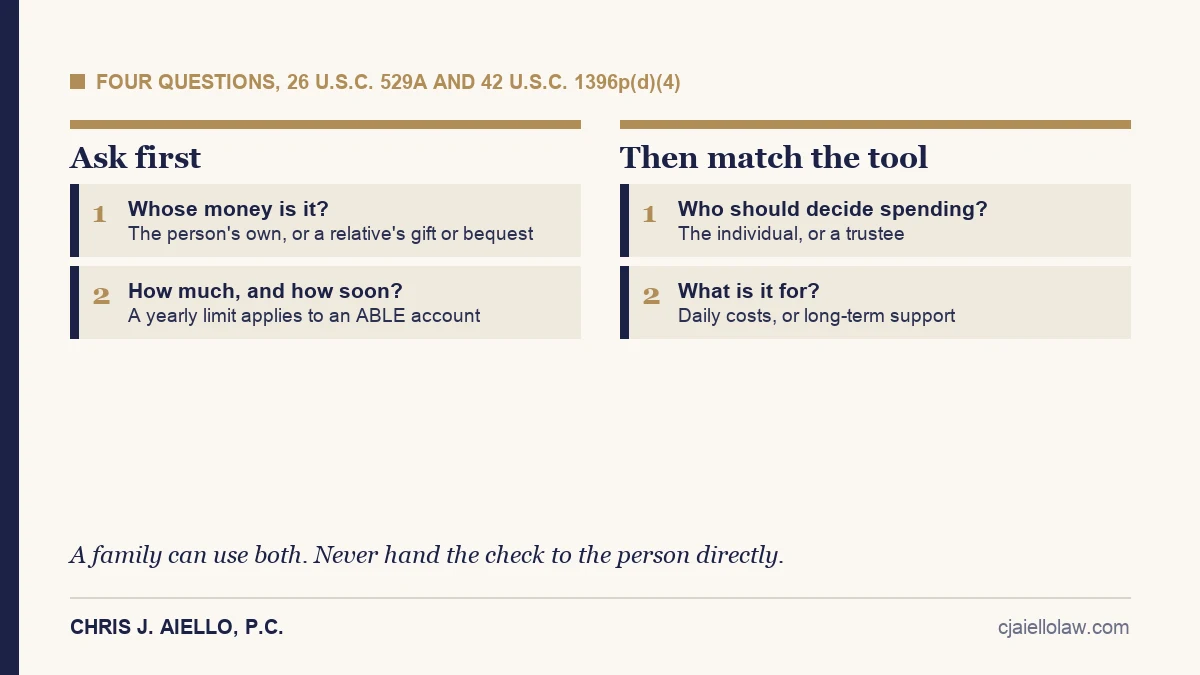
Four questions sort most situations. Answer them in order.
- Whose money is it? Money that belongs to the person with the disability (back pay, a settlement, a personal inheritance) is treated differently from a gift or a bequest from a relative. That difference decides which kinds of trust are available.
- How much, and how soon? An ABLE account takes yearly contributions up to a limit. A large one-time sum usually needs a trust.
- Who should decide how it is spent? The ABLE account belongs to the individual, or to an authorized legal representative acting for them. A trustee controls a trust.
- What is it for? Day-to-day expenses that the person can manage suit an ABLE account. Long-term support, larger purchases and money a family wants managed suit a trust.
The table below puts the four tools side by side. Cells are conditional because each trust document and each person's benefits are different.
| Tool | Who owns it and decides spending | Money that can go in | What happens at death |
|---|---|---|---|
| ABLE account | The individual, or an authorized legal representative for them | Contributions up to the yearly limit from anyone; the person's own money counts as their income if it is deposited directly | Illinois bars a state Medicaid claim against an Illinois ABLE account. The balance can go to the estate, to another eligible person's ABLE account or to a payable-on-death designee |
| Third-party special needs trust | A trustee under the trust terms | Gifts and bequests from relatives or anyone else; no fixed yearly cap | As the trust says. The federal repayment rule for individual trusts does not apply to a trust holding only other people's money, so the document controls |
| First-party (payback) trust | A trustee; may be set up by the individual, a parent, grandparent, guardian or court for a disabled person under 65 | The person's own assets | The State must receive what remains, up to the Medicaid assistance paid |
| Pooled trust | A nonprofit manages it; a separate account is kept for each person | The person's own assets, as the particular pooled trust allows | Remaining funds are kept by the nonprofit or paid to the State up to Medicaid assistance paid, depending on the trust |
For the trust rows, the federal text is 42 U.S.C. 1396p(d)(4)(A) and (C). The third-party row is the exception: because the money was never the person's, the payback rule in those subsections is not what governs it. Ask the attorney how a given family's trust will be drafted.
What an Illinois ABLE Account Can and Cannot Hold
Under 26 U.S.C. 529A, a person is eligible if entitled to Social Security disability or SSI benefits based on blindness or disability that began before age 46, or if a disability certification is on file. The older cutoff was age 26. The statute text shows the change to 46 applying to taxable years beginning after December 31, 2025, so a young adult or an adult who was previously too old may now qualify. Check the date the disability began.
The yearly contribution limit is set by reference to the federal gift tax exclusion for the year, and a working beneficiary can add more up to a limit tied to earnings and the poverty line. The statute does not print a dollar figure, so use the amount the program publishes for the current year. The Illinois program is administered by the Office of the Illinois State Treasurer, which says an authorized legal representative can open and manage an account for an eligible child, and that Illinois taxpayers can deduct contributions from state taxable income up to $10,000 for individual filers and $20,000 for joint filers. A tax preparer should confirm how that applies.
Distributions are for qualified disability expenses, defined as expenses related to the person's blindness or disability, including education, housing, transportation, employment training and support, assistive technology and personal support services. The Social Security rule, POMS SI 01130.740, excludes up to and including $100,000 of an ABLE balance as an SSI resource and counts only the part above that. A contribution from someone else is not the beneficiary's income, but the person's own income deposited into the account still counts as income. A distribution used for housing is counted as a resource if it is kept into the next month, so spending it in the month it is withdrawn matters.
Two points stand out. Federal law, section 529A(f), lets a state file a claim for what Medicaid paid after the account was opened, but Illinois law bars Illinois state agencies from making that claim against an Illinois ABLE account (15 ILCS 505/16.6). At death the balance can pass to the estate, to another eligible person's ABLE account or under a payable-on-death agreement, and the State Treasurer may first ask for proof that funeral and burial costs were paid. And the yearly cap means the account is a poor home for a six-figure inheritance on its own.
Which Money Belongs in a Trust, Not an ABLE Account?
A trust can receive a large amount at once, name a trustee to make purchases for the person's benefit, and say what happens to what is left. For money that came from a relative, a third-party trust is the usual tool, and its terms decide who benefits at the end. For money that belongs to the person, federal law allows an individual trust set up by the individual, a parent, grandparent, guardian or court for a person under 65 who is disabled, provided the State receives what remains up to the Medicaid assistance paid. A pooled trust, run by a nonprofit with a separate account for each person, is the third option and is covered in subsection (d)(4)(C).
The trade-off is control. A trustee has to approve payments, and how a trust pays for food or housing can affect SSI under Social Security's in-kind support rules, which this guide does not cover. The attorney will check the drafting against them. An ABLE account's housing distributions have their own rule in the Social Security text above. Our overview of planning for a family member with a disability explains how a trust is set up, and the trusts practice page covers the wider picture.
Can a Family Use Both?
Yes. The ABLE account handles everyday money the person can direct. The trust holds the larger sum and pays for things the account is not suited for. An illustration, with made-up numbers: a grandparent leaves $250,000 in a life insurance payout to a young adult who receives SSI. Paid directly, the money would count as a resource and could end the benefit. Paid to a third-party special needs trust, the trustee can pay for therapy, equipment or a vehicle, and can move an amount each year into an ABLE account for the person to spend on housing and daily costs. The split is not fixed. It depends on the yearly limit, the person's needs and what the trust allows.
Mistakes That Can Cost a Benefit
- Naming the person with a disability as the direct beneficiary of a policy, account or will.
- Paying an inheritance to the person to "hold" until a trust is set up.
- Putting the person's own earnings or back pay into an ABLE account and treating it as a gift.
- Letting a withdrawal for housing sit in the checking account past the month it was taken.
- Opening an account without checking the date the disability began, which decides eligibility.
Our guide on guardianship in Illinois covers the other decision many of these families face, and our comparison of a will vs a trust in Illinois shows where the instructions to leave money to a trust should be written.
What to Bring to the First Meeting
- Award letters for SSI, SSDI and Medicaid, with the date the disability began.
- Life insurance policies, retirement accounts and wills that name the person.
- Any money the person already owns, with account statements.
- Your guardianship or power of attorney papers, if any.
- A list of expenses the family wants the money to cover.
When to Bring in Legal Help
A call is worth making before an inheritance is paid, before an ABLE account is opened with the person's own money, and before any beneficiary designation is changed. Legal help can include choosing the right trust, coordinating the trustee and the ABLE account, and drafting wills and beneficiary designations so that nothing is left to the person outright. Chris J. Aiello, P.C. serves families across DuPage County.
Money coming to a family member on SSI?
Chris J. Aiello, P.C. has helped DuPage County families plan since 1990. Bring the award letters and the paperwork, and we will tell you which tool fits which dollars.
Schedule a ConsultationSources: 26 U.S.C. 529A · 15 ILCS 505/16.6 · 42 U.S.C. 1396p · SSA POMS SI 01130.740 · Illinois State Treasurer, ABLE program
General information about federal and Illinois law, current as of November 2026. This guide describes the sources cited; your family's facts may call for a different answer. It is not legal advice and it does not create an attorney-client relationship.