How Long Does a DUI Stay on Your Record in Illinois?
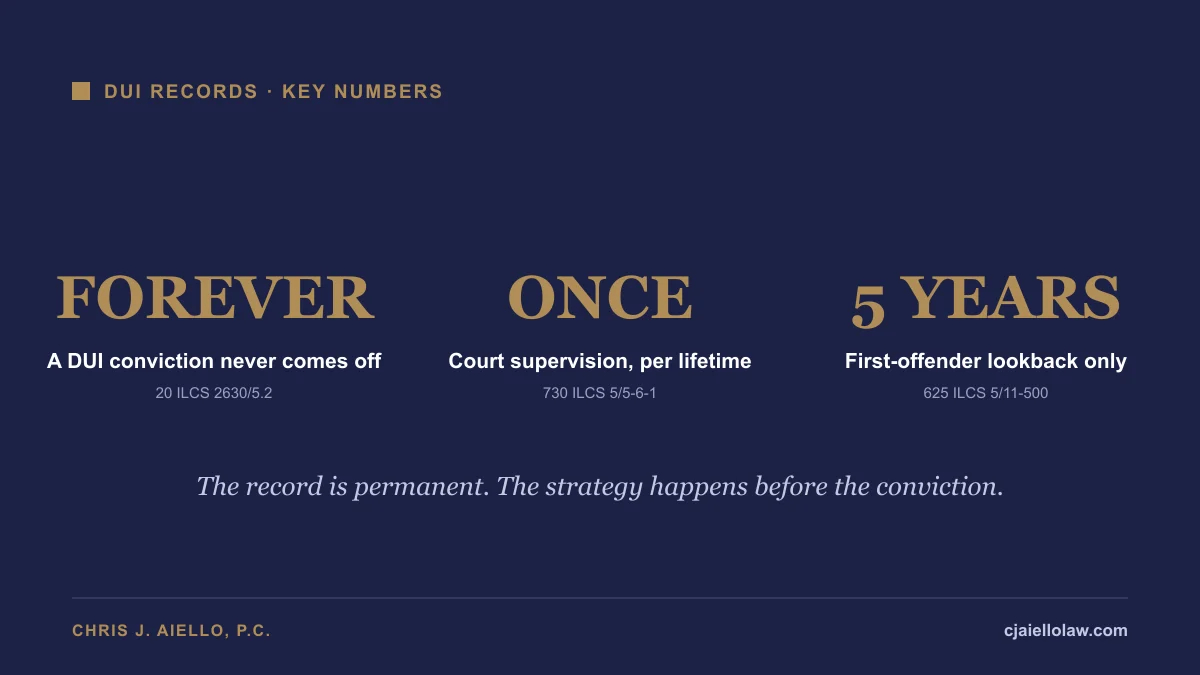
- A DUI conviction stays on your record permanently. It cannot be expunged or sealed, ever (20 ILCS 2630/5.2).
- Court supervision keeps a conviction off your public driving record, but the arrest and the supervision can never be expunged either (20 ILCS 2630/5.2).
- Supervision for DUI is available once per lifetime (730 ILCS 5/5-6-1).
- The famous 5-year lookback only decides first-offender status for license suspension purposes. Prior DUIs count forever when a new charge is filed (625 ILCS 5/11-500).
- Only a DUI that ends without a conviction, dismissed or not guilty, can be expunged from your criminal record.
- Insurance treats you as high risk for roughly 3 to 5 years, not forever.
The consensus answer, and the correct one: in Illinois, a DUI conviction stays on your record for life. How long a DUI stays on your record in Illinois is not a waiting game with a finish line, because there is no finish line. Illinois is one of the strictest states in the country on this point. There is no 7-year falloff, no automatic clearing, and no expungement path for a conviction. That is the bad news. The useful news is that "your record" is really four different records, they show different things to different people, and what lands on them is largely decided in the first weeks of the case, not years later. Here is exactly what goes where, what the 5-year lookback actually means, and the short list of things you can genuinely remove.
The Straight Answer: A DUI Conviction Never Comes Off
Illinois law flatly excludes DUI from both expungement and sealing. The Criminal Identification Act allows many convictions to be sealed after a waiting period, but it carves out violations of 625 ILCS 5/11-501, the DUI statute, as ineligible (20 ILCS 2630/5.2). There is no waiting period that fixes this, and no judge has discretion to override it. A conviction also triggers a revocation entry on your driving record with the Secretary of State, and that entry is permanent too.
Practical takeaway: if anyone promises they can "clear" an Illinois DUI conviction for a fee, walk away. The only lawful path to expunging a DUI conviction is a pardon from the Governor that specifically authorizes expungement, which is rare. Everything else that can be done about a DUI record happens before conviction, which is why the disposition you negotiate matters more than anything you can file afterward.
Which Record Shows What (and Who Sees It)
Before you assume the worst, know which record the person in front of you is actually looking at. These are the four that matter:
| Record | Kept by | Who typically sees it | How long a DUI stays |
|---|---|---|---|
| Driving record (court purposes abstract) | Illinois Secretary of State | Courts, police, the Secretary of State | Conviction and supervision entries: permanently |
| Public driving abstract | Illinois Secretary of State | Insurers, employers with your consent | Conviction: permanently. Court supervision does not appear as a conviction here |
| Criminal history record | Illinois State Police | Police, courts, fingerprint background checks | Arrest, supervision, and conviction: until expunged, and DUI outcomes other than dismissal or acquittal cannot be |
| Circuit court file | Circuit clerk (public) | Anyone who searches by name | Until expunged, same limits as above |
Do this before your next job or insurance application, so nothing surprises you: order your own driving abstract from the Secretary of State, and request your criminal history transcript from the Illinois State Police. Read them side by side. People routinely assume an old supervision shows as a conviction when it does not, and just as often assume a conviction quietly aged off when it has not.
Court Supervision: The One Outcome That Protects Your Driving Record
Court supervision is the reason two people with the same arrest can have very different records ten years later. Supervision is a sentence, but it is not a conviction. Complete it successfully and the case is dismissed, no conviction is entered, and your public driving abstract stays conviction-free, which also means no revocation of your license. For most first-time defendants it is the single most valuable outcome on the table, and we walk through how it fits the larger case in our guide to a first DUI in Illinois.
Know its two hard limits before you count on it:
- Once per lifetime. A defendant who has ever been convicted of DUI, or ever received supervision for DUI, anywhere in any state, cannot get it again (730 ILCS 5/5-6-1).
- It still never disappears. Supervision for most offenses can be expunged two years after completion. DUI supervision is specifically excluded, so the arrest and the supervision stay visible on your criminal history and to courts and police forever (20 ILCS 2630/5.2).
So supervision protects your license and your insurance-facing record, not your background check. If a job or licensing application asks about the case, get advice on how to answer accurately, because the record will be there to compare against.
The 5-Year Lookback Myth
"DUIs only count for 5 years in Illinois" is half true, and the wrong half gets people charged as repeat offenders. The 5-year window comes from the definition of a first offender: you count as one only if you have had no DUI suspension, revocation, or supervision within the 5 years before the current arrest (625 ILCS 5/11-500). That status controls the civil license side, a 6-month versus 12-month or longer statutory summary suspension and whether you qualify for the interlock driving permit.
What the 5 years does not do: erase anything. When prosecutors charge a new DUI, prior DUI dispositions count for enhancement with no time limit. A 1998 supervision still makes today's charge your second DUI. That is why "how long does it stay on my record" and "how long does it count against me" have two different answers in Illinois: 5 years for first-offender status on the license side, forever for everything else.
What You Can Actually Remove: A Checklist
The removable list is short, but if you are on it, act. Every item requires the case to have ended without a conviction:
- Dismissed, not guilty, or never charged. An arrest that ends in dismissal, acquittal, or release without charging can be expunged from your criminal history and the public court file.
- Get your paperwork first. Order a certified copy of the disposition from the circuit clerk in the county of arrest, and your criminal history transcript from the Illinois State Police, so the petition matches the record exactly.
- File in the county of arrest. The petition to expunge goes to the circuit court there. The State's Attorney and the arresting agencies then have 60 days to object before a judge rules.
- Clean up the license side separately. If your statutory summary suspension was rescinded, confirm the rescission actually reached your Secretary of State record.
- Conviction on the record anyway? The only remaining door is executive clemency, a pardon that authorizes expungement. Long odds, but it exists.
Eligibility rules and the petition forms are laid out by Illinois Legal Aid Online, and a criminal record expungement attorney can tell you in one conversation whether your disposition qualifies before you spend a filing fee.
What It Costs You While It Sits There
Permanent on the record does not mean permanent in consequences. Budget for these windows: insurers typically treat a DUI as a surcharge event for 3 to 5 years, and carriers price off your driving abstract, which is one reason supervision is so valuable. Professional licensing boards and CDL rules run on their own clocks, and a commercial driver faces a minimum 12-month disqualification regardless of what happens in court. The full money picture, fines, insurance, interlock, and reinstatement, is broken down in what a DUI actually costs in Illinois.
Honest take: the record fight is won or lost at disposition, not years later with a petition. Once a conviction is entered, no lawyer in Illinois can remove it, and anyone who says otherwise is selling something. What a lawyer can do is fight the case toward the outcomes that keep your record livable: dismissal or acquittal, which can be expunged, or supervision, which protects your license and insurance record. A Villa Park DUI defense attorney serving DuPage County should be having the record conversation with you at the first court date, not after sentencing.
Conclusion: Permanent Record, Short Window
How long does a DUI stay on your record in Illinois? A conviction: forever, on every record that matters. Supervision: forever on your criminal history, but invisible as a conviction on your public driving abstract, which is the record insurers and most employers see. A dismissal or acquittal: only until you expunge it, so file. The window that actually decides which of those three sentences describes you is the few weeks between arrest and disposition. Spend it deliberately.
Worried about what a DUI will do to your record?
Bring your citation and court date. We will tell you which outcomes are realistically on the table, what each one leaves on your record, and whether anything already there can be removed.
Schedule a Free ConsultationSources: 20 ILCS 2630/5.2 · 625 ILCS 5/11-500 · 625 ILCS 5/11-501 · 730 ILCS 5/5-6-1 · Illinois Legal Aid Online, Expunging or Sealing a Criminal Record