Letters of Office in Illinois Probate: What They Are and How to Get Them
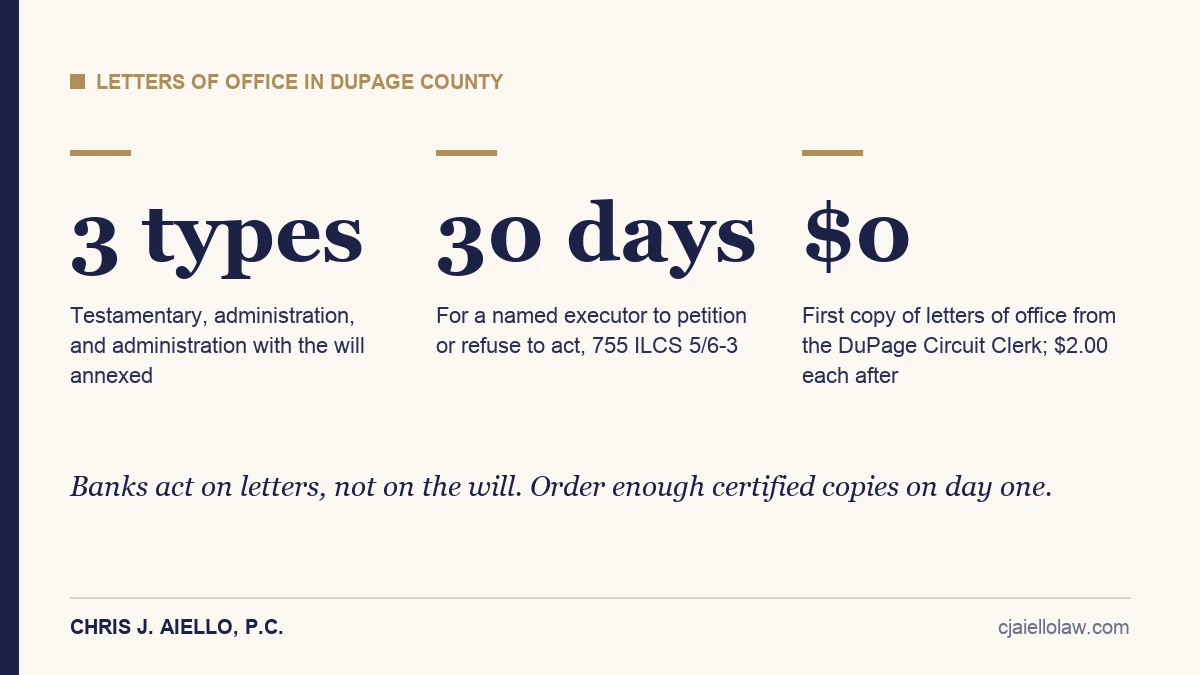
Letters of office are the short court document, signed and certified by the circuit clerk, that proves who has authority to act for a deceased person's estate. Banks, brokerages and title companies act on letters, not on the will. You get them only by opening a probate estate: the will is filed, a petition is filed, the court appoints you, you take the oath and give bond unless it is excused, and the clerk issues the letters. There are three main kinds, depending on whether there is a will and whether the named executor is serving. In DuPage County the Circuit Clerk lists letters of office at the first copy free and $2.00 for each additional copy, so order enough on day one. Every institution will want its own.
Most people hear the phrase for the first time on the phone with a bank. You call to close your mother's account, and the answer is that they will need "letters." Not the will, not the death certificate, not a note from the family. Letters of office in Illinois are a specific court document, and until you have them, the bank will not take instructions from you on the decedent's accounts.
If you want the whole administration from petition to closing, our guide to Illinois probate administration, step by step walks it in order. This piece is about the one document in the middle of that process that everything else depends on.
What Are Letters of Office?
"Letters of office" is the Probate Act's umbrella term for the document the court issues when it appoints a representative for an estate. It is usually one page. It names the person appointed and the estate, states what kind of representative they are, and carries the clerk's signature and the court's seal. The independent administration statute, 755 ILCS 5/28-2, requires the order and the letters to say whether the person is appointed as an independent executor or independent administrator, which is why that word matters when a bank reads them.
Letters are proof, not the source of the power. The authority comes from the court's order of appointment and from the Probate Act. The letters are the portable, certified evidence of it that a third party can rely on without reading the court file.
Which Kind of Letters Will You Get?
The type depends on two facts: whether there is a valid will, and whether the executor it names is able and willing to serve.
- Letters testamentary go to the executor named in a will once the will is admitted and the executor qualifies and accepts the office, under 755 ILCS 5/6-8.
- Letters of administration issue when there is no will. The court appoints an administrator from the people with preference under 755 ILCS 5/9-3, starting with the surviving spouse.
- Letters of administration with the will annexed issue when there is a will but no executor is named, or the named executor fails or refuses to serve, dies, resigns or has their letters revoked, under 755 ILCS 5/6-9.
A fourth, narrower type exists for emergencies: letters of administration to collect, a stopgap appointment when regular letters are delayed and the estate is at risk.
| Type of letters | When it issues | Who the court appoints | What the holder can do | Statute |
|---|---|---|---|---|
| Letters testamentary | A will is admitted to probate and names an executor who qualifies | The named executor, if 18 or older, a U.S. resident, of sound mind and not currently in prison, not an adjudged person with a disability, and not disqualified by a felony conviction (with a narrow exception) | In independent administration, most acts without a court order, including selling real estate; in supervised administration, major acts need a court order first | 755 ILCS 5/6-8, 6-13, 28-2, 28-8 |
| Letters of administration | There is no will | The person with the highest preference under 9-3, or their nominee, starting with the surviving spouse, then the children, grandchildren, parents and siblings | Same split between independent and supervised administration | 755 ILCS 5/9-1, 9-3, 9-4 |
| Letters of administration with the will annexed | There is a will, but no executor is named or the named executor cannot or will not serve | Chosen under the same 9-3 preferences, where legatees rank right after the spouse | Administers under the will's terms, with the same independent or supervised split | 755 ILCS 5/6-2, 6-9, 9-3 |
| Letters of administration to collect | Regular letters are delayed and the estate is liable to waste or loss, or a person is missing | The court's choice, giving weight to the named executor or the 9-3 preferences | Collect the personal estate and debts due; more only by leave of court; ends when regular letters issue | 755 ILCS 5/10-1, 10-4, 10-5 |
How Do You Get Letters of Office in Illinois?
There is no separate application for letters. They are the output of opening an estate, and the sequence is set by statute:
- File the original will. Whoever has the will must file it with the clerk of the proper county immediately upon the death, under 755 ILCS 5/6-1.
- The named executor acts within 30 days. Under 755 ILCS 5/6-3, within 30 days after learning they are named, the executor either starts the probate proceeding or declares they refuse to act.
- File the petition. The petition states the facts the court needs, including the approximate value of the estate and the names and addresses of the heirs and legatees (6-2 for a will, 9-4 without one). The will is usually proved by its attestation clause or a witness affidavit, so witnesses rarely have to appear, under 6-4.
- Oath and bond. Before acting, every individual representative takes an oath and files a bond approved by the court, under 755 ILCS 5/12-2. A will can excuse the surety, but under 12-4 the court can still require security if it has reason to, and a nonresident executor can be required to post bond regardless.
- The clerk issues the letters. After the order appointing you is entered and the oath and bond are on file.
- Notice follows. Within 14 days after the order, copies of the petition and order go to the heirs and legatees, or notice is published if an address is unknown, under 6-10 (9-5 where there is no will).
A clean will and a cooperative family keep that sequence short. A missing heir, a will that is hard to prove or a family member with a better claim to serve slows it down, and so does anyone objecting to independent administration.
What Letters Let You Do, and What They Do Not
With letters in hand, an independent representative can, without going back to the judge, sell or lease personal property, settle claims, hire accountants and counsel, keep running an unincorporated business for a time, and take possession of, lease, sell or mortgage the decedent's real estate. Those powers are listed in 755 ILCS 5/28-8. One limit in that list catches people: real estate left to a specific person in the will cannot be sold, leased or mortgaged without that legatee's written consent.
In supervised administration the same acts usually need a court order first. Selling or mortgaging real estate, for example, starts with a petition to the court that issued your letters under 755 ILCS 5/20-5.
What letters never do is reach property that is not in the probate estate. A payable-on-death account, a house held in joint tenancy, a retirement account with a living beneficiary or assets titled in a trust pass outside probate, and letters give you no authority over them. Our guide to what assets pass through an Illinois probate estate sorts one from the other. Letters also do not stay in force regardless of conduct: the court can remove a representative and revoke letters for the reasons listed in 755 ILCS 5/23-2.
How Many Certified Copies Should You Order?
More than you think. Every bank, brokerage, transfer agent, insurer and title company wants its own certified copy, and many keep it. A photocopy of a certified copy does not count. Some institutions will also only accept a copy certified recently, and each one sets its own cutoff, so a copy that was fine in March can be turned away in September.
A simple way to count: list every institution holding something in the decedent's sole name, add one for the title company if there is real estate, one for the estate's own bank account, and two spares. Then order that number at the start.
When an institution rejects your letters, ask in writing what exactly it needs. The usual answers are a more recently certified copy, the name on the account not matching the name in the letters, or a request for the order appointing you as well as the letters. Most of these are solved at the clerk's window rather than in front of the judge.
When You Do Not Need Letters at All
Not every estate needs a probate case. If no letters are outstanding or contemplated and the personal estate passing by will or intestacy is within the statutory limit, excluding vehicles registered with the Secretary of State, the family may be able to collect it by affidavit under 755 ILCS 5/25-1 instead. Whether an estate qualifies, and what the affidavit route asks of the family, is laid out in our walkthrough of the small estate affidavit in Illinois. Real estate in the decedent's sole name, a dispute in the family or creditors you cannot pay in full usually push an estate back into court.
Getting Letters of Office in DuPage County
DuPage County estates are handled in the Eighteenth Judicial Circuit at the DuPage Judicial Center, 505 N. County Farm Road, Wheaton. The original will is filed with the DuPage County Clerk of the Circuit Court, and the petition and later filings are normally submitted electronically through eFileIL.
On copies of letters, the Circuit Clerk's own copy order page lists letters of office at the first copy free and $2.00 for each additional copy, and says copies ordered online cost the same as copies ordered in person or by mail. Court fees change, so check that page before you rely on the number. The cheap copy is the reason to order generously at the start rather than one at a time when each bank asks.
If the estate includes real estate, the recording side runs through the DuPage County Recorder, and title companies will want a certified copy of your letters with the deed. When there is no will, who gets appointed and how the estate is then run is the work of an attorney for intestate estates in DuPage County.
This is general information about Illinois practice, not legal advice. County procedures and fees change; confirm the current requirement with the clerk or your attorney.
Letters also make the representative the person who receives any heir's written refusal of a gift, and disclaiming an inheritance in Illinois explains what that disclaimer has to contain and where the share goes.
When to Get Help With Letters
Plenty of executors get through appointment with a clean will and a cooperative family. Get help when someone else has an equal or better claim to serve, when a family member has said they will object, when the will's witnesses cannot be found, when there is real estate to sell, or when a bank keeps refusing letters you know are valid. Once you are appointed, the next question is what an Illinois executor owes the estate once appointed, and that is its own list.
Getting appointed cleanly and using the letters well is what an executor attorney in DuPage County does from the first filing, and it sits inside the wider work of a probate lawyer serving Villa Park and DuPage County.
Need letters of office, or a bank will not accept yours?
Chris J. Aiello, P.C. has guided Villa Park and DuPage County executors and administrators through the Wheaton courthouse since 1990. Bring the will and a list of the accounts, and we will tell you which letters you need and how fast you can have them.
Schedule a ConsultationSources: 755 ILCS 5/6-1 · 755 ILCS 5/6-3 · 755 ILCS 5/6-8 · 755 ILCS 5/6-9 · 755 ILCS 5/9-3 · 755 ILCS 5/12-2 · 755 ILCS 5/28-2 · 755 ILCS 5/28-8 · 755 ILCS 5/25-1 · DuPage Circuit Clerk: ordering copies · Illinois Courts eFileIL · Illinois Legal Aid Online: probate
General information about Illinois law, current as of September 2026. It is not legal advice and it does not create an attorney-client relationship.