Disclaiming an Inheritance in Illinois: How to Refuse a Gift, and What Happens Next
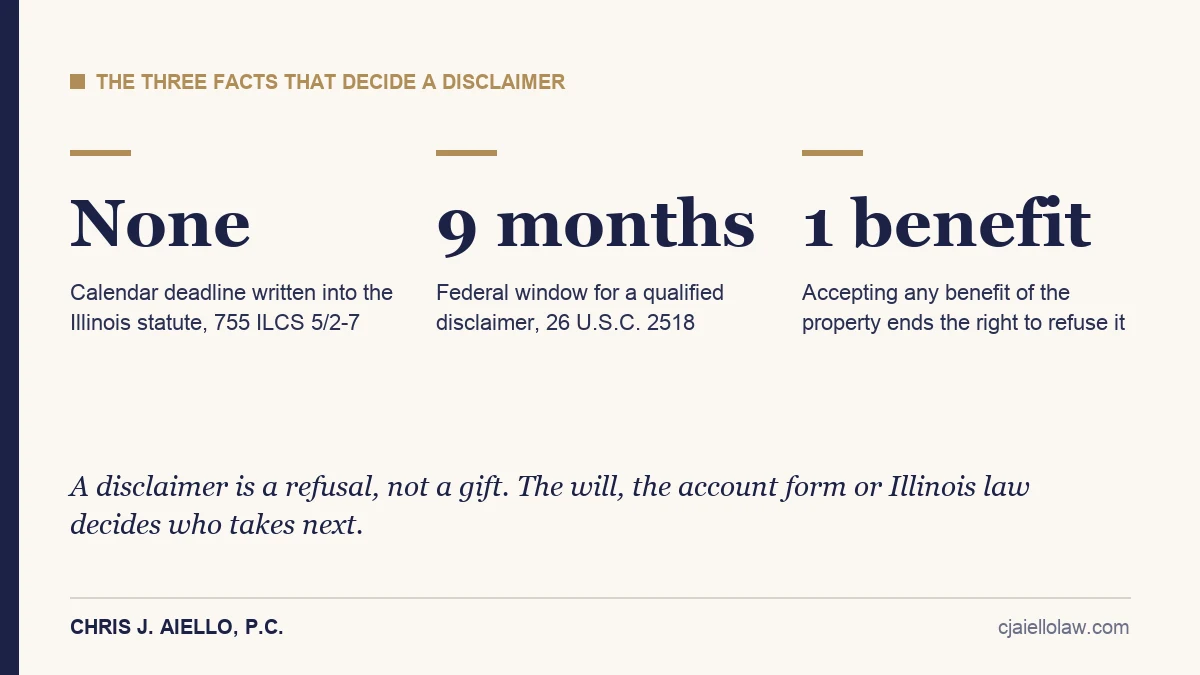
Yes, you can refuse it. Illinois calls it a disclaimer, and it lives in one section of the Probate Act, 755 ILCS 5/2-7. It has to be in writing, it has to describe what you are refusing, you sign it, and it goes to the person who holds the property or runs the estate. You can refuse all of it or only part. What ends the right is accepting the property or any benefit from it, and that can happen on day three as easily as month eight. The Illinois statute itself sets no calendar deadline. The nine months you keep reading about is the federal tax rule for a qualified disclaimer, and for most people it is the deadline that matters. The part nobody likes: a disclaimer is a refusal, not a gift. You are treated as if you had died before the person who left it to you, and the will, the account form or the Illinois inheritance rules decide who takes it next. You do not.
Sometimes the thing you inherited is the problem. A house with a second mortgage and a roof that needs replacing. A share of an estate you would rather see go straight to your children. A bequest that lands in the middle of a divorce or a bankruptcy. Disclaiming an inheritance is how you say no, and Illinois law has a specific procedure for it. Get the procedure right and the refusal is permanent and clean. Get it wrong, or accept a dollar of the benefit first, and you may own the thing you were trying to refuse.
This guide is written for the person holding the letter from the executor, or the bank notice, and wondering whether they have to take it.
Can You Refuse an Inheritance in Illinois?
Yes. Under 755 ILCS 5/2-7, a person to whom property passes "by whatever means" may disclaim it in whole or in part. That covers a gift in a will, a share of an estate where there was no will, a joint account, a beneficiary designation and an interest in a trust. The statute also says the right to disclaim exists even if the gift came with a spendthrift clause or a similar restriction.
Two points in the statute surprise people. First, a disclaimer can be partial. You can disclaim a fractional share, a specific asset, a set dollar amount or a limited interest, and keep the rest. It is a common belief that Illinois is all or nothing. The statute says the opposite. Second, a disclaimer is irrevocable. Once it is effective, it binds you and anyone claiming through you, so there is no changing your mind in March about what you signed in January.
The Four Steps of a Valid Illinois Disclaimer
Section 2-7(b) sets three requirements for the document itself, and 2-7(c) sets the fourth, which is where it goes. Treat each one as a step you complete, not a box you tick.
- Describe the property. Name exactly what you are refusing: "my one-third interest in the residue of the Estate of ..." or "the brokerage account ending 4411." If you are refusing part, say which part and how much.
- Sign it. The disclaimant signs, or their representative does. A representative signing for someone who has died or for a ward generally needs the court's permission first under 2-7(a), unless that person's will or other signed document specifically authorizes it. Notarizing is sensible practice, and if the disclaimer covers real estate you will want it in a form the recorder will accept.
- Declare the disclaimer and its extent. Plain words that you disclaim, and how much. A letter saying you "do not really want" the house is not a disclaimer.
- Deliver it to the right person. The statute lists them in order: the person who made the transfer or their representative (in an estate, that usually means the executor or administrator), or the trustee or other person holding legal title. If none of those can readily be identified, it goes to whoever has possession or is entitled because of the disclaimer, or it can be filed or recorded instead.
For an interest passing because of a death, a signed counterpart may also be filed with the clerk of the circuit court in the county where the estate is being administered, or where it could be. For real estate, a counterpart may be recorded with the county recorder where the land sits. The word in the statute is "may", so filing and recording are not what makes the disclaimer valid. We still recommend both where they apply, because a recorded disclaimer is what a title examiner finds ten years later.
This is general information about Illinois law, not legal advice about your situation. A disclaimer cannot be undone, so have the document reviewed before you sign it.
When Is the Deadline to Disclaim?
Read 2-7 from top to bottom and you will not find a calendar deadline. The statute says the opposite in so many words: the mere lapse of time does not count as acceptance. What ends the Illinois right is not a date. It is one of four things listed in 2-7(e): a judicial sale of the property, you transferring, selling, pledging or contracting over it, a written waiver of the right to disclaim, or your acceptance of the property or any of its benefits.
The nine months comes from federal tax law. Under 26 U.S.C. 2518, a disclaimer is "qualified" for federal estate and gift tax purposes only if it is in writing, is received by the transferor, their legal representative or the title holder no later than nine months after the later of the transfer or your 21st birthday, you have not accepted the interest or any of its benefits, and the property passes without any direction from you to someone other than you (a surviving spouse is the exception). Miss that test and the refusal can still be valid under Illinois law, but the tax system may treat it as if you took the property and then gave it away, which can be a taxable gift. That is why nine months is the working deadline for nearly everyone, and why the date to count from is a question to settle with counsel and a tax professional before you rely on it.
Where Does the Share Go When You Refuse It?
This is the part people get wrong most often. A disclaimer is not a way to hand the property to someone you pick. Under 2-7(d), unless the will or other instrument says otherwise, the disclaimed interest passes as if you had predeceased the person who died. The document that created the gift then decides the next taker, and Illinois default rules fill any gap.
So the useful question before you sign is not "who do I want to have this?" It is "if I had died first, who would get it?" The table below walks the common cases.
| How the gift reached you | Who takes it if you disclaim | What decides it | The trap |
|---|---|---|---|
| Will gift with a named backup ("to my son, or if he does not survive me, to his children") | The named backup | The will's own terms, which 2-7(d) follows first | The backup was chosen by the person who wrote the will, not by you |
| Will gift to a child or other descendant of the person who died, no backup named | Your own descendants, per stirpes; if you have none, the residue | 755 ILCS 5/4-11(a) and (c), because you are treated as having died first | Disclaiming "so my sister gets it" usually sends it to your children instead |
| Will gift to someone who is not a descendant, no backup named | Usually the residue of the estate | 755 ILCS 5/4-11(c) | The residuary beneficiaries may not be who you expect; read the residuary clause |
| Gift to a group ("to my children equally") | The rest of the group, unless you are a descendant of the person who died, in which case your own descendants take your share | 755 ILCS 5/4-11(b) | Whether your line keeps the share depends on your relationship to the person who died |
| No will, and you are a child of the person who died | Your descendants, per stirpes; if you have none, it is shared by the others in your class | 755 ILCS 5/2-1 read with 2-7(d) | Same as above: your children, not your siblings, are usually next |
| No will, and you are the surviving spouse with descendants | The descendants take what would have been your half | 755 ILCS 5/2-1(a) and (b) | A spouse's disclaimer can move a large share a generation down in one step |
| Joint tenancy with right of survivorship | With three or more joint owners, the other survivors; if you were the only survivor, the deceased owner's share usually passes under their will or by intestacy | 2-7(d) and (e) | Disclaiming a survivorship share can pull it into probate. Acceptance only reaches your own fraction, so a joint owner can often still disclaim the rest |
| Payable-on-death account, TOD designation or retirement account | The contingent beneficiary on the form; if none, whatever the account agreement says | The designation and account terms | Pull the beneficiary form before you sign; a blank contingent line can push it into probate |
| Interest in a trust | The next beneficiary under the trust terms | The trust instrument; deliver to the trustee under 2-7(c) | Trust terms often name a different next taker than the will does |
One more line in 2-7(d) matters in family planning. Disclaiming a gift does not stop you from receiving the same property in another capacity. A surviving spouse can disclaim an outright gift and still take as a trust beneficiary if the plan was built that way. That is the legitimate version of "redirecting", and it only works when the documents already provide for it.
What Ends the Right to Disclaim
Acceptance is the usual culprit, and the statute defines it broadly: taking possession, accepting delivery or receiving benefits of the property. Acceptance has to be affirmatively proved, so the burden is on the person claiming you accepted. In practice, these are the moves that cause the problem:
- Cashing a distribution check, even a small partial one.
- Moving into the inherited house, renting it out or collecting the rent.
- Taking dividends or interest from an inherited account.
- Using the inherited car.
- Signing a receipt or release for your share.
- Selling, pledging or promising the property to someone, which 2-7(e) lists as its own bar.
Two statutory limits help. For a joint tenancy, acceptance extends only to your fractional share, one divided by the number of joint tenants. And for a minor or a ward, acceptance reaches only what was actually received for them during the minority or incapacity.
Good Reasons to Disclaim, and Bad Ones
The disclaimers we see work well tend to fall into a few patterns:
- The property costs more than it is worth: an underwater house, a lot with a tax problem, a rental with a liability history.
- You are comfortable and would rather the gift move to your children, and the documents or the default rules send it there.
- Post-death tax planning in a larger estate. We cover the Illinois estate tax itself in our guide to what Illinois heirs pay in estate tax, and the planning side is work for an estate tax planning lawyer in Villa Park.
And the ones that tend to go badly:
- Trying to steer the property to a particular person. The table above is why.
- Trying to keep it away from your own creditors. A disclaimer is not asset protection. Whether a particular disclaimer holds against a particular creditor, a tax lien or a bankruptcy trustee is a question to answer with counsel before you sign, not after.
- Trying to protect eligibility for Medicaid, SSI or another means-tested program. A refusal can be treated as a transfer by those programs. Get advice first.
A Disclaimer Is Not a Spouse's Renunciation of the Will
Illinois law uses similar words for two very different things. A disclaimer refuses property. A surviving spouse's renunciation under 755 ILCS 5/2-8 does the opposite: the spouse gives up what the will offers in order to take a statutory share instead, by filing a signed instrument in the probate court within seven months after the will is admitted. Different right, different deadline, different result. If you are a surviving spouse unhappy with a will, that is the section to ask about, and it is a separate conversation from anything on this page.
How Disclaimers Work in DuPage County
A DuPage County estate is administered in the Eighteenth Judicial Circuit at the DuPage Judicial Center, 505 N. County Farm Road, Wheaton. The disclaimer goes first to the executor or administrator of that estate, or to the trustee or account holder if the gift passes outside the estate. If you also file a counterpart, it goes to the Clerk of the Circuit Court in the estate's case, and filings in Illinois circuit courts are normally made electronically through eFileIL.
If the disclaimer covers DuPage real estate, record a counterpart with the DuPage County Recorder. That is what puts it in the chain of title where the next buyer's title company will look. If nobody has opened an estate, 2-7(c) still lets you file with the clerk of the county where administration could be opened. When there is no will at all, how the estate then gets opened and who runs it is the work of an intestate probate attorney in DuPage County, and our plain-language guide to dying without a will in Illinois covers who inherits.
In an open estate, the executor or administrator is the person holding letters of office issued by the court, so the name on those letters is the name the disclaimer should be delivered to.
When Should You Get Help Before You Sign?
If the gift is a single small account going to your children either way, you may not need much help. Bring someone in when real estate is involved, when the estate is large enough for tax to matter, when you have creditors or receive benefits, when a trust or retirement account is part of it, or when you are not sure what the will's backup clause says. Before you decide, it also helps to know what is inside the estate at all: our guide to what goes through probate and what passes outside it covers that by titling.
That review, and the drafting and delivery that follow, is exactly what a Villa Park probate attorney does in an open estate. If your goal is to keep the next estate out of court entirely, start with the ways to keep an estate out of probate in Illinois.
A spouse who wants less than the will gives is disclaiming, while a spouse who wants more is renouncing, and the surviving spouse renunciation right in Illinois explains that seven-month election.
Thinking about refusing an inheritance?
Chris J. Aiello, P.C. has advised Villa Park and DuPage County families on estates since 1990. Bring the will, the account statements and any letter from the executor, and we will tell you plainly where the share would go and what to avoid until you decide.
Schedule a ConsultationSources: 755 ILCS 5/2-7 · 755 ILCS 5/2-8 · 755 ILCS 5/2-1 · 755 ILCS 5/4-11 · 26 U.S.C. 2518 · DuPage County Clerk of the Circuit Court · DuPage County Recorder · Illinois Courts eFileIL · Illinois Legal Aid Online: probate
General information about Illinois law, current as of September 2026. It is not legal or tax advice and it does not create an attorney-client relationship.