What Assets Go Through Probate in Illinois
Probate covers what the person owned alone, in their own name, on the day they died, with no surviving co-owner and no living beneficiary attached to it. A solely titled house, a one-name bank account, a tenancy in common share, a car, the contents of the house. What stays out: joint tenancy with right of survivorship, tenancy by the entirety, payable-on-death and transfer-on-death designations, retirement accounts and life insurance with a living named beneficiary, anything already retitled into a funded trust, and Illinois real estate under a transfer on death instrument recorded before death. The will does not decide this. The title does. And on a small enough personal estate, a small estate affidavit may move what is left without a court case at all.
Someone has died and you are holding the folder. Bank statements, a deed, a title certificate, an old life policy, a letter from a 401(k) plan. Before you file anything, settle what assets go through probate in Illinois, because that single sort decides whether you are opening a case in Wheaton next week or closing this out with two forms. Our firm has worked through this folder with DuPage County families since 1990. The rule that sorts it is shorter than most of what you will read online.
How Was It Titled on the Day of Death?
One question does most of the work. Look at how each asset was titled on the day of death. Not what the will says. Not what everyone agreed at the kitchen table two Christmases ago.
If the asset stood in the decedent's name alone, with no co-owner holding survivorship rights and no living beneficiary named on it, the court now controls it. That is the probate estate. If the asset already had a landing place built into it, a surviving joint owner, a named beneficiary, a trust as the record owner, it passes on its own terms and never reaches the judge.
A will only directs the probate half. It cannot pull a joint account back into the estate and it cannot override a beneficiary form signed twenty years ago. Nearly every family fight we get called into starts at exactly that gap.
Assets That Go Through Probate
- Real estate titled in the decedent's name alone, and the decedent's share of anything held as a tenancy in common.
- Bank, credit union and brokerage accounts in one name with no payable-on-death or transfer-on-death designation.
- Vehicles, boats and trailers titled to the decedent alone.
- Furniture, jewelry, tools, firearms, collections, everything in the house that carries no title document at all.
- Business interests, partnership shares and closely held stock registered to the decedent.
- Money owed to the decedent: a final paycheck, a tax refund, a personal loan, an unpaid settlement.
- Any account or policy whose named beneficiary died first and was never replaced.
- Any account or policy that names the estate as beneficiary. That wording sends the money into probate on purpose.
Assets That Pass Outside Probate
- Joint tenancy with right of survivorship. Illinois does not presume it on a deed. Under 765 ILCS 1005/1 the deed has to declare the joint tenancy expressly, and if it does not, the co-owners are tenants in common and the decedent's share goes through probate. Multi-party bank deposits run on a separate set of rules in 765 ILCS 1005/2, so read the signature card rather than assuming the deed rule applies to the account.
- Tenancy by the entirety on a homestead held by spouses or civil union partners, which 765 ILCS 1005/1c allows when the instrument says so in writing.
- Payable-on-death and transfer-on-death accounts with a living beneficiary.
- Retirement accounts and life insurance with a living named beneficiary.
- Assets retitled into a living trust. The trust is the owner of record, so there is nothing left for the court to administer. If you are working out which assets belong in one, our revocable and irrevocable trust services in Villa Park start with that retitling step.
- Illinois real estate under a transfer on death instrument, provided it was recorded before the owner died. 755 ILCS 27/40 is strict about that sequence, and we walk through it in our guide to how a transfer on death instrument works.
If most of the folder lands in this column, the family may never need a case opened. The planning side of the same question, meaning which tools put an asset in this column while you are alive, is covered in our guide to avoiding probate in Illinois.
Sort Your Folder With This Table
Work down the left column with the actual paperwork in front of you. The right column is where files go sideways.
| How it was titled on the day of death | In or out of the probate estate | What transfers it | The trap that flips it |
|---|---|---|---|
| House in the decedent's name alone | In | Letters of office, then a deed or a court order | A deed the family signed years ago and never recorded |
| House in joint tenancy with right of survivorship | Out | Death certificate recorded with the county recorder | The deed never declared joint tenancy expressly, so it is a tenancy in common |
| House under a transfer on death instrument | Out | The recorded instrument, then a notice of death affidavit | Signed but never recorded before the owner died |
| Bank account, one name, no beneficiary | In | Letters of office | Family assumed a signature card gave someone survivorship |
| Bank account with a payable-on-death beneficiary | Out | Beneficiary claim at the institution | The beneficiary died before the owner |
| IRA or 401(k) with a living beneficiary | Out | Beneficiary claim with the plan administrator | The form names the estate, or names a former spouse |
| Life insurance with a living beneficiary | Out | Claim filed with the insurer | Beneficiary section left blank at the carrier |
| Brokerage account held as tenants in common | In, as to the decedent's share | Letters of office | Everyone assumed it was joint |
| Anything retitled into a living trust | Out | The trustee acts under the trust | The trust was signed but the asset was never retitled into it |
| Vehicle titled to the decedent alone | In, unless the affidavit route fits | Letters of office, or a small estate affidavit | Letters of office are already outstanding or contemplated, which closes the affidavit route |
| Final paycheck, tax refund, money owed in | In | Letters of office | Nobody looks for it until the claim window has closed |
The Traps That Flip an Asset
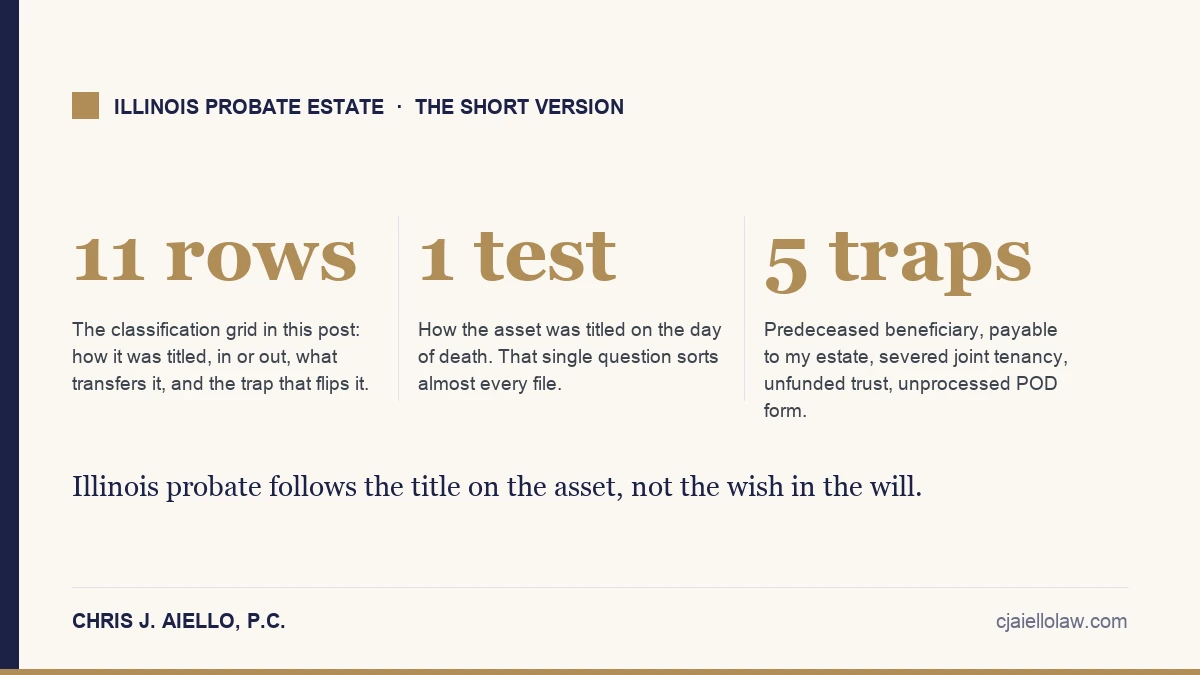
Five situations move an asset from the column the family expected into the other one. They account for most of the surprises we see.
A beneficiary who died first. The designation does not pass to that person's children unless the form or the contract says so. Where nothing takes its place, the money falls into the probate estate, and it usually falls there years after anyone last looked at the paperwork.
A form that names the estate. Some carriers default to it, and some people choose it deliberately so the money is available to pay debts. Either way it is a probate asset, and it is fully exposed to creditors in a way a direct beneficiary payment is not.
A trust that was signed but never funded. This is the most expensive one. A trust document with no assets retitled into it controls nothing, and the house you thought was protected opens a case anyway.
A joint tenancy that was severed. If one owner deeded their interest away, or a deed was redrawn without the express survivorship language, what looks like joint ownership is a tenancy in common and the decedent's share is in the estate.
A payable-on-death form the bank never processed. The customer filled it out. The branch never keyed it in. The account shows one name at the institution, so the institution treats it as a probate asset no matter what the copy in the folder says.
Order a date-of-death statement from every institution and read how the account is captioned there, not how you remember it. The caption on the bank's own record is what the bank will act on.
Does Estate Size Change the Answer?
It changes the paperwork, not the classification. A house in one name is a probate asset whether the estate is worth $60,000 or $6 million. What the size affects is whether a case has to be opened at all.
Below a ceiling set by 755 ILCS 5/25-1, a small estate affidavit can move personal property instead. The point worth taking from this post is narrower: only probate assets count toward that ceiling. The joint account, the IRA with a living beneficiary and the insurance policy are not in the calculation at all, which is why the sort has to come before the arithmetic. Families routinely add up every statement in the folder, decide they are over, and open a case they never needed.
Real estate does not move on the affidavit either way, so a solely titled house usually means a case. Who qualifies, what the affiant is personally signing up for and how the thresholds work are in our guide to the Illinois small estate affidavit.
Sorting an Estate in DuPage County
If a case has to be opened for a DuPage County estate, it opens in the Eighteenth Judicial Circuit at the DuPage Judicial Center, 505 N. County Farm Road, Wheaton. Filings go through the Clerk of the Circuit Court, and civil filings are submitted electronically through the state eFileIL system rather than at a counter.
Anything titled to real estate also touches the DuPage County Recorder, whether you are recording a death certificate against a joint deed, recording a notice of death affidavit after a transfer on death instrument, or recording a deed out of the estate at the end. Pull the recorded deed for the house early. The recorded document is the answer to the titling question, and it is public.
If there is no will, the statute names who takes and in what shares, and the sorting exercise stays exactly the same. That path is set out on our page on intestate estate administration in DuPage County.
When Should You Stop and Call?
Sort the folder yourself. It is your estate and nobody knows the paperwork better than the family does. Bring someone in when one of these shows up: a solely titled house, a business interest, a beneficiary who died first, a trust nobody can confirm was funded, an out-of-state property, a creditor already calling, or a relative who says the will is wrong.
At that point the cost of guessing is higher than the cost of an hour with a DuPage County probate attorney. If you want the full sequence of what a case looks like once it is opened, read our walkthrough of Illinois probate administration step by step.
The other question families ask in the same meeting is what the job pays the person doing it. Illinois sets no percentage, and what counts as a reasonable executor fee walks through how the amount is supported and who has to approve it.
Not sure which column a parent's house falls into?
Chris J. Aiello, P.C. has guided Villa Park and DuPage County families through estate administration since 1990. Bring the folder, and we will tell you plainly what the court controls and what it does not.
Schedule a ConsultationSources: 755 ILCS 5/25-1 · 755 ILCS 27/40 · 765 ILCS 1005/1 · 765 ILCS 1005/2 · 765 ILCS 1005/1c · DuPage County Clerk of the Circuit Court · DuPage County Recorder · Illinois Courts eFileIL · Illinois Legal Aid Online: probate
General information about Illinois law, current as of September 2026. It is not legal advice and it does not create an attorney-client relationship.