Ancillary Probate in Illinois: When an Estate Owns Property in Two States
Land is probated where it sits, so an estate with property in two states can need a second, smaller court case in the state that is not the owner's home. For an out-of-state owner with a house in DuPage County, the Illinois case goes in the county holding the greater part of the Illinois real estate (755 ILCS 5/5-1), and a will already admitted elsewhere can be proved here with an authenticated copy (5/7-3). If the only goal is to sell or mortgage Illinois land, a nonresident representative may petition for that alone, with no Illinois letters (5/22-4). For Illinois personal property such as a bank account, the out-of-state representative can sometimes collect it by affidavit with no Illinois case at all (5/22-1). For a DuPage resident who also owned a place in another state, the Illinois case is the main one and that state's rules govern its own land.
Your father lived in Wheaton and kept a condo in Florida. Or your aunt lived in Arizona and never sold the family house in Glen Ellyn. Either way, the paperwork now points at two states, and someone has told you the phrase ancillary probate in Illinois, or in the other state, without saying what it means for you.
Put simply, ancillary probate is a second, supporting court case opened in the state where the decedent did not live but owned property. The main case is opened where the person was domiciled. The Illinois Probate Act does not use the word "ancillary" in the sections that matter here; it talks about foreign wills and foreign representatives. This guide sorts out which direction your estate runs, what the Illinois side needs, and what to leave to a lawyer in the other state.
Work Out Which Direction Your Estate Runs
Two families can both say "we have property in two states" and need very different things. The first question is which state is home and which state is the visitor. The second is what kind of asset sits in the visiting state: land, or money and accounts. The table sets out the three common patterns for a family with an Illinois connection.
| Where the owner lived and what was owned | Which court opens the main case | What the Illinois side needs | Papers that travel between the cases |
|---|---|---|---|
| A DuPage County resident who also owned real estate in another state | The DuPage County court, as the home county under 755 ILCS 5/5-1(a) | The Illinois case runs as usual. The other state's court handles the land there under that state's own rules, and Illinois law does not decide how | Typically a certified copy of the Illinois will and letters, whatever form the other state's court asks for |
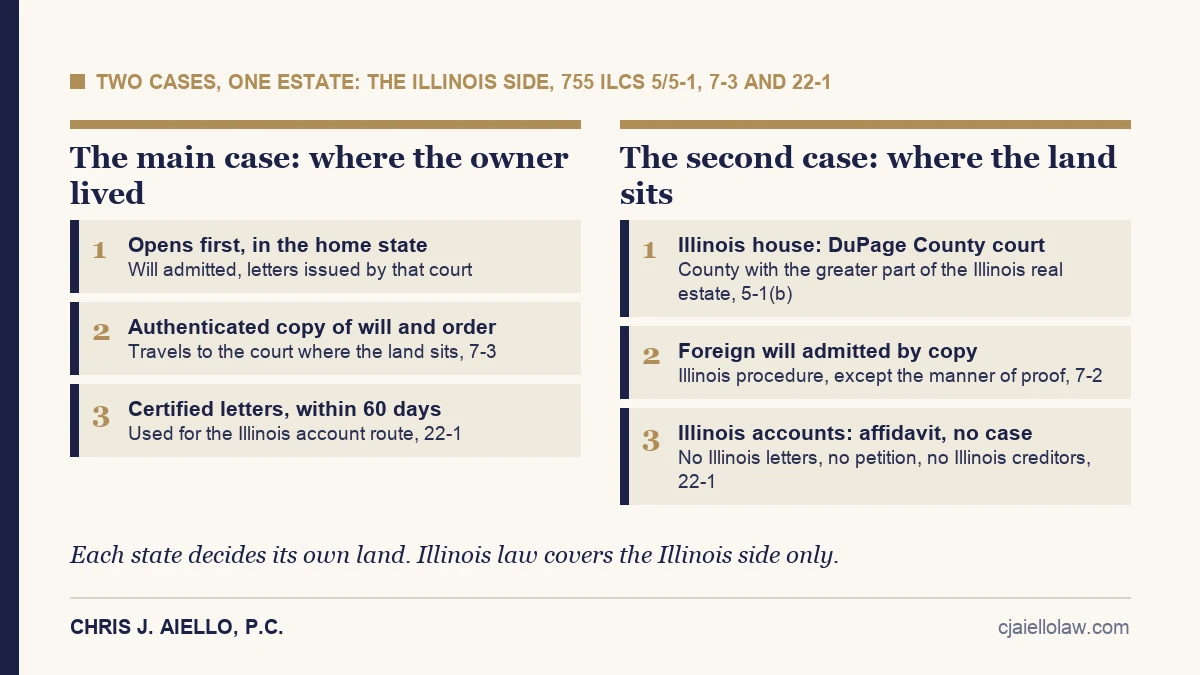
| An out-of-state resident with a house or other real estate in DuPage County | The home state's court first. An Illinois case follows for the Illinois land, unless the only goal is to sell or mortgage it, which 22-4 allows a nonresident representative to petition for without Illinois letters | An Illinois case in the county holding the greater part of the Illinois real estate (5-1(b)). A foreign will is admitted under Article VII, often by authenticated copy (7-3) | Authenticated copy of the will and the order admitting it; certified letters from the home state if an affidavit route is used |
| An out-of-state resident whose only Illinois assets are bank, brokerage or similar accounts | The home state's court | Possibly no Illinois case at all. The home-state representative may collect Illinois personal estate by affidavit and certified letters (22-1), if no Illinois letters or creditors stand in the way | An affidavit by the representative and a copy of the letters certified within 60 days of presentation |
One caution runs through the whole table. Title decides what is a probate asset in the first place. A condo held in a living trust, a house with a recorded transfer on death instrument, or an account with a named beneficiary may never need either court. Which assets go through probate in Illinois is worth reading before you assume a second case is coming.
A DuPage Estate With Property in Another State
If the person lived in DuPage County, the main probate case belongs here. Under 755 ILCS 5/5-1(a) an estate is administered in the county where the decedent had a known place of residence. The Illinois representative gets Illinois letters and runs the estate in the ordinary way.
The land in the other state is handled by that state's court, under that state's law. This is where families get into trouble by assuming the Illinois rules travel. They do not. How long the other state's case takes, what it costs, whether it is simple or formal, and whether your Illinois representative can serve there are all answered by that state, not by Illinois. Our practice is Illinois law, so we say plainly where our part ends. It is ordinary and sensible to hire a local attorney in the other state for that piece, and a good Illinois attorney will coordinate with them so the two cases tell the same story.
What you can do from the Illinois side is gather what the other court will ask for: the death certificate, the original or a copy of the will, a certified copy of the Illinois letters, and a list of the out-of-state property with how it is titled. Ask the other court's clerk which form of certification it accepts before you order copies, because the answer varies from place to place.
An Out-of-State Estate With a House in DuPage County
A common version: a retiree moved south, kept the family home or a rental in DuPage County, and was domiciled in the home state at death. The home state opens the main case. Illinois opens a second one for the real estate.
Which Illinois county. Under 755 ILCS 5/5-1(b), when the decedent had no known place of residence in Illinois, the case goes in the county where the greater part of the decedent's real estate in the state is located at death. If every Illinois parcel is in DuPage County, the answer is simple. If the decedent owned land in two Illinois counties, the county holding the greater part decides. Subsection (c) covers the case with no Illinois residence and no Illinois real estate: the county holding the greater part of the personal estate.
Getting the will admitted. The Probate Act has a whole article for wills from elsewhere. Section 7-1 allows a will to be admitted when it has already been admitted to probate outside Illinois, or when it was signed outside Illinois in accordance with Illinois law, the law of the place where it was signed, or the law of the testator's domicile at the time. Under 7-2 the ordinary Illinois procedure for admitting a will applies, except for the manner of proof.
The manner of proof is the useful part. Section 7-3 says a written will already admitted to probate elsewhere is sufficiently proved in Illinois by introducing an authenticated copy of the will and of the order admitting it. That means the family does not have to bring the original witnesses to a DuPage courtroom. Where the home state does not require wills to be probated, an authenticated certificate from the legal custodian of the will does the same job, and a notarial will from a place that keeps such wills with a notary can be proved by the notary's authenticated copy.
If the will was not probated at home, 7-4 allows original proof in Illinois by the method that Illinois, the place of signing, or the testator's domicile uses for its own wills. Even then, the court will not admit a will on proof of fraud, forgery, compulsion or other improper conduct that, in its opinion, is enough to invalidate it.
Illinois letters. Once the will is admitted, it has the same effect as a domestic will, and the court may issue letters to the person who will run the Illinois side unless the issuance of letters is excused (7-5). How letters of office work in an Illinois probate explains that sequence, and it is the same here. The Illinois representative collects the Illinois land, pays Illinois obligations, and, if the house is to be sold, follows the same rules a resident estate would. If a sale is the goal, selling a house during Illinois probate covers what the representative needs before listing.
A shortcut when the only goal is a sale. If no letters are issued in Illinois and a representative has been appointed in the home state, Section 22-4 lets that representative petition the Illinois court for leave to lease, sell or mortgage the Illinois real or personal estate, in the county holding the greater part of it. The petition comes with authenticated copies of the letters (authenticated within 60 days before presentation), of the home court's order authorizing the application, and of any bond and the order approving it. Whether a full Illinois case or this narrower petition fits depends on what the family intends to do with the property, which is a good question to settle before anything is filed.
Illinois Accounts and Personal Property Without an Illinois Case
Not every out-of-state estate needs a DuPage County case. Section 22-1 lets a representative holding letters from a court in another state, territory, country or the District of Columbia collect personal estate located in Illinois and remove it to the home jurisdiction. The person or institution holding the asset needs two things:
- an affidavit by the representative that, to the representative's knowledge, no letters issued on the petition of an heir, legatee or creditor are outstanding in Illinois, no petition for such letters is pending, and there are no creditors of the estate in Illinois; and
- a copy of the letters certified within 60 days before the date of presentation.
Once the holder pays or delivers the asset on that paper, it is released as if it had paid a qualified Illinois representative. No payment or delivery may be made sooner than 30 days after the death. The route reaches personal estate only, not land. And it depends on its conditions being true: if letters issued on an heir's, legatee's or creditor's petition are outstanding in Illinois, if such a petition is pending, or if the estate has any creditor in Illinois, the affidavit cannot truthfully be given and the institution will want an Illinois representative instead.
A related rule matters if something goes wrong. Under 22-3, when no Illinois letters have issued, an out-of-state representative may sue in Illinois in any case where a resident representative could, though the court may require a bond for costs. Between 22-1 and 22-3, a small Illinois bank balance or a refund owed to a nonresident estate often does not justify a full Illinois case. Institutions differ in how readily they accept the affidavit, so call the holder first and ask what they require.
Who Can Serve When the Family Lives Elsewhere
A family in another state often asks whether the person named as executor can serve in Illinois at all. Section 6-13(a) requires an executor to be at least 18, a resident of the United States, not of unsound mind and not otherwise disqualified, with limited exceptions for a felony conviction the testator knew about. Living outside Illinois does not by itself disqualify anyone.
There is a safeguard, however. Under 6-13(d) the court may require a nonresident executor to furnish a bond in an amount and with a surety the court decides, even if the will says no bond is needed. Plan for the possibility. The bond is an expense of the estate, and it is a reason some families name an Illinois co-executor or ask the Illinois court to appoint someone local for the Illinois piece.
How This Runs in DuPage County
When the Illinois property is in DuPage County, the Illinois case for an out-of-state decedent is filed in the Eighteenth Judicial Circuit, which sits at the DuPage Judicial Center, 505 N. County Farm Road, Wheaton. Filing goes through the DuPage County Clerk of the Circuit Court and the statewide eFileIL system, so an out-of-state family does not need to travel for the filing itself. The petition, the authenticated will, and the required notices are the usual package.
When the case ends with a sale or transfer of the house, the deed is recorded with the DuPage County Recorder. The sale is where a DuPage house inside a two-state estate becomes a real estate matter, and handling a DuPage house inside an estate is part of our probate real estate practice.
Avoiding a Second Case Next Time
The cleanest way to avoid ancillary probate is not to own the second-state property in the decedent's name alone at death. A living trust that holds the title can keep Illinois property out of probate here, and whether it does the same for a parcel in another state is that state's question. how families avoid probate in Illinois goes through the Illinois options. For Illinois real estate specifically, a recorded transfer on death instrument can pass the house without a court case. Joint ownership can also work in some situations, but it brings its own risks, so get advice before retitling anything. What passes for an out-of-state parcel depends on the rules of the state where it sits, so any plan for that parcel needs a lawyer there.
When to Bring in a Probate Attorney
Early, and mainly for coordination. Two courts will each ask for papers the other issued, and the order matters: a certified letter from the home state may be needed for the Illinois filing, and Illinois letters may be needed by the other state. A DuPage County probate attorney can run the Illinois side, tell you which questions belong to the other state's counsel, and keep the two files from contradicting one another. If you only have an Illinois bank account to collect, a short consultation may be all you need to decide whether the 22-1 affidavit fits.
Property in Illinois and an estate somewhere else?
Chris J. Aiello, P.C. has guided DuPage County families through probate since 1990, including estates opened in another state that hold a house or accounts here. Bring the will, the other state's letters if there are any, and a list of the Illinois property. We will tell you whether an Illinois case is needed and what it takes.
Schedule a ConsultationSources: 755 ILCS 5/5-1 · 755 ILCS 5/7-1 · 755 ILCS 5/7-2 · 755 ILCS 5/7-3 · 755 ILCS 5/7-4 · 755 ILCS 5/7-5 · 755 ILCS 5/22-1 · 755 ILCS 5/22-3 · 755 ILCS 5/22-4 · 755 ILCS 5/6-13 · DuPage County Clerk of the Circuit Court · Illinois Courts eFileIL · DuPage County Recorder · Illinois Legal Aid Online: probate
General information about Illinois law, current as of October 2026. This guide covers Illinois law only; the law of any other state is for a lawyer licensed there. It is not legal advice and it does not create an attorney-client relationship.