A Trust Does Not Make the Debts Disappear: What an Illinois Trustee Does About Creditors

A trust avoids probate, not debts. Under 760 ILCS 3/505(a)(5), the property of a trust that was revocable at the settlor's death is subject to the settlor's creditors, the costs of administering the estate, funeral expenses and the surviving spouse's and children's awards, to the extent the probate estate cannot pay them. Claims that would be barred against the estate are barred against the trust property too, as to claims connected with settling the estate. Before distributing, a trustee finds the debts, checks whether an estate is open and which dates matter, and holds back money until the picture is clear. The section releases a trustee from liability under it for assets distributed under the trust instrument nine months or more after the death, if the trustee had not received a written notice from the estate's representative that the estate is or may be insufficient to pay allowed claims.
Short answer: yes, in many Illinois trusts creditors can be paid from trust property after the owner dies. Families often hear the opposite. A parent sets up a living trust, the house and accounts sit in it, and everyone concludes that debts are someone else's problem. This guide is for the successor trustee who has just been told the trust avoids probate and now has to decide whether creditors get paid from a trust in Illinois before the beneficiaries see a dollar.
It follows the Trust Code and the Probate Act sections that bear on the question, and it says so where the text we reviewed leaves a point open.
Do Creditors Get Paid From a Trust in Illinois?
For a trust that was revocable when the settlor died, generally yes, but only after the estate runs short. Section 505 of the Trust Code says that, subject to the settlor's right to direct the source from which liabilities will be paid, the property of a trust that was revocable at death is subject to the settlor's creditors, the costs of administration of the estate, funeral and disposal expenses, and statutory awards to a surviving spouse and children, to the extent the probate estate is inadequate to pay them. Distributees take what is left after those payments.
The same subsection puts limits on the reach. Sums a personal representative recovers from the trust are administered as part of the probate estate. The exposure does not apply to assets that are exempt under Illinois or federal law. As to claims connected with settling the estate, any claim that would be barred against the estate is barred against the trust property, the trustee and the beneficiaries. And the Probate Act's claim classes and payment order, sections 18-10 and 18-13, apply to a revocable trust to the extent the probate assets are inadequate and the representative, a creditor or a taxing authority has perfected its right to collect.
Notice what the section does not say. It does not say the trust is the first place a creditor looks. The probate estate comes first, which is why the first fact a trustee needs is what the parent owned in their own name.
Which Assets Creditors Can Reach, and Which They Cannot
The answer turns on what kind of trust it is and what else the parent left. The table is the checklist a trustee can work down before any distribution. Cells stay conditional because the instrument and the facts can change the result.
| Situation | What the trustee checks | What to hold back |
|---|---|---|
| Estate is open and the claims period is running | The dates in the published notice, the list of claims filed and the executor's view of whether the probate assets can pay them | Enough to cover the claims and expenses not yet resolved, until the executor confirms the estate is solvent or the claims are barred |
| No estate has been opened | Whether the parent owned anything in their own name and whether any bills are outstanding. Section 18-12(b) bars most claims 2 years after death whether or not letters issue | A reserve sized to the debts you can identify. Ask the attorney how a creditor can proceed when no estate exists, because the sections reviewed do not answer that |
| Trust assets plus assets that went through probate | Whether the probate assets are enough on their own. Section 505 reaches the trust only for the shortfall | Nothing extra if the estate clearly covers its debts. Otherwise the shortfall amount |
| Secured debt such as a mortgage on a house in the trust | The loan documents and the payment status | Enough to keep payments current while the trustee decides whether to keep or sell the property |
| Irrevocable trust where the settlor could not receive distributions | The instrument. Section 505(a)(2) lets a settlor's creditor reach what could be distributed to or for the settlor, so the key question is what the settlor could receive | Depends on the instrument. Do not assume protection until it is read |
| Income tax and other tax returns for the final year | Who prepares the returns and what is owed. The sections reviewed for this guide do not cover tax payment | An amount the return preparer gives you |
Under section 18-10, funeral and burial costs and the expenses of administration are paid first, then the surviving spouse's or child's award. Our guide to paying claims in an insolvent Illinois estate explains the class order, and disputed claims against an Illinois estate covers the executor's side when a claim looks wrong. Those posts are about the estate. This one is about the trustee.
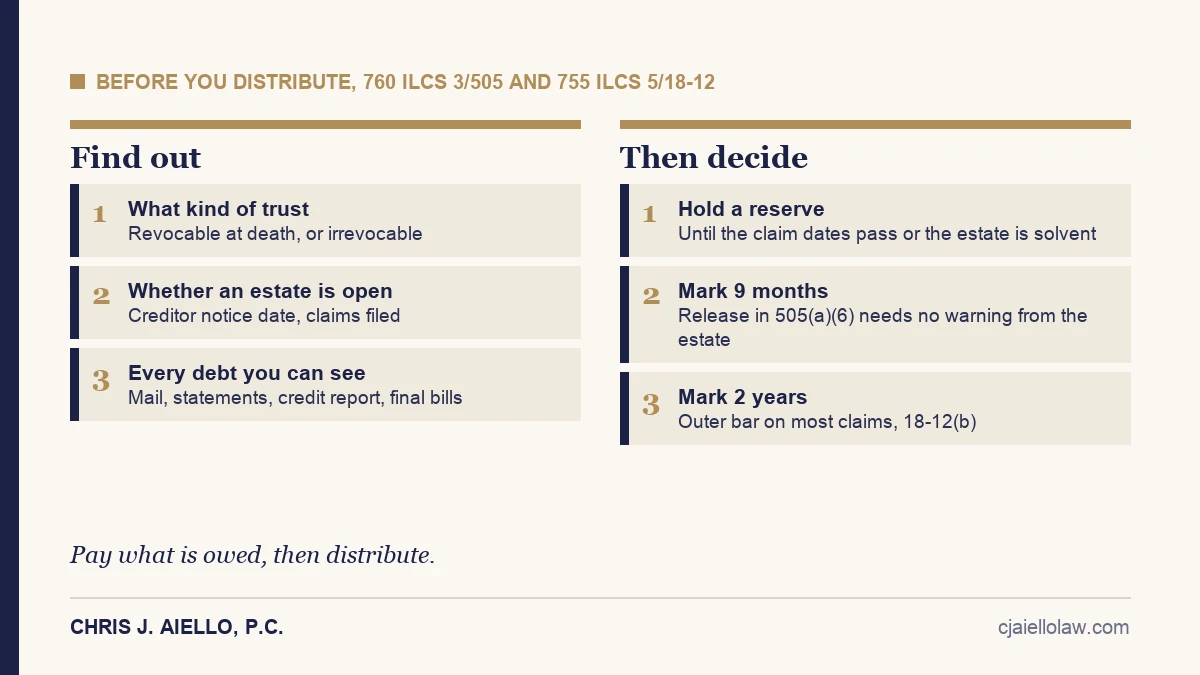
How to Find the Debts Before You Distribute
You cannot hold back for a debt you do not know about. Start with the mail, because creditors write to the address they have. Then go further.
- Keep every bill, statement and collection letter that arrives, and log the date each one came in.
- Read the parent's last twelve months of bank and credit card statements for recurring payees.
- Request the decedent's credit report through the process the reporting agencies publish for deceased persons.
- Ask the medical providers and the nursing home, if any, for a final bill.
- If an estate is open, ask the executor for the list of claims filed and the date the notice says claims are barred.
If an estate is open, the published notice states the date by which claims must be filed (755 ILCS 5/18-3), and under 755 ILCS 5/18-12 most claims are barred 2 years after death in any event, whether or not letters of office are issued. Those dates are the clock a trustee works against.
When Should a Trustee Hold Money Back?
Until the picture is clear. The statutes give three markers, and none of them is a promise of safety. The first is the creditor notice date, if an estate is open. The second is nine months from the date of death. Section 505(a)(6) releases a trustee of a trust that was revocable at death from liability under that section for assets distributed under the trust instrument if the distribution was made 9 months or later after the settlor's death and the trustee had not received a written notice from the personal representative saying the probate estate is or may be insufficient to pay allowed claims (unless the personal representative withdrew that notice or the court revoked it before the distribution). The third is the 2-year outer bar in 18-12(b).
In practice, many trustees make a partial distribution once the obvious debts are paid and keep a reserve until the claim dates pass. How large the reserve should be depends on the size of the estate, the debts known so far and what the executor says, so there is no formula here. Beneficiaries can find this slow. A short update letter explaining why a reserve is held goes a long way, and the trustee's notice and accounting duties already call for regular communication.
What Puts a Trustee Personally at Risk
The text we reviewed does not say in so many words that a trustee is personally liable for a distribution made too soon. What it does is release a trustee who waits nine months and receives no qualifying warning from the estate's representative. That release covers liability under section 505 only. It does not cover a complaint from a beneficiary or a different claim.
The wider risk comes from the trustee's duties to the beneficiaries. Section 1001 lists what a court may do when a trustee breaches a duty owed to a beneficiary, including ordering the trustee to pay money or restore property, ordering an accounting, removing the trustee and reducing or denying compensation. That section concerns a duty owed to a beneficiary. The sections reviewed do not say whether a distribution that leaves a creditor unpaid is such a breach, so it is a question for the attorney. The safer habits are the dull ones: write down what you checked, keep a reserve and pause any large payout until the executor, if there is one, has confirmed the status.
A separate rule in 18-12(d) lets an unbarred claim be asserted against a distributee of the estate. That rule belongs to the estate side, and the executor's attorney handles it.
What to Bring to the First Meeting
- The trust document, any amendments and the death certificate.
- The will, if there is one, and the court case number if an estate has been opened.
- Every unpaid bill, collection notice and statement that has arrived since the death.
- Recent statements for every account, and the deed and mortgage statement for any real estate.
- A list of the beneficiaries and what each is to receive.
- Any notice you have received from an executor or from a creditor.
When to Bring in Legal Help
A call is worth making before the first distribution, when a collection notice lands, when an executor sends a warning that the estate may be short, or when you are not sure whether the trust is revocable. Help with trust administration in Illinois can include reading the instrument for how debts are to be paid, coordinating with the executor, working out a sensible reserve and handling a creditor who writes directly to you. If an estate is open as well, our probate practice in DuPage County works alongside. For the planning side, what a living trust does and does not shield is covered in our living trust guide.
Just became a trustee and a bill arrived?
Chris J. Aiello, P.C. has guided DuPage County families through trust administration since 1990. Bring the trust and the paperwork, and we will tell you what to check, what to hold back and what to pay.
Schedule a ConsultationSources: 760 ILCS 3/505 · 760 ILCS 3/1001 · 755 ILCS 5/18-3 · 755 ILCS 5/18-12 · 755 ILCS 5/18-10 · 755 ILCS 5/18-13 · Illinois Courts · DuPage County Clerk of the Circuit Court
General information about Illinois law, current as of November 2026. This guide describes the Trust Code and Probate Act sections cited; your trust's facts may call for a different answer. It is not legal advice and it does not create an attorney-client relationship.