Disputed Claims Against an Illinois Estate: How an Executor Says No
An Illinois executor or administrator does not have to pay a claim because it showed up. If the creditor sent the claim only to you, a written notice of disallowance under 755 ILCS 5/18-11(b) gives them a stated date, at least two months out, to file in court or lose the claim for good. If the creditor filed in court, you answer with a pleading within 30 days after the copy is mailed or delivered to you under 18-5 and the judge decides under 18-7. Paying or consenting in writing allows the claim and binds the estate. Nothing gets distributed to heirs while a claim is still open.
Most of what you will read about contesting a claim against an estate in Illinois is written for the creditor: how to file, which clock applies, what happens if you miss it. This guide is written for the person on the other side of the table. You are the executor or administrator of a DuPage County estate, and a claim has landed that looks wrong. A hospital bill the insurer already paid. A "loan" from a cousin with no paperwork. A credit card balance that doubled after the death. A claim from your own sibling for years of caregiving. The Probate Act gives you a procedure for every one of them, and it is more favorable to the estate than the creditor-facing guides let on.
One boundary first. A creditor's claim is a demand for money from the estate. It is not a challenge to the will, which is a separate proceeding on its own six-month deadline; if that is your situation, start with what it takes to challenge the will itself in Illinois. Everything below assumes the will stands and the fight is about a debt.
Can an Executor Refuse to Pay a Claim Against an Illinois Estate?
Yes, and the statute expects you to. Under 755 ILCS 5/18-11 the representative "may at any time" pay or consent in writing to a claim you determine is valid, as long as it is not barred under 18-12 and the court has not disallowed it, and "may at any time disallow all or any part of any claim" that has not been filed with the court. Everything below applies the same way to an administrator appointed when there is no will.
Refusing is not a lawsuit. It is you declining to spend other people's inheritance on a debt nobody has proved, and the statute puts the first move on the creditor: under 755 ILCS 5/18-2 a claim must be in writing and state enough to tell you the nature of the claim, and under 18-7 the court may require the claimant to prove the claim even when nobody has objected to it.
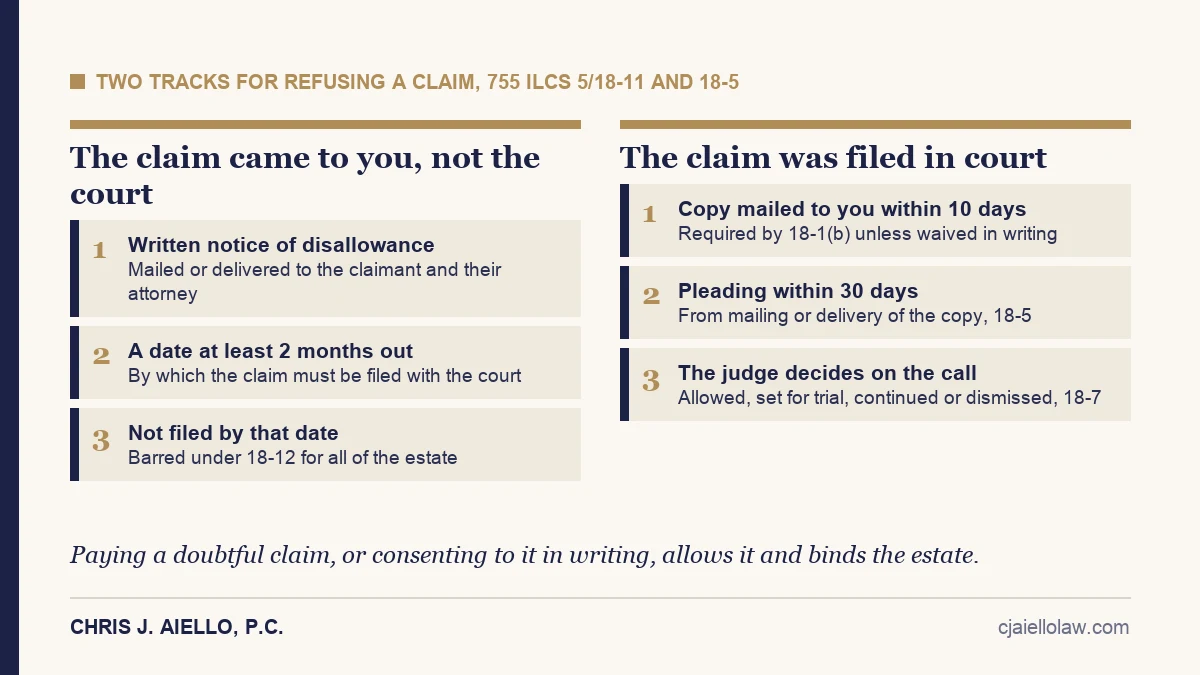
What decides the procedure is where the claim was filed. 755 ILCS 5/18-1(a) lets a creditor file with the representative, with the court, or both. A claim sent only to you has not been filed in court, and you have no duty to file it there for them. A claim filed with the court comes to you as a copy the claimant must mail within 10 days under 18-1(b), unless you or your attorney waived mailing or consented to the claim in writing. Those are the two tracks, and the rest of this guide follows them.
First, Decide Whether the Claim Holds Up
Before you choose a track, read the claim against this list. Each line is a reason the estate can say no.
- It was already paid. Medical providers bill the patient and the insurer in parallel. Ask for the ledger, not the summary.
- It is time-barred. Every claim except expenses of administration and the spouse's or child's award is barred if the creditor missed the date in the notice mailed to them, or, for a creditor you could not reasonably identify, the date in the published notice, under 755 ILCS 5/18-12(a), and every claim the section reaches is barred two years after death under 18-12(b) whether or not letters ever issued. The notice mechanics, and why the six-month window is really two clocks, are in our guide to the Illinois probate timeline.
- The amount is wrong. Interest and late fees that accrued after death, collection charges, or a balance that does not match the last statement the decedent received.
- There is no writing behind it. A personal "loan" with no note, no bank record of the transfer, and no repayment history is a claim the estate can make the claimant prove.
- It is not the decedent's debt. A spouse's own card, an adult child's account the decedent paid out of habit, a debt of a business entity rather than the person.
- It is covered by insurance. 18-12(c) lets a liability claim proceed to the extent of the policy, but the estate's own assets are not the target. Tender it to the carrier.
Write down which line applies. The notice of disallowance does not have to give a reason, but you will want one if the claimant files in court.
Paying or Agreeing in Writing Binds the Estate
The trap to avoid. Under 18-11(a), payment or written consent by the representative "constitutes allowance of the claim and binds the estate." Once you pay a doubtful claim, the estate cannot get the money back by changing its mind, and any interested person can require you to "establish the propriety" of the allowance. An executor who paid a questionable $9,000 claim to stop the phone calls may be explaining that choice to the heirs at the final accounting, and in the wrong case making it good personally.
Pay only claims you have checked and can document, and when a court-filed claim is allowed, file notice of the allowance with the court as 18-11(a) directs. Everything else gets the procedure below.
| Where the claim was filed | What the representative does | The deadline in the statute | Who decides | Jury |
|---|---|---|---|---|
| Sent only to the representative, not filed with the court | Mails or delivers a written notice of disallowance to the claimant, and to the claimant's attorney if known (18-11(b)) | The notice names a date not less than 2 months from the date of the notice; a claim not filed in court by that date is barred under 18-12 | The claimant has to move it into court or lose it. No hearing happens unless they do | Not reached unless the claim is filed in court |
| Filed with the court (the claimant mails you a copy within 10 days, 18-1(b)) | Files a pleading with the clerk: an answer, defenses, and any counterclaim the estate holds against the claimant (18-5) | Within 30 days after mailing or delivery of the copy of the claim; the court can also order pleadings on its own schedule (18-5(b)) | The judge, on the call of the claim: allowed, set for trial, continued or dismissed (18-7(a)). A claim with no pleading filed may be taken as proved | Claimant demands at filing; the estate demands no later than its answer or other pleading (18-6) |
| Filed by the representative or the estate's attorney against the estate | Filed like any other claim; the court may appoint a special administrator to defend the estate (18-8) | Same 30-day pleading rule for anyone whose rights are affected | The judge, with the special administrator opposing | Available to either side on the same timing |
Track One: The Claim Came to You, Not the Court
This is the common case. A collection letter, a final hospital statement, a relative's email. None of it has been filed with the DuPage Circuit Clerk. Your tool is the notice of disallowance in 755 ILCS 5/18-11(b), and the statute tells you what it has to contain.
- It is in writing, and it is mailed or delivered to the claimant. If you know the name and address of the claimant's attorney, it goes to the attorney too.
- It states that the claim is disallowed, in whole or in part. You may disallow only the part you dispute and allow the rest.
- It states a date by which the claim must be filed with the court, and that date is "not less than 2 months from the date of the notice." Give yourself margin: count two full calendar months from the date on the letter and add a few days.
- It states the consequence: a claim not filed with the court on or before that date "will be barred."
Keep a copy and proof of mailing. A disallowed claim not filed in court by the stated date is barred under 18-12 "in the same manner as a claim not timely filed": gone for all of the decedent's estate, not deferred. A creditor who does file after your notice has done nothing wrong; the notice invites exactly that. There is also no rule against talking, and many a doubtful claim is withdrawn once the claimant is asked for the ledger.
What Happens When a Creditor Files the Claim in Court?
Online summaries say the court sets a "preliminary hearing within 30 days." That is not what the statute says. What 755 ILCS 5/18-5(a) actually says is that the representative, or anyone else whose rights could be affected, "may file pleadings with the clerk of the court within 30 days after mailing or delivery of the copy of the claim." Thirty days is your window to answer, not the court's deadline to hold a hearing.
What goes in the pleading is what you wrote down in the first section: paid, time-barred, wrong amount, no writing, not the decedent's debt. If the claimant owes the estate money, 18-5(a) lets you file a counterclaim in favor of the estate in the same proceeding, and under 18-7(b) the court can enter judgment for the estate on it. A sibling who claims $30,000 for caregiving while holding $12,000 of estate funds from the decedent's checking account is the classic example.
Then the claim comes up on the court's call. Under 18-7(a) it "may be allowed, set for trial, continued or dismissed." A claim the representative consented to, or "to which no pleading has been filed within the time provided," may be taken as proved. That clause is why the 30 days matters: silence is not a defense. The court may still require the claimant to prove the claim, but do not rely on the judge's discretion when a pleading would have cost an afternoon.
Read 755 ILCS 5/18-6 before you file anything. A claimant must demand a jury when filing the claim. The person opposing the claim must demand one "not later than the filing of his answer or other pleading." File the answer without the demand and you waive your own jury demand, unless the court finds good cause to allow it later. Costs other than the claimant's filing fee are in the court's discretion under 18-9, so a baseless claim can end with the claimant paying for the hearing.
None of this changes in independent administration. 755 ILCS 5/28-8(e) gives an independent representative the power to "settle, compound or compromise and pay all claims against the estate as provided in Sections 18-11 and 18-13" without a court order. The disallowance notice and the 30-day pleading are the same tools whether your letters say independent or supervised.
Can the Executor or the Estate's Lawyer Make a Claim?
Yes, but not on the honor system. 755 ILCS 5/18-8 says a representative or the representative's attorney with a claim against the estate "must file a claim as other persons," and the court "may appoint a special administrator to appear and defend for the estate." Do not allow your own claim; the court can put a special administrator in your place to defend it. Money you advanced for the funeral goes through the same door as a stranger's claim, with someone else holding it.
Caregiving claims deserve their own paragraph because they are the ones families fight over. Illinois has a statutory custodial claim under 755 ILCS 5/18-1.1 for a spouse, parent, brother, sister or child of a person with a disability who lived with and personally cared for that person for at least three years. The statute sets minimum amounts by degree of disability, from $45,000 at 25 percent to $180,000 at 100 percent, "subject to the extent of the assets available," and it lets the court reduce the amount where the arrangement also benefited the caregiver through free housing or the like. Under 755 ILCS 5/18-10 a statutory custodial claim is a first-class claim, paid alongside funeral and administration expenses and ahead of every ordinary creditor. The full order is in the statutory order an executor pays debts in.
A caregiving claim that does not meet 18-1.1, because the care ran two years rather than three or the decedent had no disability, is an ordinary seventh-class claim that has to be proved like any other debt.
Do Not Distribute While a Claim Is Open
A disallowed claim is not dead until its date passes, and a court-filed claim is not dead until the court dismisses it or rules against it. Until then the estate holds the money. 755 ILCS 5/18-12(d) protects a representative who acts in good faith to find creditors and give notice under 18-3, but read the exception: that protection does not cover "a claimant whose claim is known to the representative and is not paid or otherwise barred." A claim you have in hand is known to you by definition.
The same subsection says an unbarred claim may be asserted against the estate "to the extent that assets have not been distributed," and against a distributee other than a creditor, but only so far as it leaves that person no less than they would have received had the claim been paid. So an early distribution does not make the claim disappear; it moves the argument to your heirs' living rooms, and in the wrong case to your own pocket. An estate that is short even after the invalid claims fall away is a different problem, governed by 18-13's class-by-class rule rather than by disallowance. The estate closes only when, as the closing checklist for an Illinois estate puts it, every filed claim is paid, settled, or formally disallowed.
How Does This Run in DuPage County?
Decedents' estates for DuPage residents are heard in the Eighteenth Judicial Circuit at the DuPage Judicial Center, 505 N. County Farm Road, Wheaton. A creditor who wants track two files the claim with the Clerk of the Circuit Court, in practice through eFileIL, and then mails you and your attorney of record the copy that starts your 30 days. Your pleading goes to the same clerk under the same case number. The statute does not require the notice of disallowance to be filed; it is a letter from you to the creditor, and the only court filing it produces is the one the creditor makes if they decide to fight.
Keep the estate's own paper tidy. The published notice to unknown creditors and the mailed notice to known ones under 755 ILCS 5/18-3 are what make the bar dates in 18-12 work at all; proof of publication is filed with the clerk, and copies of every mailed notice stay in the estate file. An estate with several disputed claims, a counterclaim, or a claimant inside the family is the kind of matter that calls for a DuPage County probate attorney who handles creditor claim defense.
When to Bring in Counsel
Not for every disputed bill. A single medical statement the insurer paid is a phone call and a letter. The moments that justify a lawyer are specific: a claim that has been filed in court, because the 30-day pleading and the jury demand are procedural traps with permanent consequences; a claim by a family member or a caregiver, because 18-1.1 and 18-8 put the analysis beyond a form letter; a claim large enough that disallowing it wrongly or allowing it wrongly changes what the heirs receive; and any claim that arrives after you have already started distributing. In each of those, counsel for an Illinois executor who has been served with a claim is cheaper than the mistake.
The executor's job is to make sure the estate pays what it owes, declines what it does not, and can prove the difference. The two tracks above are how the Probate Act lets you do that.
A claim that is valid but larger than the estate can pay raises a different question, and how an insolvent estate pays claims in Illinois covers the class order and pro rata payment.
Holding a claim against an estate that does not look right?
Chris J. Aiello, P.C. has represented DuPage County executors and administrators through disputed creditor claims, counterclaims and family claims since 1990. Bring the claim, the letters of office and whatever statements you have, and we will tell you which track it is on and what the next letter should say.
Schedule a ConsultationSources: 755 ILCS 5/18-1 · 755 ILCS 5/18-1.1 · 755 ILCS 5/18-2 · 755 ILCS 5/18-3 · 755 ILCS 5/18-5 · 755 ILCS 5/18-6 · 755 ILCS 5/18-7 · 755 ILCS 5/18-8 · 755 ILCS 5/18-9 · 755 ILCS 5/18-10 · 755 ILCS 5/18-11 · 755 ILCS 5/18-12 · 755 ILCS 5/28-8 · DuPage County Clerk of the Circuit Court · Illinois Courts eFileIL · Illinois Legal Aid Online: probate
General information about Illinois law, current as of October 2026. It is not legal advice and it does not create an attorney-client relationship.