When an Illinois Estate Owes More Than It Holds: Paying Claims in an Insolvent Estate

An estate is insolvent when valid claims exceed the probate assets. Under 755 ILCS 5/18-13 claims are paid class by class in the order set by 18-10, and when the money runs out inside a class, everyone in that class shares pro rata. Funeral costs, administration expenses and the spouse's or child's award come ahead of the IRS, the hospital and the credit cards. The debts belong to the estate, not to the family; apart from debts an heir signed for and a spouse's family expenses, an heir's exposure from the estate is limited to what they received before a valid claim was paid. The executor's exposure comes from paying out of order or distributing too soon.
You have added up the bills and the number is bigger than the bank balance. That is the whole definition of an insolvent estate in Illinois: the valid claims against a decedent's estate exceed the assets available to pay them. It is common: a long illness, a reverse mortgage, or a modest estate and a large final hospital bill will do it. What matters now is that Illinois has a fixed procedure for this situation, and that an executor who follows it is protected while an executor who improvises is not.
This guide is for the DuPage County executor or administrator holding that stack of bills, and for the heir sitting next to them who is afraid the debts are about to become theirs. The short answer to the heir is no, with narrow exceptions covered below.
What Is an Insolvent Estate in Illinois?
The Probate Act builds the rule in one sentence. 755 ILCS 5/18-13 directs the representative to pay all claims "in the order of their classification, and when the estate is insufficient to pay the claims in any one class, the claims in that class shall be paid pro rata." An estate that is "insufficient" to pay every class in full is insolvent. The only exception the section carves out is 19-6, which gives obligations of a decedent's unincorporated business the representative keeps running (one month after letters, longer if the court allows) priority out of that business's own assets.
Two features of that rule do most of the work. First, the order is not negotiable: the executor has no discretion to pay a sympathetic creditor ahead of a higher class. Second, inside the class where the money ends there is no first-come, first-served; every claimant in that class takes the same percentage, whatever order the bills arrived in.
One more rule sets the scene. Under 755 ILCS 5/18-14 all of the decedent's real and personal estate is chargeable with claims "without distinction," unless the Probate Act or the will provides otherwise, and may be leased, sold, mortgaged or pledged as the court directs. The house counts. An estate with $20,000 in the bank and a $300,000 house free of mortgage is not insolvent because the cash ran out; it is solvent with an illiquid asset, and that is a different conversation.
Confirm the Estate Is Short Before You Call It Insolvent
Insolvency is a conclusion, not a feeling, and it is reached in a particular order.
- List the probate assets at their realistic value: accounts titled to the decedent alone, vehicles, personal property, the decedent's interest in real estate, and anything owed to the estate. Joint accounts, beneficiary-designated accounts and trust assets are generally not probate assets; whether a creditor can reach them is a separate question.
- Give the notices that start the claim clocks. Under 755 ILCS 5/18-3 the representative publishes once a week for three successive weeks, and mails or delivers notice to every known or reasonably ascertainable creditor. The claim date is not less than six months from first publication or three months from mailing, whichever is later. How long the creditor claim period keeps an Illinois estate open is its own topic; for an insolvent estate the point is that you cannot know the total until the window closes.
- Collect the claims that are filed and sort out the ones that are not valid. A claim that was already paid, is time-barred, or cannot be proved is refused through the disallowance notice or a pleading, not counted toward insolvency.
- Rank what remains by class under 755 ILCS 5/18-10 and total each class.
Only when the valid, ranked claims exceed the assets do you have an insolvent estate. Many estates that look short on the day of death are not, once the invalid claims drop out and the house is counted.
Stop Paying Anyone Until You Know the Total
The one rule that protects the executor. Nothing in a lower class gets paid until you know every higher class is covered, and nothing in the class where the money ends gets paid until you know the percentage. An executor who repays a friend's personal loan in month two and then finds in month seven that the nursing home and the spouse's award exceed what is left has paid a seventh-class claim ahead of the second and fourth classes, and can be held personally responsible for the shortfall.
Reasonable administration expenses, which are first class, are the exception that lets the estate function: court costs, the bond premium, the attorney, the accountant, and the executor's own fee are paid as administration runs. The rules on an executor's own fee apply unchanged, but in a short estate the fee is one more first-class claim competing with the funeral bill, so document the hours.
The table below is an illustration with round numbers, not a real estate. It shows the arithmetic the statute requires once the claims window has closed and the invalid claims are gone.
| Class under 755 ILCS 5/18-10 | Claims in this estate (illustration) | Amount claimed | Amount paid | How it was calculated |
|---|---|---|---|---|
| Probate assets available | Checking account, vehicle, net proceeds of the house sale | $100,000 | Starting total after sale costs | |
| 1st: funeral and burial, administration expenses, statutory custodial claims, final guardianship fees and costs | Funeral home $11,000; court costs, bond premium, attorney and executor fees $19,000 | $30,000 | $30,000 | Paid in full; $70,000 remains |
| 2nd: surviving spouse's or child's award | Spouse's award as fixed by the court | $25,000 | $25,000 | Paid in full; $45,000 remains |
| 3rd: debts due the United States | Final federal income tax | $5,000 | $5,000 | Paid in full; $40,000 remains |
| 4th: final-year medical, hospital and nursing home expenses; wages up to $800 per employee for the last 4 months | Hospital $48,000; nursing home $24,000; home aide wages $800 | $72,800 | $40,000 | Pro rata at 54.9 cents on the dollar: hospital $26,373, nursing home $13,187, aide $440. Money ends here |
| 5th: trust money the decedent held that cannot be traced | None | $0 | $0 | |
| 6th: debts due Illinois and local governments | None filed | $0 | $0 | |
| 7th: all other claims | Two credit cards $22,000; personal loan from a friend $9,000 | $31,000 | $0 | Nothing left in the estate. Unpaid when the estate closes; not owed by the heirs |
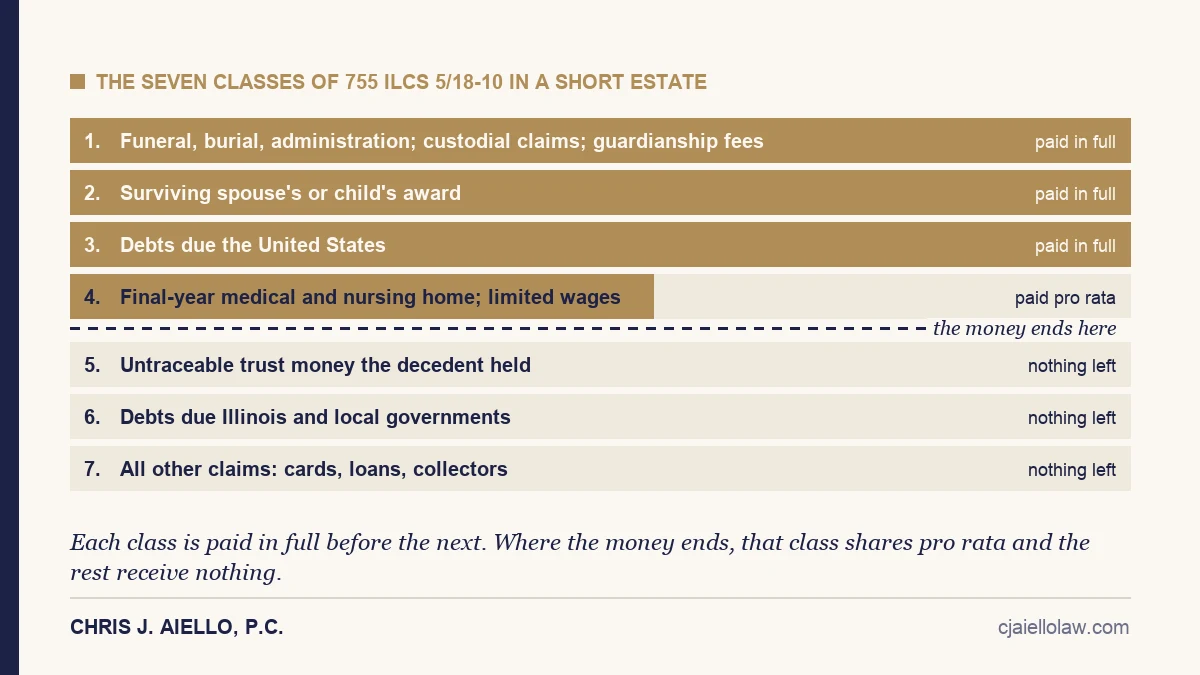
Pay Class by Class, Then Pro Rata Where the Money Ends
With the window closed and the table built, the payment sequence writes itself. Pay the first class in full, then the second, and so on down 18-10 until you reach the class the remaining money cannot cover. Divide what is left by the total of that class, and pay every claimant in it that same fraction. Everything below that class receives nothing from the estate.
The seven classes, in the statute's order, are in the table above and in how an Illinois executor ranks and pays the estate's debts, which covers the order in the ordinary case. This page is about what the order does when the money is short.
Two things people get wrong. The 18-10 fourth class is limited to care "during the year immediately preceding death"; an older unpaid hospital balance is seventh class. And the $800 wage figure is a cap per employee, not a total, so a decedent who employed a home aide and a housekeeper can have two capped wage claims in the fourth class.
In independent administration the representative has the power to pay claims this way without a court order: 755 ILCS 5/28-8(e) authorizes paying "all claims against the estate as provided in Sections 18-11 and 18-13." That said, an insolvent estate is the textbook case for asking the court anyway. Under 755 ILCS 5/28-5 any interested person may petition for a hearing on any matter germane to the estate, and an independent representative who petitions for instructions hands that decision to the judge. An order approving the pro-rata schedule is the cleanest protection an executor of a short estate can hold.
Where Do the Spouse's and Child's Awards Fall?
Second class, ahead of the IRS and ahead of every hospital and every card. The award is a statutory allowance for the surviving spouse, and for dependent children, for a period of support after the death; it is paid before third-class federal debts and before the fourth-class medical and nursing home bills that so often cause the insolvency in the first place. The amounts, how the court fixes them, and the spouse's other rights are the subject of the surviving spouse's award and the other rights of an Illinois spouse; what matters on this page is the rank.
Notice too that 755 ILCS 5/18-12(a) exempts "expenses of administration and surviving spouse's or child's award" from the claim bar dates altogether. A spouse who did not file a "claim" during the six-month window has not lost the award. In the table above, the $25,000 award is paid before a single dollar reaches the hospital.
Do Heirs Have to Pay a Parent's Debts in Illinois?
As a rule, no. A claim against the estate is exactly that: a claim against the estate's assets under 18-14, decided and paid through the probate case. When the estate cannot pay the seventh class, those creditors go unpaid when the estate closes. They do not acquire a new debtor in the decedent's children.
The exceptions are narrow and worth stating precisely so nobody is scared into paying what they do not owe.
- A debt the heir already owed. A co-signed loan, a joint credit card, a jointly held mortgage: the surviving signer owes it because they signed, not because they inherited.
- Family expenses between spouses. Under the Illinois Rights of Married Persons Act, 750 ILCS 65/15, "the expenses of the family" are chargeable upon the property of both spouses and either may be sued for them. The same section bars a creditor from pursuing a spouse for an expense that was not a family expense, unless that spouse agreed in writing to be liable or bought, holds or ordered the goods or services, and makes a creditor who does so liable for the spouse's costs and attorney's fees.
- Money that left the estate too early. Under 755 ILCS 5/18-12(d) an unbarred claim may be asserted against a distributee, "but only to the extent that the distributee's share of the estate will not, in effect, be diminished below what the distributee would have received had the claim been paid by the representative." An heir who received $15,000 in month three from an estate that turned out to owe that money to a fourth-class creditor can be asked for it back. An heir who received nothing cannot.
A collector who tells an adult child that they "inherited" a parent's card balance is describing none of these. The right response is to ask them to file a claim with the estate, where it will be ranked and paid, or not, under 18-13.
Does the House Have to Be Sold?
Often, yes, and 18-14 is why. Because real and personal estate are chargeable with claims "without distinction," and because "there is no priority as between real and personal estate" in deciding what gets sold, unless the Probate Act or the will provides otherwise, a house the decedent owned alone is available to pay the funeral home, the spouse's award and the hospital when the cash is gone. An independent representative has the power to sell real estate under 28-8(i), subject to the written consent of a legatee to whom it was specifically left; in supervised administration the sale runs on a court order. The mechanics of getting a house from the estate to a buyer, and where the proceeds go, are in how a house is sold during Illinois probate.
A sale does not change the order; the net proceeds are paid down the same classes. Heirs who want to keep the house can sometimes cover the shortfall themselves, and that negotiation has to happen before the representative is obligated to sell.
The Executor's Own Exposure, and the Bond
An insolvent estate is where executors get hurt, and the statute says so in two places. 755 ILCS 5/12-4(a) lets the court require security from a representative the will excused from bond whenever the court "believes that the estate of the decedent will not be sufficient to discharge all the claims against the estate." Expect the bond question early, and under 12-10 the court can require further security at any time, and checks the bond at each accounting before the final one.
And 18-12(d), read carefully, is a shield with a hole in it. A representative who acts in good faith to find creditors and give notice is not personally liable to a creditor, "except with respect to a claimant whose claim is known to the representative and is not paid or otherwise barred." In a short estate every creditor you know about is a known claimant, so the protection comes from paying them in the statutory order at the statutory percentage and distributing nothing to heirs until that is done.
How This Runs in DuPage County
Estates of DuPage residents are administered in the Eighteenth Judicial Circuit at the DuPage Judicial Center, 505 N. County Farm Road, Wheaton. Claims that creditors choose to file in court go to the Clerk of the Circuit Court, generally through eFileIL, and the representative's petition for instructions on a pro-rata schedule, where one is sought, is filed in the same case. Proof of publication of the creditor notice is filed with the clerk as 18-3(b) requires. The Article XVIII claim procedure has no separate "notice of insolvency" filing; the protection comes from the published and mailed notices, the class-by-class payment, and where the estate wants it, a court order approving the schedule.
A short estate's file should show its work, because the creditors who will not be paid scrutinize every administration dollar: the asset list, the notices and proof of mailing, each claim with its class and disposition, the arithmetic and the receipts. That record is what DuPage County probate counsel for an estate that cannot pay every claim builds from the first week.
When to Bring in Counsel
Earlier than in a solvent estate. The moment the known bills look likely to exceed the known assets, the decisions that follow are the ones with personal consequences for the executor: whether to pay the funeral home now, whether to seek a court order on the schedule, whether and when to sell the house, how to respond to the collector who has started calling the children. An attorney who represents Illinois executors through an insolvent administration is there to keep the executor's name off the shortfall.
The family's part is simpler: do not pay the decedent's creditors from your own money, do not sign anything a collector sends, and route every demand to the representative.
Before a claim ever reaches that ranking, the executor can reject one that looks wrong, and how an executor disputes a claim in Illinois covers the notice and the filing steps.
Settling an estate where the bills are bigger than the balance?
Chris J. Aiello, P.C. has guided DuPage County executors and families through insolvent estates since 1990: the notices, the class order, the pro-rata schedule and the court order that protects the person doing the work. Bring the bills and the account statements and we will tell you where the money ends and what the heirs do and do not owe.
Schedule a ConsultationSources: 755 ILCS 5/18-10 · 755 ILCS 5/18-13 · 755 ILCS 5/18-14 · 755 ILCS 5/18-12 · 755 ILCS 5/18-3 · 755 ILCS 5/12-4 · 755 ILCS 5/28-5 · 755 ILCS 5/28-8 · 750 ILCS 65/15 · DuPage County Clerk of the Circuit Court · Illinois Courts eFileIL · Illinois Legal Aid Online: probate
General information about Illinois law, current as of October 2026. The table is an illustration with invented figures. It is not legal advice and it does not create an attorney-client relationship.