Surviving Spouse Rights in Illinois Probate: The Award, the Renunciation, and What You Get Without a Will
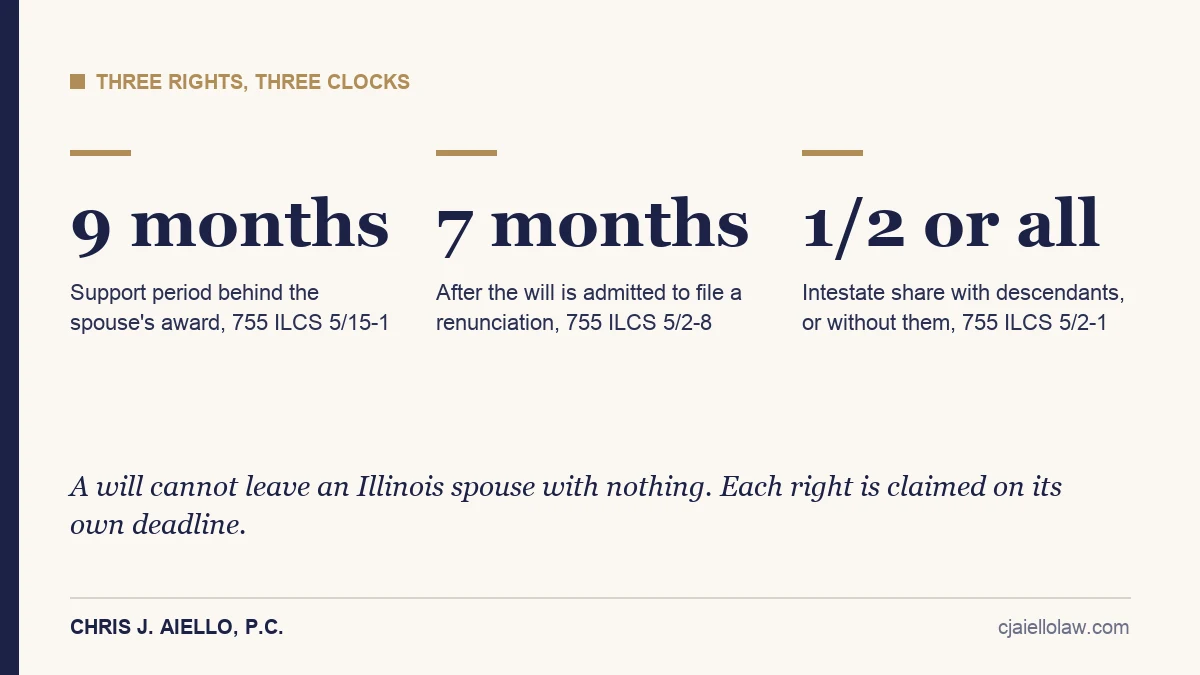
A will cannot leave an Illinois spouse with nothing. Three separate rights stand behind a surviving spouse, and each runs on its own statute, its own clock and its own math. The spouse's award under 755 ILCS 5/15-1 is support money for nine months, never less than $20,000, paid ahead of nearly every creditor. The renunciation under 755 ILCS 5/2-8 lets a spouse reject the will and take one-third of the estate if there are descendants, one-half if there are none, but only by filing in the probate court within seven months after the will is admitted. And if there is no will, 755 ILCS 5/2-1 gives the spouse half the estate alongside descendants or all of it without them. None of the three reaches assets that were never in the estate, and a valid marital agreement can waive them.
The sentence that brings people to us is "the will says I get nothing." Sometimes from a widow holding a will written before the marriage, sometimes from a husband whose wife left everything to children from a first marriage. Illinois has an answer to it. Surviving spouse rights in Illinois are three distinct rights, and the mistake almost every family makes is treating them as one. This guide separates them, puts them in a table, and then tells you the order to do things in.
This post does not restate who inherits down the line when there is no will; for that, see the full Illinois intestate order. This one is about the spouse only.
What Are Surviving Spouse Rights in Illinois?
A child can be disinherited with a sentence. A spouse cannot, because three rights survive whatever the will says.
The first is the spouse's award: support money for the nine months after death, set by the court and paid ahead of ordinary creditors, will or no will.
The second is the renunciation of the will: the right to file a paper rejecting the will and take a fixed statutory share instead, whether or not the will provides for the spouse.
The third is the intestate share: what the spouse takes when there is no valid will. Each right is claimed differently, on a different deadline, against a different pool of assets. The table sets them side by side.
| Right | Statute | Who qualifies | How much | Deadline and where it is claimed | Does the will control it? | Effect of a prenup or postnup |
|---|---|---|---|---|---|---|
| Spouse's award | 755 ILCS 5/15-1 | Spouse of a deceased Illinois resident whose estate is administered here, will or no will | Reasonable support for nine months; never less than $20,000, plus at least $10,000 per minor child living with the spouse; up to three installments | Set by the court in the open estate; 30 days after notice of allowance to elect goods instead of cash (15-4) | Only if the will expressly says its gift is in lieu of the award, and the spouse does not renounce | A valid agreement can waive it |
| Renunciation of the will (statutory share) | 755 ILCS 5/2-8 | Spouse of a testator, whether or not the will provides for the spouse | One-third of the estate if the testator leaves a descendant; one-half if none; after all just claims | Signed instrument filed in the court where the will was admitted, within seven months of admission; extension only on a petition filed inside that window citing pending litigation | No. Filing bars any claim under the will, and the will cannot block it | A valid agreement can waive it |
| Intestate share | 755 ILCS 5/2-1 | Spouse where there is no valid will | One-half of the estate if the decedent leaves a descendant; all of it if none; after all just claims | No filing; distributed by the administrator in the estate | Not applicable; there is no will | A valid agreement can waive it |
| Child's award | 755 ILCS 5/15-2 | A minor child not living with the surviving spouse; all minor children where there is no spouse | Reasonable support for nine months; never less than $10,000 per child, plus at least $20,000 shared where there is no spouse | Set by the court and paid to the person it directs | No. Section 15-2 has no in-lieu clause; the court sets it whatever the will says | A premarital agreement cannot cut a child's right to support (750 ILCS 10/4(b)) |
What Does the Spouse Get If There Is No Will?
755 ILCS 5/2-1 is short on this point. Spouse and a descendant: one-half to the spouse, the other half to the descendants per stirpes. Spouse and no descendant: everything to the spouse. Parents and siblings take nothing while a spouse survives. The share is computed after all just claims are paid, which includes the award, because the award is itself a claim.
The spouse also has first preference to serve as administrator under 755 ILCS 5/9-3, so in a no-will estate the surviving spouse is usually both running it and its largest beneficiary. Opening and carrying that estate through is the work of a DuPage County attorney for estates without a will.
Renouncing the Will and Taking the Statutory Share
This is the only one of the three that is an election. You have to choose it, in writing, on time, and it cannot be undone.
Under 755 ILCS 5/2-8, a surviving spouse who renounces the will takes one-third of the entire estate if the testator leaves a descendant, or one-half if the testator leaves no descendant, in each case after payment of all just claims. The right exists "whether or not the will contains any provision for the benefit of the surviving spouse", so a will that leaves the spouse a token gift, a life estate, or nothing at all is treated the same way.
The mechanics are exact. The spouse files a signed written instrument declaring the renunciation in the court where the will was admitted, within seven months after admission. The court may allow more time only if, inside those seven months or an extension already granted, the spouse petitions and states that litigation is pending that affects the spouse's share. Not knowing about the deadline earns no extension. And the trade is blunt: filing is a complete bar to any claim under the will. Renounce, and whatever the will did leave you is replaced by the fraction.
Two further rules matter to the rest of the family. Under subsection (c), a future interest that was to follow the spouse's interest accelerates as though the spouse had died first, unless the will says otherwise. Under subsection (d), the court apportions the loss or gain among the other legatees in proportion to their gifts. A renunciation re-cuts everyone else's slice, which is why it tends to be the moment a calm estate turns adversarial.
Whether to renounce is arithmetic: what the will gives, against one-third or one-half of a net estate you can only estimate once claims are known. Seven months is shorter than the six-month claims window plus the time it takes to value a house, which is why we calendar the deadline the day the will is admitted.
Renouncing a Will Is Not Challenging It, and It Is Not Disclaiming
Illinois uses three verbs for three different acts, and families mix them up expensively.
A renunciation under 2-8 accepts that the will is valid and takes the statutory share instead. No grounds, nothing proved. A will contest says the document is not valid, for lack of capacity, undue influence or bad execution, and must be filed within six months of admission; if it succeeds the will falls. Read the grounds and deadline for a will contest in Illinois if that is your situation. A spouse can do both at once, and the pending contest is exactly the litigation that supports a 2-8 extension petition.
A disclaimer under 755 ILCS 5/2-7 runs the other way: it refuses property rather than claiming more, usually for tax or benefits reasons. The document, the federal nine-month rule and where the refused share goes are in our guide to refusing an inheritance outright under 755 ILCS 5/2-7. The two instruments have opposite effects and neither can be withdrawn.
The Spouse's Award: Support Money While the Estate Is Open
The award is the right nobody plans around and almost every estate underpays. 755 ILCS 5/15-1 gives the surviving spouse of a deceased Illinois resident, whose estate is administered here, a sum the court deems reasonable for the spouse's proper support for the nine months after death, suited to the spouse's condition in life and the condition of the estate, and in no case less than $20,000. Minor children of the decedent who lived with the spouse add not less than $10,000 each. The award is the spouse's own property, exempt from a judgment creditor while the representative holds it, and it is paid in up to three installments.
Subsection (a-5) adds a piece most people overlook: at least $5,000 more for each adult child likely to become a public charge who was financially dependent on the decedent and lived with the spouse. It has a trap: the spouse or adult child must give the representative written notice of the dependency within 30 days of receiving notice of the potential award, and missing the 30 days bars it.
Three practical points. The award ranks second among claims under 755 ILCS 5/18-10, behind funeral and burial expenses, expenses of administration and the other first-class claims, and ahead of medical bills, credit cards and Illinois taxes; in an insolvent estate it is often all the family receives. It is in addition to whatever the spouse inherits; support, not a share. And under subsection (b) the will displaces it only by expressly saying its provisions are in lieu of the award, and even then the spouse recovers it by renouncing the will.
Under 755 ILCS 5/15-4 the spouse may elect, in writing within 30 days of notice that the award is allowed, to take part or all of it in goods and chattels of the decedent not specifically bequeathed, at appraised value. That is how the car and the furniture stay with the widow without a fight.
The child's award
A minor child who did not live with the surviving spouse gets a separate award under 755 ILCS 5/15-2, not less than $10,000, paid to whoever the court directs. Where there is no surviving spouse, every minor child takes not less than $10,000 and the children share at least $20,000 more. A dependent adult child living apart from the spouse has the same $5,000 floor and 30-day notice rule.
What Do These Rights Not Reach?
The honest section. All three are rights in the probate estate, meaning property passing under the will or by intestacy. Many "the will left me nothing" cases turn out to be about assets that were never in the estate.
- A house held in joint tenancy with right of survivorship with someone other than you passes to the survivor at death.
- Bank and brokerage accounts with a payable-on-death or transfer-on-death designation go to the named person.
- Life insurance and annuities go to the named beneficiary.
- Real estate covered by a recorded transfer on death instrument on the house passes under that deed.
- Assets already titled in a trust are administered under the trust, not the estate.
Retirement plans run the other way: federal law gives a spouse protections in certain employer plans that a beneficiary form alone cannot defeat. That is a federal question to bring to counsel with the plan documents, not one to assume either way.
On the tax side, what passes to a spouse is treated differently from what passes to anyone else, and that treatment, with the Illinois and federal thresholds, is explained in how the Illinois estate tax treats what passes to a spouse. No figures here; that post owns them.
Prenups, Postnups and Waivers
All three rights can be given up in advance. The Illinois Uniform Premarital Agreement Act, at 750 ILCS 10/4, lets the parties contract about their rights in each other's property "whenever and wherever acquired", about the disposition of property upon death, and about making a will or trust to carry the agreement out. A waiver of the award, the renunciation right and the intestate share is a common term in a second-marriage prenup, and a postnuptial agreement can do the same work. Whether a particular document is enforceable, and whether it says what the other side claims, is a question for counsel with the signed agreement in hand. One thing the Act will not let a couple bargain away is a child's right to support, under section 4(b).
What If You Were Estranged, Separated, or Mid-Divorce?
The Probate Act's spouse provisions turn on whether you were married at the moment of death, not on the state of the marriage. A judgment of dissolution ends the status; a pending divorce does not, and neither does years apart. The decedent's children discover that the estranged spouse still has the renunciation right and the $20,000 floor; the spouse discovers that a joint-tenancy house or a changed beneficiary form during the separation took most of the estate out of reach.
Illinois does carry conduct-based bars, and they are narrow. Under 755 ILCS 5/2-6, a person who intentionally and unjustifiably causes the decedent's death takes nothing by reason of it, including by renunciation. Under 755 ILCS 5/2-6.2, a person convicted of financial exploitation, abuse or neglect of an elderly person or person with a disability, or found civilly liable for financial exploitation, is likewise barred from taking by reason of that person's death, unless it is shown by clear and convincing evidence that the decedent knew of the conviction or finding and afterward confirmed the gift. Neither is about a bad marriage. Absent one of them, a spouse is a spouse.
Doing It in DuPage County: The Order to File Things In
A DuPage estate is in the Eighteenth Judicial Circuit at the DuPage Judicial Center, 505 N. County Farm Road, Wheaton. The file is kept by the DuPage County Clerk of the Circuit Court, filings go through eFileIL, and the renunciation is filed in the same case number in which the will was admitted, because 2-8 requires it to be filed in that court.
- Find out whether an estate is open and who holds the letters. If nobody has filed, you likely have first preference.
- Get the date the will was admitted from the file. Count seven months forward. That is the renunciation deadline, and it does not wait for the inventory.
- Ask the representative in writing to petition for the award, and give the 30-day dependency notice if an adult child qualifies under 15-1(a-5).
- Get the inventory and a claims estimate, then run the arithmetic: what the will gives you against one-third or one-half of the net estate.
- If renouncing, file the signed instrument well inside the seven months, and any extension petition inside the window too.
- Within 30 days of notice that the award is allowed, file the 15-4 selection if you want goods counted against it.
This is general information about Illinois practice, not legal advice. Deadlines here run from dates in the court file; confirm each one against the file with the clerk or your attorney.
When to Sit Down With a Probate Attorney
Before the seven months run, and before you sign anything. The renunciation is irrevocable once filed, the award is undervalued when nobody asks, and the estranged-spouse cases turn on what was titled where. If the will is being written rather than administered, the limits on what a will can do to a spouse are a drafting question for a Villa Park wills attorney. If a spouse has died and the will is already in the file, the three rights above are claimed inside an open estate, on deadlines, and that is the work of a probate attorney handling DuPage County estates.
If the executor is ignoring the spouse’s award or the renunciation, what it takes to remove an executor in Illinois covers the petition an interested person can file.
Were you told the will leaves you nothing?
Chris J. Aiello, P.C. has filed renunciations and award petitions for Villa Park and DuPage County spouses since 1990. Bring the will, the date it was admitted, and what you know about the accounts, and we will tell you which of the three rights applies and how much time you have.
Schedule a ConsultationSources: 755 ILCS 5/2-8 · 755 ILCS 5/15-1 · 755 ILCS 5/15-2 · 755 ILCS 5/15-4 · 755 ILCS 5/2-1 · 755 ILCS 5/2-6 · 755 ILCS 5/2-6.2 · 755 ILCS 5/18-10 · 755 ILCS 5/9-3 · 750 ILCS 10/4 · DuPage County Clerk of the Circuit Court · Illinois Courts eFileIL · Illinois Legal Aid Online: probate
General information about Illinois law, current as of September 2026. It is not legal or tax advice and it does not create an attorney-client relationship.