Is a DUI a Felony in Illinois? When a Misdemeanor Becomes Aggravated DUI
A first or second DUI in Illinois is almost always a Class A misdemeanor. That is the direct answer, and if that is all you needed, you have it. But Illinois law lists specific circumstances that convert an ordinary DUI charge into aggravated DUI, an automatic felony, and several of them surprise people: driving without insurance, a suspended license, a crash with injuries, a child in the car. Two identical breath tests can produce a misdemeanor for one driver and a felony for another. This guide lays out exactly where the line sits, what the penalties look like at each level, and the one deadline that starts running the night of the arrest.

How Illinois Classifies DUI
Illinois DUI law lives in 625 ILCS 5/11-501. The offense is the same at every level: driving under the influence of alcohol (a 0.08 BAC, or impairment at any level), drugs, or a combination. What changes the classification is not the number on the breath machine. It is the circumstances around the driving. Prosecutors do not have to prove you were more impaired to charge a felony; they have to prove an aggravating fact existed.
The Felony Triggers: What Makes a DUI "Aggravated"
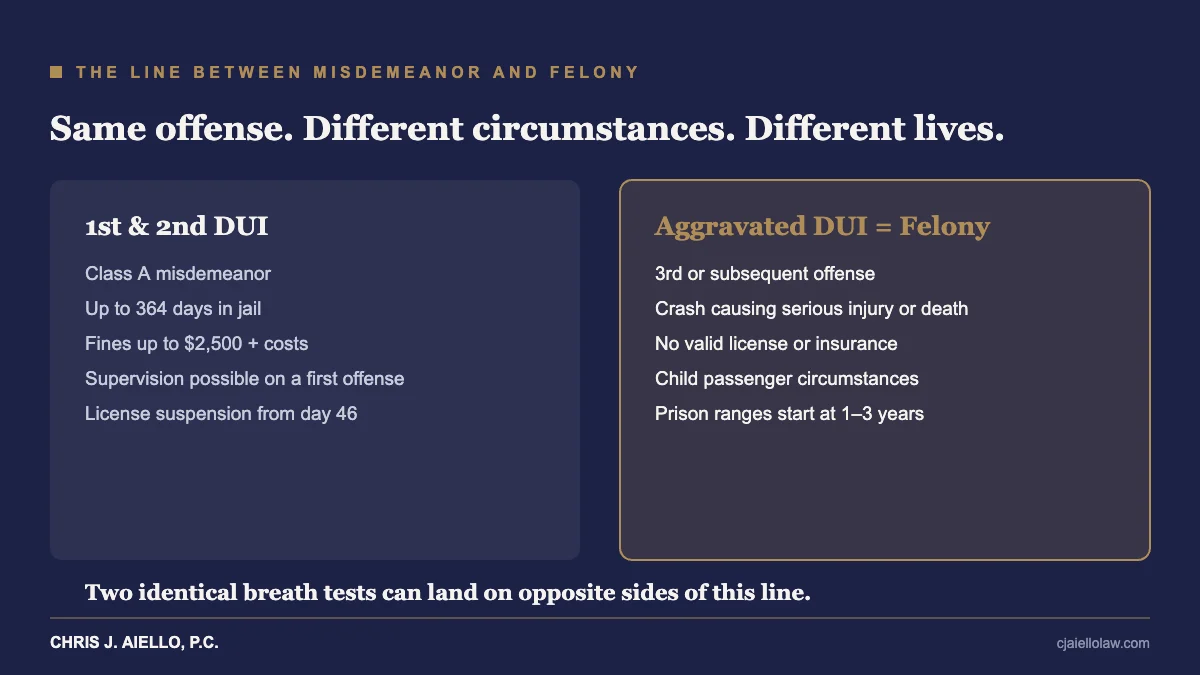
The most common triggers under 625 ILCS 5/11-501(d):
- A third or subsequent DUI: Class 2 felony, no exceptions.
- DUI while your license was suspended or revoked for a prior DUI-related reason.
- DUI without a valid driver's license or without vehicle insurance: Class 4 felony, and one of the most common surprises we see.
- DUI causing great bodily harm, permanent disability, or disfigurement: Class 4, with an extended 1–12 year range.
- DUI resulting in a death: Class 2, 3–14 years per death, and 6–28 years where more than one person died.
- Child-passenger circumstances: a second DUI with a passenger under 16, or any DUI in which a child passenger is injured.
- DUI while driving a school bus carrying passengers 18 or younger.
Each trigger moves the case out of misdemeanor court and into felony ranges, and most of them limit or eliminate the supervision and probation outcomes available on an ordinary first offense.
The Illinois DUI Penalty Chart
| Offense | Classification | Jail / prison exposure | Fines | License consequence |
|---|---|---|---|---|
| 1st DUI | Class A misdemeanor | Up to 364 days | Up to $2,500 + costs | Summary suspension 6 mo (12 mo if testing refused); minimum 1-year revocation on conviction |
| 2nd DUI | Class A misdemeanor | Up to 364 days; mandatory minimum 5 days jail or 240 hours community service | Up to $2,500 + costs | Minimum 5-year revocation |
| 3rd DUI | Class 2 felony (aggravated) | 3–7 years possible | Up to $25,000 | Minimum 10-year revocation |
| DUI without valid license or insurance | Class 4 felony | 1–3 years possible | Up to $25,000 | Revocation |
| DUI causing great bodily harm | Class 4 felony | 1–12 years | Up to $25,000 | Revocation |
| DUI resulting in death | Class 2 felony | 3–14 years per death; 6–28 if multiple deaths | Up to $25,000 | Revocation |
These are the statutory frameworks as of 2026. Individual outcomes turn on the facts, the county, criminal history, and eligibility for supervision or probation, which is exactly where the case gets won or lost.
What a Felony DUI Means Beyond the Sentence
A felony conviction follows you in ways a misdemeanor does not: employment and professional licensing applications, firearm ownership and FOID revocation, and immigration consequences for non-citizens. And here is the part that surprises nearly everyone: Illinois does not allow any DUI conviction, misdemeanor or felony, to be expunged or sealed. A conviction is permanent. That permanence is the single strongest argument for fighting the classification at the charging stage, where an aggravated count can sometimes be reduced or the underlying stop challenged, rather than negotiating after the label has attached.
The 46-Day Clock Nobody Tells You About
First Offense: The Realistic Picture
For a true first offense with no aggravating facts, Illinois allows court supervision, available once in a lifetime for DUI. Successfully completed, supervision avoids a conviction and the revocation that comes with it. Whether it is realistic depends on the county, the BAC, the stop video, and how the case is prepared. What a first offense actually costs (court, fees, insurance, the breath device, everything) is its own subject: how much a DUI costs in Illinois.
How This Plays Out in DuPage County
DuPage DUI cases run through the courthouse in Wheaton, and outcomes are driven by preparation: the squad video, how the field sobriety tests were administered, the breath machine's maintenance records, and the timing of the summary-suspension petition. Our office has defended DUI cases across Villa Park, Elmhurst, Lombard, Addison, and the western suburbs since 1990: misdemeanors kept off records through supervision, aggravated counts reduced, suspensions rescinded. See our DUI defense practice for how we work a case up.
Charged? Get a straight answer this week.
The felony line and the 46-day clock are both fact-specific, and both move fast. Bring us the ticket and the notice. We will tell you exactly where your case sits and what can still be changed.
Schedule a consultationSources: 625 ILCS 5/11-501 (DUI; aggravated DUI at subsection (d)); 625 ILCS 5/11-501.1 (statutory summary suspension); Illinois Secretary of State DUI Fact Book. This article is general information, not legal advice.