Losing Your License After a DUI in Illinois (and How to Get It Back)
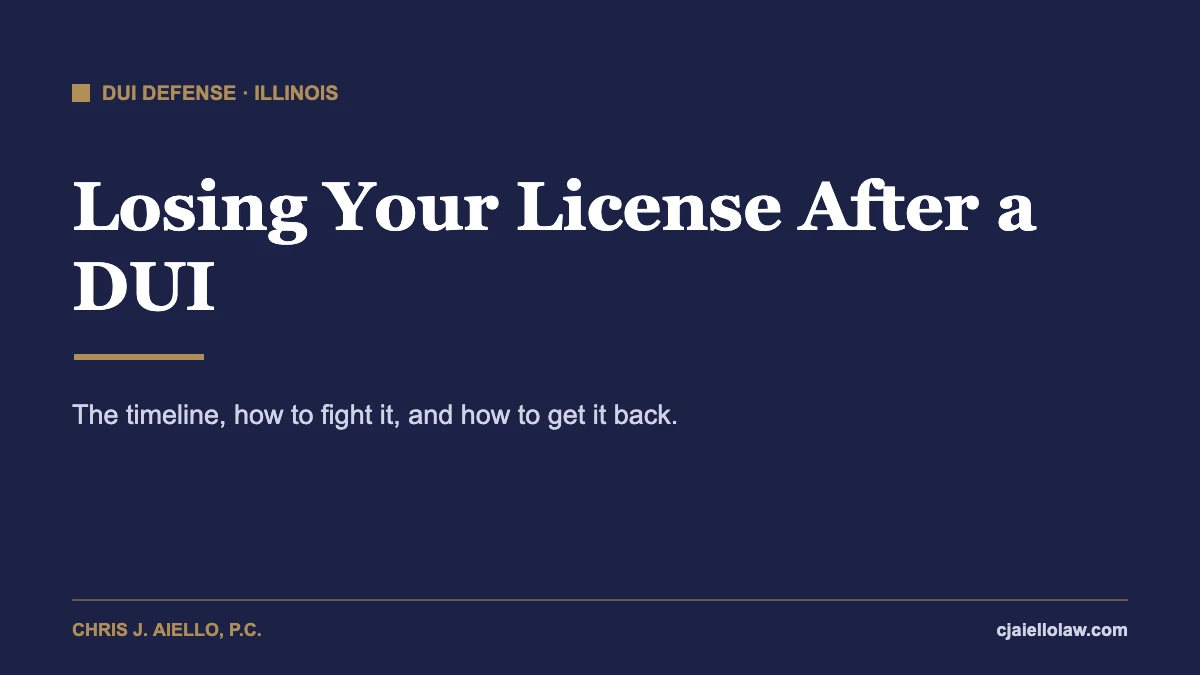
- The suspension is a statutory summary suspension: automatic, civil, and separate from the criminal DUI case (625 ILCS 5/11-501.1).
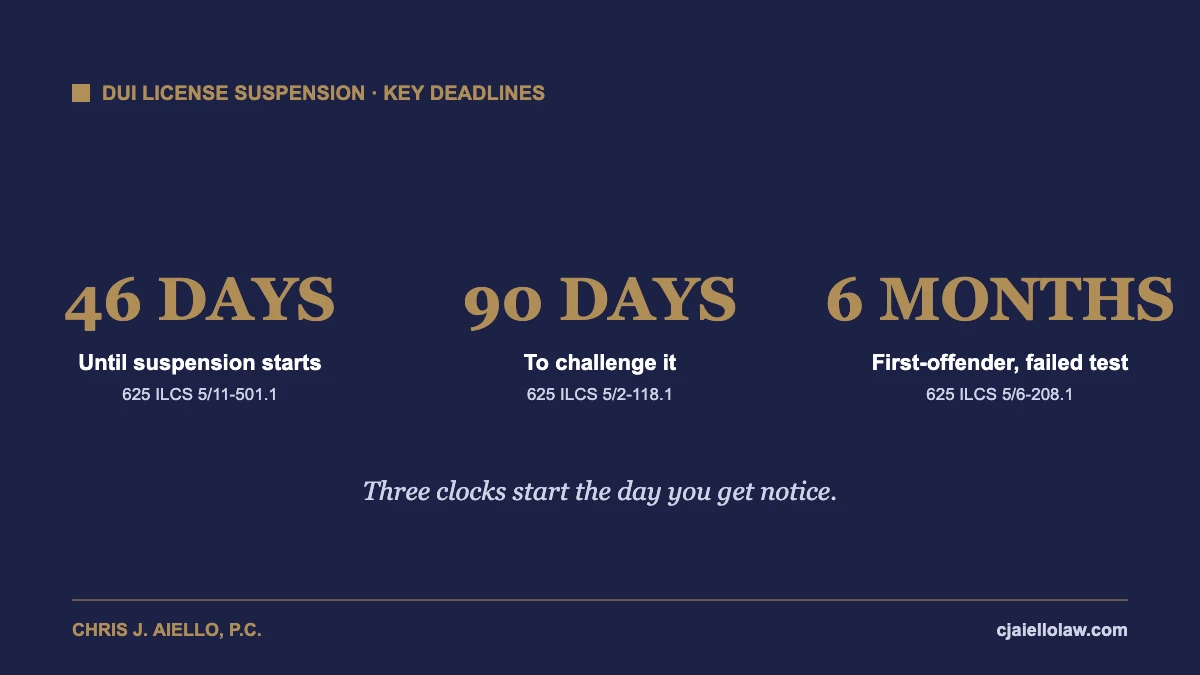
- It takes effect on the 46th day after notice, giving you a short window to act (625 ILCS 5/11-501.1).
- First offender: 6 months if you failed the test, 12 months if you refused (625 ILCS 5/6-208.1).
- You have 90 days to file a petition to rescind and challenge the suspension in court (625 ILCS 5/2-118.1).
- First offenders can keep driving with an MDDP + ignition interlock (BAIID), installed within 14 days of the permit (625 ILCS 5/6-206.1).
- Reinstatement takes a $250 fee for a first offense once the period ends (Illinois Secretary of State).
A DUI arrest in Illinois starts a clock most people never see coming. Your license suspension is automatic and civil, and it lands on the 46th day after you get notice, whether or not you are ever convicted of anything. It runs on a completely separate track from the criminal case, which is why people who beat the DUI charge are stunned to learn their license is still gone. The good news: you can often keep driving through the suspension with the right permit, you have a real window to fight the suspension itself, and getting your license back is a defined set of steps, not a mystery. This guide covers the timeline, the deadlines that matter, and exactly how to get your driving privileges back. If this is your first arrest, our overview of a first DUI in Illinois walks the criminal side in parallel.
Why This Suspension Happens (and Why the Criminal Case Won't Save You)
The moment you fail a chemical test at or above a 0.08 alcohol concentration, or refuse the test, Illinois moves to suspend your license under its implied consent law. This is the statutory summary suspension, and it is a civil action by the Secretary of State, not a criminal penalty from the judge (625 ILCS 5/11-501.1). That distinction is the whole ballgame. The burden of proof and the issues at a summary suspension hearing are different from a DUI trial, so you can be found not guilty of DUI, or have the charge dropped entirely, and still lose your license through the suspension. Treat the two as separate fights, because they are.
The Clock: Why Day 46 Decides Your Next Move
The suspension takes effect on the 46th day following the date you were given notice (625 ILCS 5/11-501.1). Those 45 days are not a grace period to relax. They are your window to challenge the suspension before it starts and to line up driving relief so you are not stranded on day 46. Miss that window and the suspension simply begins, on schedule, whether you have done anything or not. The single most common mistake is treating the arrest as one problem with one court date. It is really three deadlines running at once: day 46 (the suspension starts), 90 days (to file your challenge), and 14 days (to install the interlock once a permit issues). Mark all three the day you get notice.
How Long the Suspension Lasts (Fail vs Refuse, First vs Repeat)
Two things set the length: whether you failed or refused the test, and whether you are a first offender. Refusing the test is penalized more harshly than failing it, which surprises people who thought refusal was the safe play. Here are the exact periods from the statute.
| Your situation | Failed the chemical test (BAC 0.08+) | Refused or failed to complete the test |
|---|---|---|
| First offender | 6 months | 12 months |
| Not a first offender (repeat) | 1 year | 3 years |
Source: 625 ILCS 5/6-208.1. A "first offender" is defined narrowly by statute; a prior DUI, prior summary suspension, or prior court supervision inside the lookback period can push you into the repeat column even if you feel like a first-timer. Confirm which column you are in before you plan anything.
How to Keep Driving During the Suspension (MDDP + BAIID)
A first-offender suspension does not have to mean 6 months without a car. Illinois lets most first offenders keep driving anywhere, anytime, through the Monitoring Device Driving Permit (MDDP) paired with a Breath Alcohol Ignition Interlock Device, the BAIID (625 ILCS 5/6-206.1). Here is how it works and the trap to avoid:
- It is for first offenders. Repeat offenders are generally not eligible for the MDDP and face a hard suspension period instead.
- The 14-day install trap. Once the Secretary of State issues the MDDP, you must have the BAIID installed within 14 days (625 ILCS 5/6-206.1). Until it is installed, you cannot legally drive for any purpose except to go get it installed. Do not let the permit issue and then sit on it.
- The device blows your car, literally. The BAIID requires a clean breath sample to start the engine and periodic rolling samples while you drive. Every reading is recorded and reported.
- Costs. Expect a monthly monitoring fee to the state of up to $30 (625 ILCS 5/6-206.1), plus the private vendor's installation and monthly lease charges.
- Work-vehicle exception. If your job requires you to drive an employer-owned vehicle, you can seek permission to drive that vehicle without an interlock, within limits set by statute (not for personal use, not certain passenger vehicles, capped hours). Bring the MDDP paperwork to your employer.
How to Challenge the Suspension (Petition to Rescind)
The suspension is not automatic-and-final. You have the right to fight it, and the mechanism is a petition to rescind the statutory summary suspension. The rules:
- The deadline is 90 days. You must file a written request for a judicial hearing within 90 days after the notice of suspension (625 ILCS 5/2-118.1). File early, because you want the hearing before day 46 if possible.
- The court moves fast. The hearing must be conducted within 30 days after your written request or your first court appearance on the ticket (625 ILCS 5/2-118.1).
- Limited grounds, but real ones. The hearing is narrow: whether you were properly arrested, whether the officer had reasonable grounds, whether you were properly warned about the consequences, and whether you actually refused or actually failed the test. Procedural and paperwork defects at the arrest are where these are often won.
- Winning here restores your license even if the DUI is still pending. A successful petition to rescind lifts the suspension. It is a separate win from the criminal case.
Getting Your License Back: Reinstatement Steps and Fees
If the suspension runs its full course, your privileges do not come back on their own the second the clock hits zero. You have to reinstate. For a statutory summary suspension the steps are relatively clean:
- Wait out the full period (6 or 12 months for a first offender, per the table above).
- Pay the reinstatement fee. For a DUI summary suspension the fee is $250 for a first offense and $500 for a subsequent offense (Illinois Secretary of State).
- Confirm no other holds. Unpaid tickets, other suspensions, or an interlock still owing fees can block reinstatement even after you pay.
- Get written confirmation that your driving privileges are restored before you drive on a full license again.
Important caveat: reinstatement after a summary suspension is simpler than reinstatement after a revocation. If your DUI results in a conviction, that triggers a revocation, which is a different and much harder road (see below).
Suspension vs Revocation: Know Which One You Are Facing
People use these words interchangeably. Illinois does not, and the difference is enormous.
- Suspension is for a fixed period. When the period ends and you pay the fee, your privileges are restored, largely as a matter of course. The statutory summary suspension is a suspension.
- Revocation is an indefinite termination of your driving privileges. There is no automatic end date. To get a revoked license back you must request and win a formal hearing with the Secretary of State, prove you are not a risk, and often go through evaluation and treatment steps first. A DUI conviction generally leads to revocation.
So a first-offense DUI can hit you twice: the summary suspension early (civil, automatic, day 46) and, if you are convicted, a revocation later (from the court result). Understanding which stage you are in tells you whether you are counting down a clock or facing a hearing.
Honest take: the biggest avoidable losses happen in the first two weeks, before most people have even called a lawyer. The 46-day clock and the 90-day filing window both start at notice, and the MDDP needs to be requested and the interlock installed on a tight timeline so you are not stuck without a car on day 46. If you do nothing, the suspension just happens and your challenge window quietly closes. A Villa Park DUI defense attorney serving DuPage County can file the petition to rescind, set up your driving relief, and run the summary suspension and the criminal case on their separate tracks, so one bad outcome does not become two.
When the DUI Itself Raises the Stakes
The suspension is only one piece. If there were aggravating facts, a child in the car, a serious injury, a very high BAC, or a prior record, the DUI charge itself can be charged as a felony, which carries far heavier consequences than the license issue alone; we cover that in felony DUI in Illinois and the factor-by-factor breakdown in aggravated DUI in Illinois. And because the true price of a DUI is rarely just the fine, we break down the full financial picture, including reinstatement, interlock, and insurance costs, in what a DUI actually costs in Illinois.
Conclusion: The First Two Weeks Matter Most
A DUI license suspension in Illinois is a defined process with defined clocks, and clocks reward the person who acts first. Know your day 46 effective date, file your petition to rescind inside the 90-day window, request the MDDP and install the interlock within 14 days if you are a first offender, and pay the reinstatement fee when the period ends. Whether you are trying to keep driving now or clear your record later, the moves you make in the first two weeks shape everything that follows.
Arrested for DUI? Your license clock is already running.
The suspension starts on day 46 and the window to fight it is short. Bring your notice and your court paperwork, and we will tell you how to keep driving, whether the suspension can be challenged, and what the whole case is likely to take.
Schedule a Free ConsultationSources: 625 ILCS 5/11-501.1 · 625 ILCS 5/6-208.1 · 625 ILCS 5/2-118.1 · 625 ILCS 5/6-206.1 · Illinois Secretary of State, Reinstatement Fees