Removing an Executor in Illinois: The Grounds, the Petition, and What the Court Will Not Do
An Illinois executor is removed only by a judge, only on a ground listed in 755 ILCS 5/23-2, and only after a citation hearing where the executor gets to answer. Disliking the executor, a slow but lawful estate, or one decision that lost money will not get it done. Most petitions that succeed are built on a paper trail: no inventory after the court ordered one, no accounting after a citation, estate money in a personal account, or an estate asset sold to a relative below market. The court usually reaches for a smaller fix first, such as an order to file the inventory, a bond, or ending independent administration. If you are the executor who has been served, answer the citation on time and account. Resigning in a panic is rarely the right move.
Two kinds of people search for how to remove an executor of an estate in Illinois. One is an heir or legatee who has watched an estate sit for a year with no inventory, no accounting and no answers. The other is the executor who has just been handed a citation to show cause and wants to know how much trouble they are in. This guide is written for both, in that order, and it is honest about the part the other guides skip: most complaints about an executor do not meet the statute, and the court will say so.
If your real problem is with the will itself, that is a different proceeding on a different clock: read the grounds and six-month deadline for a will contest in Illinois. Removal attacks the person running the estate, not the document, and this post stays on the person.
How Do You Remove an Executor of an Estate in Illinois?
The Probate Act puts the power in one sentence: on the petition of any interested person, or on the court's own motion, the court may remove a representative for one of the listed causes under 755 ILCS 5/23-2. "Representative" covers an executor under a will and an administrator where there is none, so everything here applies to both.
"Interested person" is defined in 755 ILCS 5/1-2.11 as anyone with a financial interest, property right or fiduciary status the proceeding may affect: heirs, legatees, creditors, a person entitled to a spouse's or child's award, and the representative. A child cut out of the will still has standing as an heir. A neighbor who thinks the executor is rude does not.
Three things have to be true before a judge signs a removal order: a statutory ground, evidence of it rather than a feeling, and a citation hearing under 755 ILCS 5/23-3 at which the executor can answer. Skip any of the three and the petition fails, however bad the executor is.
The Grounds That Count Under the Probate Act
Section 23-2 lists ten causes. Read them as things you can recognize in your own estate rather than as a statute:
- The executor got the letters of office by false pretenses, for example by hiding a later will or misstating who the heirs are.
- The executor has been adjudged a person with a disability or subject to involuntary admission under the mental health code.
- The executor has been convicted of a felony.
- The executor wastes or mismanages the estate. This is the ground behind most successful petitions, and the next section is about it.
- The executor's conduct endangers a co-executor or the surety on the bond.
- The court ordered a bond, more security or a new bond, and the executor did not give it.
- The court ordered an inventory or an accounting, and the executor did not file it.
- The executor is hiding so that process cannot be served or notice cannot be given.
- The executor has become incapable of, or unsuitable for, the job.
- There is other good cause, which is the judge's reserve power for conduct the list did not anticipate.
A separate subsection covers a representative who moves out of the United States. Notice that the inventory and accounting grounds each carry the words after being ordered by the court to do so. A missing inventory is a breach of 755 ILCS 5/14-1, which gives the executor 60 days from the letters; it becomes a removal ground once the court has ordered it and the executor still has not filed. That sequencing is why the smart petition asks for the order first.
What Will the Court Not Remove an Executor For?
The honest list. None of the following is a ground on its own, and a petition built on them will be denied, usually with the estate paying for the hearing.
- The family does not like or trust the executor. The testator chose them, and the court starts there.
- The estate is slow but lawful. A year is ordinary. Slow becomes a ground only when it turns into a missed court order or waste.
- One judgment call that lost money, unless it was reckless or self-interested.
- The executor refuses an early distribution or hired a lawyer the family did not pick. Until claims are settled, refusing is the careful choice.
- The executor is not returning calls. Often the start of a real problem, but on its own it is a reason for a written demand, not a petition.
Breach of Fiduciary Duty: The Ground Behind Most Petitions
An executor holds the estate for other people. Treating it as their own is a breach of fiduciary duty, and under section 23-2 it reads as waste, mismanagement or unsuitability. The patterns a DuPage judge sees most:
Commingling. Estate money in the executor's personal account, even "temporarily", even if it all comes back. The bank statements prove it.
Self-dealing on a sale. The house goes to the executor's child at a price no stranger would have paid, or the executor buys estate property without court approval. How an estate sale is supposed to run, and the court authority it needs, is its own topic; a sale to an insider without that authority is the clearest self-dealing there is.
Paying themselves first. Reasonable compensation is allowed, but a large fee taken before claims are paid, without the beneficiaries' approval or a court order, is an exhibit for the petitioner. What "reasonable" means is answered in our guide to executor fees in Illinois; here it matters only as a removal ground.
Refusing to account. An executor who will not say what came in and went out, after a written demand and then a court order, has met the statute on their own.
The everyday duties an executor owes are laid out in the executor's duties and deadlines in Illinois. This post picks up where a broken duty becomes a reason to take the job away.
| Ground under 755 ILCS 5/23-2 | What the evidence usually looks like | The lesser remedy the court usually orders first | When removal itself follows |
|---|---|---|---|
| Failure to file an inventory after a court order | No inventory on file 60 days after letters (14-1); written demands ignored | Order compelling the inventory by a set date | The date passes and nothing is filed, or the inventory is plainly false |
| Failure to account after a court order | No accounting after a written demand; a citation to account under 24-1 goes unanswered | Order to file a verified account; in an independent estate, an order ending independent administration under 28-4 | The account never comes, or it shows money that cannot be explained |
| Waste or mismanagement (commingling) | Estate deposits into a personal account; estate bills paid from a mixed account | Order to open a separate estate account and account for every transfer; bond or increased bond under 12-4 | Funds are missing, or the executor repeats the conduct after the order |
| Waste or mismanagement (self-dealing sale) | Estate property sold to a relative or to the executor below appraised value | Citation under 16-1 to recover the property or its value; a special administrator to pursue it | The transaction cannot be unwound, or the executor will not cooperate with recovery |
| Failure to give bond after being ordered | Court orders a bond or new surety; none is filed | The order itself is the lesser step | The deadline passes without a bond |
| Concealment from service | Citation returned unserved; executor not at the address on file with the clerk | Notice by registered mail to the last address on file under 23-3(b) | The executor still does not appear on the return day |
| Unsuitability or incapacity | Executor is ill, absent, in a conflict with the estate, or refuses to communicate with anyone | Ending independent administration; appointing a co-representative where the will allows it | The estate cannot move under this person at all |
Start With the Lesser Remedy, Because the Judge Will
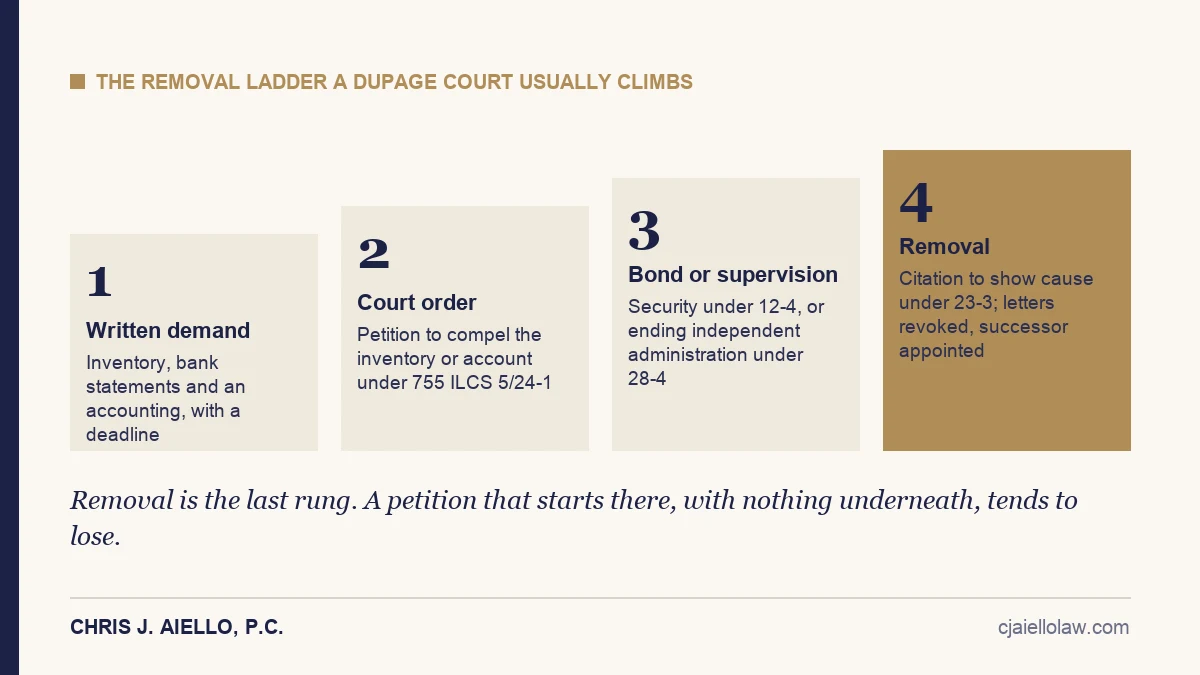
Removal is the last rung. A petition that asks for it first, with nothing underneath, tends to lose. Build the ladder.
- Write the demand. A dated letter asking for the inventory, the estate bank statements and an accounting, with a deadline. If the executor answers, you may be done. If not, the letter is your first exhibit.
- Ask the court to compel. Every representative owes a verified account under 755 ILCS 5/24-1 unless every interested person consents in writing to excuse it, and the court can require one whenever it chooses. A petition to order the inventory or the accounting is cheap, hard to oppose, and it turns a private grievance into a court order the executor can be removed for ignoring.
- End independent administration. Most Illinois estates run independently, meaning the executor acts without court orders. Under 755 ILCS 5/28-4 any interested person can petition to end that status (the court needs good cause where the will directed independent administration, and a creditor or non-residuary legatee must show the change is necessary to protect their interest). Once granted, the executor needs court approval for the acts causing the trouble. For many families this is the fix, and the executor stays.
- Demand a bond. Even where the will waived it, 755 ILCS 5/12-4 lets the court require security when it has cause to suspect fraud or incompetence, or when the estate may not cover its claims. An executor who cannot get a surety company to write the bond usually leaves on their own.
- Recover what is missing. A citation under 755 ILCS 5/16-1 brings whoever holds estate property before the court, and where the executor is the respondent the court can appoint a special administrator to pursue the claim. That runs alongside removal.
- Then removal. With the orders on file and the breaches documented, the removal petition writes itself, and the hearing is short.
Each rung costs weeks. A demand and a motion to compel might take a month, ending independent administration or forcing a bond another one to two, and a disputed removal hearing with discovery several months. The estate does not stop while this happens, but distributions usually do.
How Is the Petition Filed in DuPage County?
A DuPage estate is in the Eighteenth Judicial Circuit at the DuPage Judicial Center, 505 N. County Farm Road, Wheaton, and the removal petition is filed in the existing estate case, not as a new lawsuit. Filings go through eFileIL, and the DuPage County Clerk of the Circuit Court keeps the estate file, including the address the executor recorded with the clerk, which under section 23-3 is where the citation can be served.
The procedure is set by 755 ILCS 5/23-3. The court orders a citation directing the executor to show cause why they should not be removed for the cause stated in it, served at least 10 days before the return day the way a civil summons is served. If the executor cannot be found, the petitioner files an affidavit and the clerk sends registered-mail notice to the last address on file at least 15 days out. The executor may respond in writing by the return day, then there is a hearing on the evidence. If the court finds a listed cause it may remove the executor and revoke the letters, and under subsection (d) it may charge the costs of the proceeding to the executor it removed.
Bring documents, not adjectives: bank statements, the demand letter and the non-answer, the appraisal next to the sale price. A judge who has heard "he is stealing from us" a hundred times is moved by a spreadsheet.
This is general information about Illinois practice, not legal advice. Court procedures change; confirm the current requirement with the clerk or your attorney.
What Happens the Day After Removal?
The removal order revokes the letters of office, so the banks and title companies acting on them stop, and the estate is briefly without a representative. Why that matters to every institution holding an asset is in what letters of office prove and who issues new ones.
Three things follow, in this order:
- The removed executor must account. Section 24-1 says that where letters are revoked the account is due within the time the court directs, and the removal order will usually set that date and direct the handover of records and assets to the successor.
- A successor is appointed. Under 755 ILCS 5/6-9, unless the will says otherwise, a remaining co-executor simply carries on; where the sole executor's letters are revoked, the court issues letters of administration with the will annexed, choosing from the preference order in 755 ILCS 5/9-3. That section also says a representative who has been removed loses the right to name a successor, so the removed executor does not get to pick their replacement.
- The estate may pursue a surcharge. Where the estate lost money through the removed executor's conduct, the court can order them to make it good, and the bond, where there is one, stands behind that order.
Resignation is a separate route. Under 755 ILCS 5/23-1 an executor petitions for leave to resign and the court revokes the letters on its terms. Resigning does not erase the accounting or the surcharge.
If You Are the Executor Being Challenged
Read the citation for the cause it states; that is the case you have to answer. Then calendar the return day, file the inventory or account if either is outstanding, move any estate money into a properly titled estate account, and put your written response on file before the return day. Everything you do between service and the hearing is evidence of suitability or its opposite.
Do not resign reflexively and do not stop administering; bills still need paying and the claims window still runs. Do not "borrow" from the estate to pay your own lawyer. You could have declined the job before appointment, but once appointed the exit runs through the court. If a beneficiary has served you, representation for Illinois executors facing a removal petition is a different service from the estate's own lawyer, and often the estate's lawyer cannot act for you personally in the dispute.
When to Bring in a Probate Litigator
Two moments. For the heir, the day the written demand goes unanswered, because everything after that is a court filing drafted to the statute. For the executor, the day the citation is served. Removal fights are billed hourly on both sides, the estate often pays for the defense of a good-faith executor, and a removed executor can be charged the costs of the proceeding under section 23-3(d), so the economics belong in the first meeting. Building the petition on the ladder above, or defending against one by filing what was owed, is the work of a contested probate attorney in DuPage County. The removal petition is one piece of what a probate attorney for DuPage County estates handles from opening to closing.
If the decedent was married, the spouse also holds claims the executor has to respect, covered in our guide to a surviving spouse’s award and renunciation.
Is an executor mishandling an estate you have an interest in, or are you the executor who was just served?
Chris J. Aiello, P.C. has brought and defended removal petitions in the Wheaton courthouse for DuPage County families since 1990. Bring the will, the letters, and whatever paper you have, and we will tell you whether the statute is met and which step to take first.
Schedule a ConsultationSources: 755 ILCS 5/23-2 · 755 ILCS 5/23-3 · 755 ILCS 5/23-1 · 755 ILCS 5/1-2.11 · 755 ILCS 5/14-1 · 755 ILCS 5/24-1 · 755 ILCS 5/28-4 · 755 ILCS 5/12-4 · 755 ILCS 5/16-1 · 755 ILCS 5/6-9 · 755 ILCS 5/9-3 · DuPage County Clerk of the Circuit Court · Illinois Courts eFileIL · Illinois Legal Aid Online: probate
General information about Illinois law, current as of September 2026. It is not legal advice and it does not create an attorney-client relationship.