Can an Illinois Executor Invest Estate Money? The Prudent Investor Standard
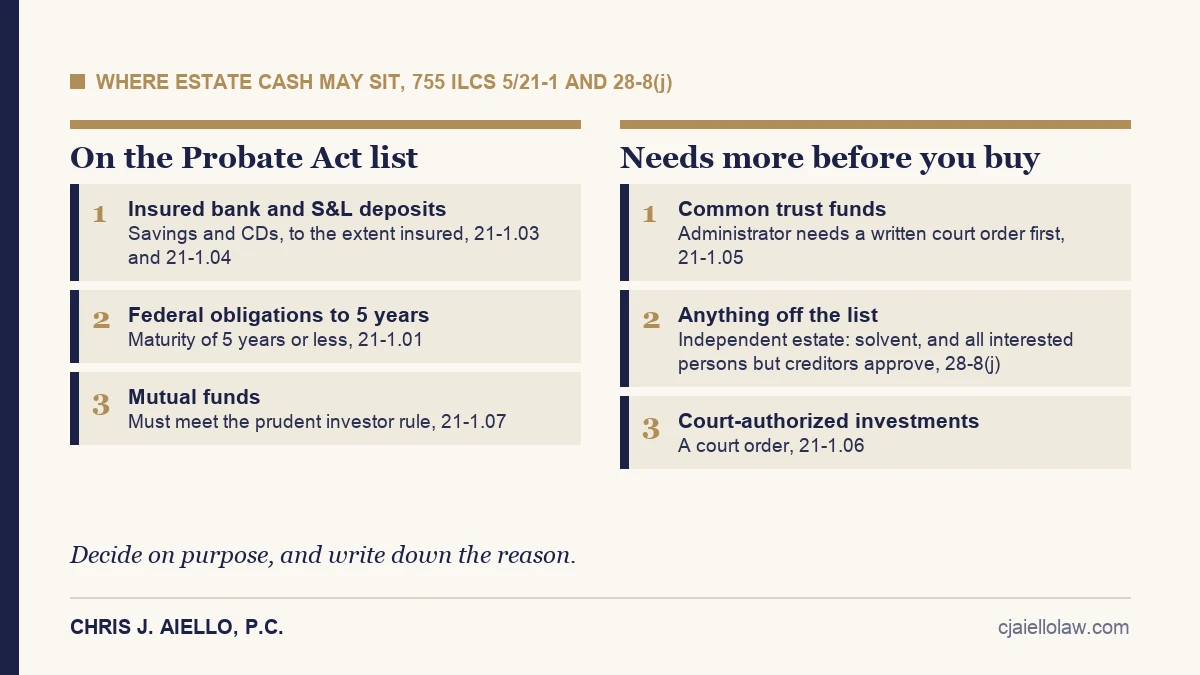
Yes, within limits. An executor holds estate money as a fiduciary, and the Probate Act lets the representative of a decedent's estate invest it, in the representative's discretion, in the list in 755 ILCS 5/21-1.01 through 21-1.07: federal obligations maturing within 5 years, insured bank and savings-and-loan deposits, common trust funds that meet the prudent person rule (with a written court order first for an administrator), mutual funds that meet the prudent investor rule, and anything a court authorizes. A will can authorize more. An independent executor can also retain what the decedent owned and, if the estate is solvent and every interested person other than creditors approves, invest as a trustee would under the prudent investor rule of the Illinois Trust Code. The sections reviewed for this guide put no interest charge on idle cash in a decedent's estate, but speculation and neglect are both exposures. Whatever you choose, write down why.
Short answer: an Illinois executor may invest estate money, but only in the ways the Probate Act or the will allows, and the sections reviewed for this guide give an executor a permission to invest, not a mandate to manage a portfolio. Here is the situation that sends people searching. A parent's accounts have been collected, the estate checking account holds a real balance, and the estate will stay open for most of a year. Someone in the family says the money should be earning something. Someone else says an executor who invests it is asking for trouble. This guide explains whether an executor can invest estate money in Illinois, where the money may sit, and how to leave a record a judge would respect.
It is written for the DuPage County executor holding cash, and it sticks to what the statute says. Where the sections reviewed say nothing, the guide says so.
What the Law Asks of an Executor Holding Cash
Start with the rule that governs a decedent's estate. 755 ILCS 5/21-1 says that, in addition to any investments the will authorizes, the representative of a decedent's estate "in his discretion, may invest" estate money in the investments listed in Sections 21-1.01 through 21-1.07. The word is "may." For a decedent's estate, investing is a permission, not a command.
There is a second layer when the estate is independent. Under 755 ILCS 5/28-8(j), an independent representative acting reasonably for the best interests of the estate can retain property properly acquired, without regard to its suitability for original purchase, and can invest estate money in the 21-1 investments. If the representative determines that the estate is solvent and all interested persons other than creditors approve, the representative can also use any investment authorized for trustees under the prudent investor rule in Article 9 of the Illinois Trust Code.
That Trust Code standard is worth knowing because it tells you what "prudent" means in practice. 760 ILCS 3/902 asks a trustee to invest as a prudent investor would, with reasonable care, skill and caution, judging each choice as part of the whole portfolio and considering the purposes and circumstances of the trust, including liquidity, income and preservation of capital. Section 903 adds a duty to diversify unless there is a reasoned basis not to. Those are trust rules. They reach an estate through the routes above, so read them as the benchmark a court will have in mind, not as a duty that attaches to every executor automatically.
One more point before the table. The Probate Act has a section that sounds like a mandate, but it is not about decedents. 755 ILCS 5/21-2 makes it the representative's duty to invest, and charges interest at the 90-day Treasury bill rate on money wrongfully or negligently left uninvested, but its heading and text are about a ward's estate, which means a guardianship. It should not be quoted as the rule for a deceased person's estate.
Where Estate Money Can Sit
The table sorts the common places estate cash ends up against what the sections reviewed say. "Verify" means read the current text or ask counsel before relying on the row, because the Act is amended from time to time.
| Where the money sits | What the Probate Act says | What to document |
|---|---|---|
| Estate checking account | 21-1.03 says the power to invest does not affect a representative's power to establish a checking account, or to continue the decedent's checking account, in any amount. | Account opened in the estate's name with its own tax ID; statements saved monthly |
| Savings account or certificate of deposit at an Illinois state or national bank | Allowed under 21-1.03 to the extent the deposit is insured by the United States or one of its agencies, even if the bank is itself the representative. | Which accounts, why this term, and the insured amount at each institution |
| Savings and loan accounts or certificates | Allowed under 21-1.04 to the extent insured by the United States or one of its agencies. | Same as above |
| Federal obligations | Direct obligations of the United States, or fully guaranteed by it, whose maturity is no longer than 5 years from the date of purchase (21-1.01). | Maturity date against the expected closing date of the estate |
| Mutual funds | Allowed under 21-1.07 for funds registered under the Investment Company Act of 1940, provided the investment meets the prudent investor rule. | The fund, the reason, and the review date |
| Common trust funds | Allowed under 21-1.05 if the investment meets the prudent person rule, and in the case of an administrator, only with written court approval first. | The written order, if one was needed |
| Individual stocks, bonds or anything not on the list | Not on the 21-1 list, unless the will authorizes it (21-1 adds the will's investments to the list). Otherwise an independent representative can use the Trust Code route in 28-8(j) only if the estate is solvent and every interested person other than creditors approves. Failing that, 21-1.06 allows investments authorized by a court. | The will's wording, the written approvals or the court order, before the purchase, not after |
| Assets the decedent already held | An independent representative may retain property properly acquired, without regard to its suitability for original purchase (28-8(j)). Verify the rule for a supervised estate with counsel. | A note of what was held at death and why it was kept or sold |
| Real estate held for sale | Not an investment. Subject to the will and to the exceptions for a residence occupied by an heir or legatee, 20-1 has the representative take possession, collect rents, keep the buildings in repair, pay taxes and liens, and allows insurance. | Insurance, tax payments and repair receipts |
The pattern is easy to see once the table is in front of you. Insured deposits and federal obligations of 5 years or less are the conservative end, and they match the purpose of an estate, which is to hold value for a few months and then distribute it. Anything riskier needs a documented basis that goes beyond the executor's own comfort.
When Idle Cash Becomes a Problem
Cash in an estate account is not misconduct. Estates need liquidity: funeral costs, taxes, claims and expenses all come due, and a distribution may be only months away. The sections reviewed for this guide contain no statutory interest charge for money left uninvested in a decedent's estate, unlike the ward's-estate rule in 21-2. A short wait in an insured account is a defensible choice.
The question changes as the timeline stretches. Idle cash is harder to explain when the estate will plainly stay open for a long stretch, when the balance is large relative to the expected expenses, and when a beneficiary has asked in writing why it is not earning anything. In each case the better practice is the same: decide on purpose, and write down the reason. Two quick checks help.
- List the cash needs for the next 90 days, then separate the money that must stay liquid from the money that will not be touched.
- Compare that to the expected closing date. Money the estate will not need for a year does not need to be in the same place as money it needs next week.
Using an Advisor Without Handing Off the Duty
An executor can get help. Section 28-8(g) lets an independent representative employ agents, accountants and counsel, including legal and investment counsel, delegate the performance of any act of administration, whether or not discretionary, and pay them reasonable compensation. That is real authority, and a competent advisor is often the right answer for an estate with securities in it.
Delegating the work is not the same as delegating the responsibility. The executor is still the person who signs the accounting, so the advisor's recommendations should be in writing, dated, and tied to the estate's needs. Ask the advisor to state the time horizon and the liquidity assumption they used, and keep what they send.
How to Document Each Decision
A record that explains itself protects the executor more than any single investment choice does. After every decision about where estate money sits, add one page to the file.
- Date, amount and the account or investment chosen.
- The reason, in a sentence or two: expected closing date, cash needs, insurance limits.
- The authority relied on: the 21-1 section, the will, the written approvals under 28-8(j), or the court order.
- Who gave advice, with the written recommendation attached.
- A review date, so a stale choice gets revisited when the timeline changes.
The papers filed in a supervised estate show what was held. The inventory states the money on hand (14-1), and the account due under 24-1 within 60 days after 12 months from the issuance of letters, and later as the court requires, states receipts, disbursements and all real and personal estate on hand, with evidence of the disbursements as the court may require. If all interested persons file written consents, the court may excuse the account (24-1(b)). An independent estate accounts to interested persons under 28-11 instead. Interest earned and holdings both show up there, which is covered line by line in the sections of an Illinois estate accounting.
What Happens if the Money Is Mishandled
The sections reviewed here do not spell out a penalty schedule for a poor investment in a decedent's estate. The consequence arrives through the ordinary channels: the executor must account, during independent administration an interested person can petition the court on any matter germane to the administration under 28-5, and a court can act on what the account shows. If a beneficiary goes further and asks for the representative to be replaced, the process for removing an executor in Illinois is the place to read next, and it is the reason a clean paper trail matters.
The practical lesson is simple. The conservative choice, explained in writing, is almost always easier to defend than the clever one.
When to Bring in a Probate Attorney
Call an attorney before the purchase when a will tells you to hold a particular stock, when the estate is large or may not be solvent, when a beneficiary has objected to how the money is held, or when you are unsure whether you are in an independent or a supervised estate. Legal guidance for an Illinois executor can cover the plan for estate funds, the written approvals or court order, and the account that follows. For the wider job, what an executor does in an Illinois estate sets out the other duties, and our probate practice in DuPage County handles estates from petition to closing.
Holding estate money and not sure where it should sit?
Chris J. Aiello, P.C. has guided DuPage County executors since 1990. Bring the account statements and the will, and we will tell you what is allowed and what to put in writing.
Schedule a ConsultationSources: 755 ILCS 5/21-1 · 21-1.01 · 21-1.03 · 21-1.04 · 21-1.05 · 21-1.06 · 21-1.07 · 755 ILCS 5/21-2 · 755 ILCS 5/28-8 · 755 ILCS 5/20-1 · 755 ILCS 5/14-1 · 755 ILCS 5/24-1 · 755 ILCS 5/28-5 · 760 ILCS 3/902 · 760 ILCS 3/903 · DuPage County Clerk of the Circuit Court · Illinois Courts
General information about Illinois law, current as of October 2026. This guide describes the Probate Act and Trust Code sections cited; your estate's facts may call for a different route. It is not legal advice and it does not create an attorney-client relationship.